
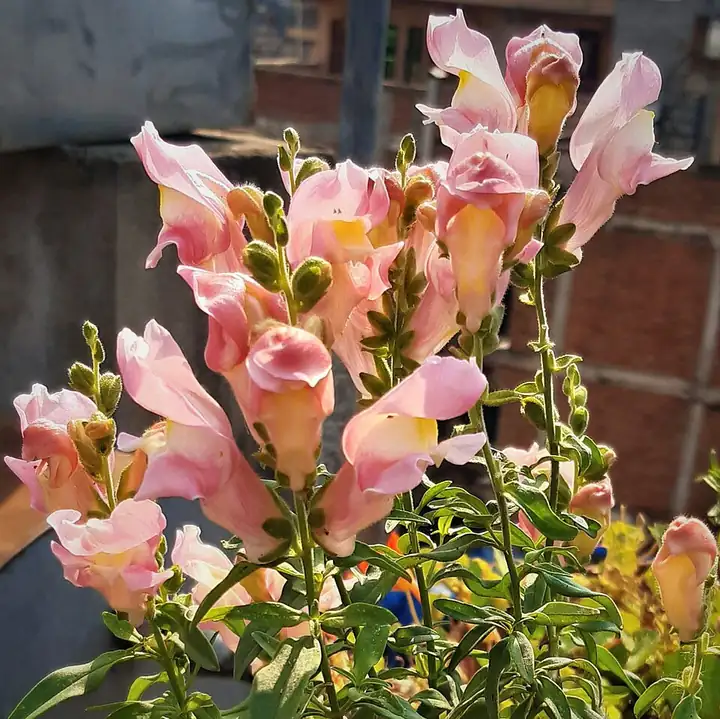
Snapdragon
Antirrhinum majus · Plantain family (Plantaginaceae)
| Hardiness zones | 7 to 10 |
|---|---|
| Sun | full sun |
| Water | moderate |
| Life cycle | tender perennial (grown as an annual) |
| Frost | Half-hardy: takes a light frost |
| Spacing | 6 to 12 inches |
About Snapdragon
Snapdragons are cool-season flowers with spikes of two-lipped blooms that snap open like a dragon's mouth when squeezed. They come in dwarf edging types, mid-size bedding types and tall cut-flower types. Bumblebees are strong enough to pry the flowers open, and hummingbirds and butterflies visit too.
A short-lived perennial in zones 7-10 (NC State), hardy to about 15 F (Arkansas); grown as a cool-season annual, planted in fall in the South and in spring up north.
When to plant
Timing is counted from your average last spring frost (and first fall frost). Sow & Tell works out the actual dates for your ZIP code.
- Start seeds indoors: 6 to 10 weeks before the last frost
Start seed indoors 6-8 weeks (Cornell) to 8-10 weeks (Nebraska, Mississippi State) before the last frost; seed needs light and sprouts in 7-14 days. Plants take light frost, so they can go out before the last frost date (Cornell). In central and south Arkansas and in Florida, plant in fall for spring bloom. Pinch young plants at 3-4 inches to make them bushier.
Soil
Rich, moist, well-drained soil high in organic matter.
Work compost into the bed for rich, moist, well-drained soil high in organic matter; follow a soil test before adding fertilizer.
Feeding
Snapdragons fade in summer heat; plant early (fall in the South) so they bloom in cool weather.
Harvest
Blooms in cool weather: spring and fall in the South, summer into fall up north; plants languish in summer heat. Deadhead spent spikes to keep blooms coming (Arkansas); for bouquets, cut when the lower third to half of the spike is open (Mississippi State).
Varieties (18)
| Variety | Type | Days | Notes |
|---|---|---|---|
| Aromas series | Bedding | ||
| Floral Showers | Dwarf | 6-10 in tall. | |
| Magic Carpet | Dwarf | 6-10 in tall. | |
| Snapshot series | Dwarf | ||
| Julie | Dwarf, open-faced | Open-faced dwarf snapdragon. | |
| Snaptastic | Dwarf-intermediate | Bushy like a dwarf type but with taller flower stems. | |
| Chimes series | Intermediate | 16-24 in tall (Nebraska). | |
| Crown series | Intermediate | 16-24 in tall. | |
| Sonnet series | Medium | About 1.5 ft tall (Cornell). | |
| Liberty series | Medium to tall | 2-2.5 ft tall. | |
| Chantilly series | Tall cut flower | Open-faced flowers; six colors. | |
| Potomac series | Tall cut flower | Nine colors. | |
| Rocket series | Tall cut flower | About 3 ft tall; good for cutting. | |
| Madame Butterfly series | Tall, double | Double, open-faced flowers on about 2-ft plants. | |
| Bright Butterflies mix | Tall, open-faced | About 2.5 ft tall. | |
| Candy Showers | Trailing | The first trailing snapdragon grown from seed; made for hanging baskets. | |
| Montego | |||
| Twinny series |
Pests to watch for
Aphids, Whiteflies, Leafminers, Twospotted spider mite, Four-lined plant bug, Tobacco budworm (geranium or petunia budworm)
Diseases and problems
Rust, Powdery mildew, Downy mildew, Anthracnose, Gray mold, Root rot, Tobacco mosaic and tomato mosaic
In the kitchen
Safety: NC State and the ASPCA list snapdragons as non-toxic.
Pets: Non-toxic to dogs and cats (ASPCA, 'Garden Snapdragon')
Sources
- plants.ces.ncsu.edu
- gardening.cornell.edu
- extension.msstate.edu
- ask.ifas.ufl.edu
- uaex.uada.edu
- lancaster.unl.edu
- aspca.org
Photo: Photo: Sabina Bajracharya, CC BY-SA 4.0, via Wikimedia Commons (CC BY-SA 4.0). Photo resized for the web.

Planting dates and advice are general guidance; check with your local Cooperative Extension office for your area.