
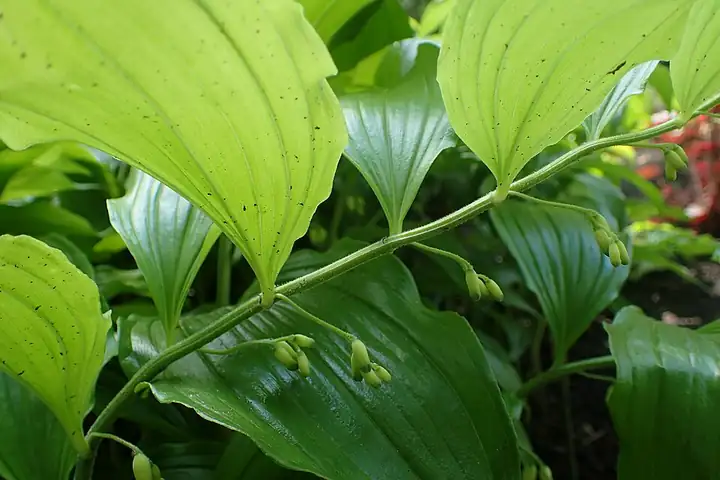
Solomon's seal
Polygonatum biflorum (native smooth Solomon's seal) and other Polygonatum species · Asparagus family (Asparagaceae)
| Hardiness zones | 3 to 9 |
|---|---|
| Sun | part shade |
| Water | moderate |
| Life cycle | perennial |
| Frost | Hardy: takes frost |
About Solomon's seal
Solomon's seal sends up graceful arching stems with paired leaves and dangling, bell-shaped, greenish-white flowers in spring, followed by blue-black berries in fall (NC State). The native smooth Solomon's seal grows in moist woods across eastern North America and turns gold in fall.
Smooth Solomon's seal is hardy in zones 3-9 (NC State).
When to plant
Timing is counted from your average last spring frost (and first fall frost). Sow & Tell works out the actual dates for your ZIP code.
Plant rhizome divisions in spring or fall while dormant (NC State). It does best with a bit of sun. Seed is slow: sow fresh in September or give it a cold, moist period.
Soil
Moist, well-drained soil high in organic matter; it takes occasional dry or wet spells (NC State).
Moist, well-drained soil high in organic matter (NC State).
Feeding
Keep new plantings moist the first season (NC State).
Harvest
Blooms in spring; berries ripen September-October (NC State).
Pests to watch for
Slugs, Brown garden snail
In the kitchen
Safety: The berries are poisonous (NC State: low severity; vomiting and diarrhea). Don't eat any part without expert identification.
Pets: Not listed as toxic by the ASPCA. NC State lists the berries as poisonous to people, so it's wise to keep pets from eating them.
Sources
Photo: Photo: Krzysztof Ziarnek (Kenraiz) / Wikimedia Commons, CC BY-SA 4.0 (CC BY-SA 4.0). Photo resized for the web.

Planting dates and advice are general guidance; check with your local Cooperative Extension office for your area.