
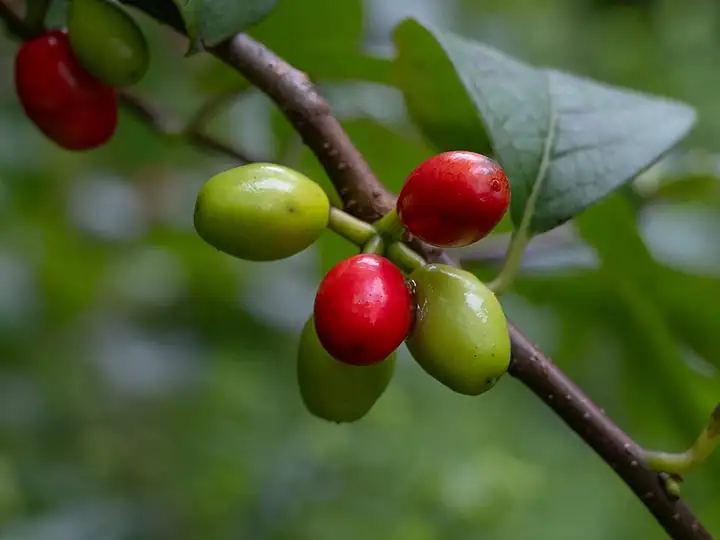
Spicebush
Lindera benzoin (northern spicebush) · Laurel family (Lauraceae)
| Hardiness zones | 4 to 9 |
|---|---|
| Sun | part shade |
| Water | moderate |
| Life cycle | perennial |
| Frost | Hardy: takes frost |
About Spicebush
Spicebush is a rounded native shrub of moist woods and stream banks with clouds of tiny, fragrant yellow flowers in early spring before the leaves, clear yellow fall color, and leaves and twigs that smell spicy when crushed. It's native from Maine and Michigan to Kansas, Texas and Florida (wildflower.org, NRCS). Plants are male or female: only females bear the shiny red berries birds love, and only if a male grows nearby. It's the main host plant of the spicebush swallowtail butterfly (NC State, Morton Arboretum).
Hardy in zones 4-9 (Morton Arboretum; NC State says 5-9). NC State lists it as susceptible to laurel wilt.
When to plant
Timing is counted from your average last spring frost (and first fall frost). Sow & Tell works out the actual dates for your ZIP code.
Plant small container shrubs in spring or fall; its fibrous roots make bigger plants hard to move (Morton Arboretum, NRCS). Water deeply until established, at least two growing seasons (UMN), and more often in full sun. Plant at least one male near female plants for berries.
Soil
Moist, well-drained, acid to slightly alkaline soil; it handles wet spots and brief flooding but is moderately sensitive to drought (Morton Arboretum, NC State, wildflower.org).
Test the soil before planting; established shrubs in decent soil need little or no fertilizer (Clemson).
Feeding
- Spring to early summer after new growth starts, only if a soil test shows a need: slow-release complete fertilizer in a 3:1:2 ratio, or what the soil test calls for. Spread evenly from the trunk out to the drip line and water it in; a typical soil-test rate for shrubs is about 2 lb of 12-6-6 per 100 sq ft (Clemson). Follow a soil test.
Water is what new shrubs need most: daily for the first 2 weeks, every 2-3 days through week 12, then weekly until the roots spread (at least two growing seasons), using about a quarter to a third of the nursery pot's volume each time (UMN). Spicebush is moderately sensitive to drought and needs more water in full sun (Morton Arboretum, NC State); don't feed drought-stressed shrubs (Clemson).
Harvest
Blooms March to April before the leaves. Red berries ripen on female plants from late summer into fall, mostly hidden until the leaves drop (NC State, Morton Arboretum). It blooms on old wood, so prune soon after flowering if needed.
Varieties (2)
NC State documents only these two; most spicebush is sold as unnamed seedlings.
| Variety | Type | Days | Notes |
|---|---|---|---|
| Xanthocarpa | Female | Female with orange berries instead of red; needs a male nearby to fruit. | |
| Rubra | Male | Non-fruiting male with red early-spring flowers. |
Diseases and problems
Laurel wilt
In the kitchen
Native Americans used the dried fruit as a spice and the leaves for tea, and a tea can be brewed from the aromatic leaves and twigs (NRCS, wildflower.org).
Safety: No toxicity is listed in the sources we used. We found no modern safety review of spicebush as food, so use only a little, and only when you're sure of the plant.
Pets: Not listed by the ASPCA.
Sources
- plants.ces.ncsu.edu
- wildflower.org
- mortonarb.org
- plants.sc.egov.usda.gov
- extension.umn.edu
- aspca.org
- extension.rutgers.edu
- hgic.clemson.edu
Photo: Photo: Alex Abair / Wikimedia Commons, CC BY 4.0 (CC BY 4.0). Photo resized for the web.

Planting dates and advice are general guidance; check with your local Cooperative Extension office for your area.