
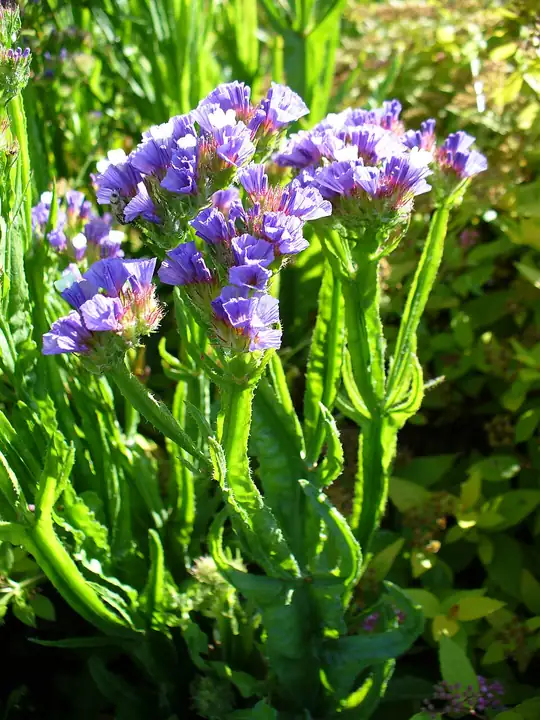
Statice (annual statice)
Limonium sinuatum · Leadwort family (Plumbaginaceae)
| Hardiness zones | 8 to 10 |
|---|---|
| Sun | full sun |
| Water | low |
| Life cycle | annual |
| Frost | Half-hardy: takes a light frost |
| Spacing | 8 to 12 inches |
| Days to harvest | 70 to 90 days |
About Statice (annual statice)
Annual statice sends up winged stems topped with clusters of papery, long-lasting color in purple, blue, pink, yellow, apricot and white. It's a favorite cut flower because it practically dries itself in the garden and keeps its color for dried bouquets and wreaths. It comes from the Mediterranean and handles heat, drought and salty coastal air once established (NC State).
Grown as an annual in every zone; it is a short-lived perennial only in zones 8-10 and isn't very hardy (NC State). Perennial sea lavenders (Limonium latifolium and kin) are different plants.
When to plant
Timing is counted from your average last spring frost (and first fall frost). Sow & Tell works out the actual dates for your ZIP code.
- Start seeds indoors: 6 weeks before the last frost
- Set out plants: around the last frost
Sow indoors about 6 weeks before planting out, pressing seed onto the mix with only a light cover since it needs light; it sprouts in 5-14 days at 70 F, and seedlings like it cool (50-55 F) for a few weeks after they come up (USU). Plant out after the last frost while nights are still cool, 8-12 inches apart. Days to harvest count from transplanting: cutting starts 70-90 days after planting out (USU).
Soil
Light, sandy or loamy soil with good drainage; avoid overwatering (NC State).
Test the soil (Utah State says every 2 years). Plan on about 0.2 lb of nitrogen per 100 sq ft for the season, and add phosphorus and potassium only if the test shows a need.
Feeding
- Through the growing season, in several small doses: nitrogen fertilizer such as 46-0-0 (urea) or an organic 12-0-0. Split the season's 0.2 lb of nitrogen per 100 sq ft (up to about 2/3 cup of 46-0-0, or about 6 cups of an organic 12-0-0) into several smaller feedings and water each in (USU).
Soggy soil and overhead watering bring root and crown rot; keep it on the dry side once established (NC State, LSU).
Harvest
Blooms through summer into fall (NC State). Cut stems at the base in the morning once most of the tiny flowers on a stem are open and colored (USU, LSU, Iowa State); plants keep sending up new stems over the season.
Varieties (7)
Extension sources document 7 varieties; many seed series are named only in catalogs.
| Variety | Type | Days | Notes |
|---|---|---|---|
| Compindi Light Blue | Compindi series | Light blue; strong stems and heavy heads, but few, small flowers in NC State's 1995 trial. | |
| Forever Gold | Forever series | Upright annual with bright yellow flowers. | |
| Forever Happy | Forever series | Light rose-lavender color with small yellow flowers; very even color. Dried, it fades to light pink or tan. | |
| QIS Apricot | QIS series | Mixed pinks, apricots, purples and yellows; less uniform, so often sold as a mix. | |
| QIS Dark Blue XL | QIS series | Dark blue; healthy plants with long, heavy stems and big heads that rebloom after cutting. | |
| QIS Soft Pastel Shades | QIS series | Pastel mix; earliest to cut in its trial, but stems were short and some colors looked washed out. | |
| Seeker Blue | Seeker series | Purple to blue tones, a hard-to-find color for bouquets. |
Pests to watch for
Aphids, Cutworms, Cabbage looper, Grasshoppers, Tarnished plant bug, Twospotted spider mite, Whiteflies, Slugs, Brown garden snail, Cucumber beetles, Rabbits, Deer
Diseases and problems
Root and crown rot, Crown rot
In the kitchen
Pets: Not listed by the ASPCA (we found no statice or sea lavender entry), so we can't call it pet-safe; discourage pets from chewing it.
Sources
- plants.ces.ncsu.edu
- projects.sare.org
- lsuagcenter.com
- cutflowers.ces.ncsu.edu
- cutflowers.ces.ncsu.edu
- cutflowers.ces.ncsu.edu
- extension.iastate.edu
- aspca.org
- aspca.org
Photo: Photo: Neelix / Wikimedia Commons, Public domain. Photo resized for the web.

Planting dates and advice are general guidance; check with your local Cooperative Extension office for your area.