
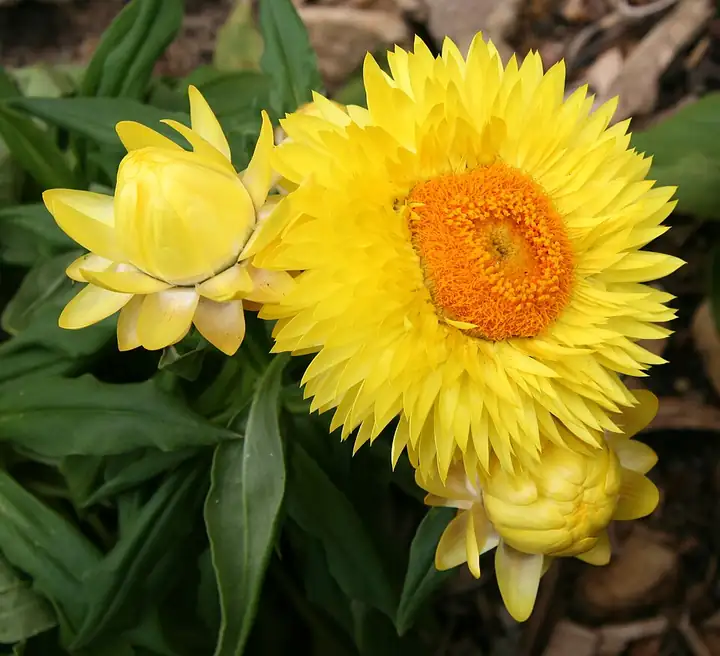
Strawflower
Xerochrysum bracteatum (formerly Helichrysum bracteatum or Bracteantha bracteata) · Aster family (Asteraceae)
| Hardiness zones | 8 to 10 |
|---|---|
| Sun | full sun |
| Water | moderate |
| Life cycle | annual |
| Frost | Half-hardy: takes a light frost |
| Spacing | 9 to 12 inches |
| Days to harvest | 49 to 56 days |
About Strawflower
Strawflower is an Australian daisy whose stiff, papery bracts in yellow, orange, red, pink and white keep their color and shape when dried. It blooms from early summer to frost, makes a long-lasting cut flower, and is one of the classic everlastings for dried bouquets. Bees and butterflies visit the flowers (NC State).
Grown as a summer annual in every zone; it can live over as a short-lived tender perennial only in zones 8-10 (NC State).
When to plant
Timing is counted from your average last spring frost (and first fall frost). Sow & Tell works out the actual dates for your ZIP code.
- Start seeds indoors: 6 to 8 weeks before the last frost
- Set out plants: around the last frost
Start seed indoors 6-8 weeks before the last frost (Illinois); press it onto the mix and barely cover, since it needs light, and expect sprouts in 7-10 days at 70-75 F (USU). Set plants out after the last frost, 9-12 inches apart. Days to harvest count from transplanting: Utah growers cut their first stems 7-8 weeks after planting out (USU).
Soil
Average, loamy, well-drained soil; it does fine on the dry side and dislikes soggy ground (Illinois, USU, NC State).
Test the soil first. Utah State suggests about 0.2 lb of nitrogen per 100 sq ft for the season, with half worked in before planting, preferably from a slow-release source; add phosphorus and potassium only if the test calls for them.
Feeding
- Before the first flowers open: nitrogen fertilizer, slow-release if you can (such as an organic 12-0-0). Apply the second half of the season's nitrogen, about 0.1 lb of nitrogen per 100 sq ft, and water it in (USU); follow a soil test.
Overwatering and wet, heavy soil lead to root rot, and overhead watering in humid, rainy weather spoils leaves and flowers (USU, Illinois).
Harvest
Blooms from June until frost (Illinois). For drying, cut when the outer few rows of bracts have opened but the center is still closed; later cuts show yellow centers and can shatter (Iowa State, USU). Cut on dry, sunny mornings, since flowers close at night and in rain, and leave at least 3 nodes on the stem so it branches again (USU).
Varieties (15)
| Variety | Type | Days | Notes |
|---|---|---|---|
| Apricot Peach | Cut flower | Light peach to deep terracotta; keeps its color well when dried. | |
| Copper Red | Cut flower | Rusty red to copper orange. | |
| Orange | Cut flower | Bright orange touched with red and gold. | |
| Purple Red | Cut flower | Deep wine color; yellow centers show if cut too late. | |
| Silvery Rose | Cut flower | Rose pink to white; the pink deepens as flowers age. | |
| Vintage White | Cut flower | Dusty white; its cone shape makes the right cutting stage harder to judge. | |
| Bright Bikini | Dwarf | Up to 15 in tall; mixed colors; good for containers and edging. | |
| Cockatoo | Perennial type | Pale yellow bracts around small orange centers. | |
| Dargan Hill Monarch | Perennial type | Gray leaves and yellow flowers. | |
| Diamond Head | Perennial type | Green leaves and yellow flowers. | |
| Kimberly Sunset | Perennial type | Gray leaves and pink flowers. | |
| Princess of Wales | Perennial type | Yellow flowers; more compact than 'Dargan Hill Monarch'. | |
| Choice Mix | Tall annual | 30-36 in tall with strong stems; a wide mix of bright colors for cutting and drying. | |
| Forever Mix | Tall annual | Up to 3 ft tall; mixed colors. | |
| Kingsize Mixed | Tall annual | Larger flowers on plants up to 3 ft tall. |
Pests to watch for
Aphids, Fungus gnats, Grasshoppers, Leafhoppers, Tarnished plant bug, Whiteflies, Slugs, Brown garden snail
Diseases and problems
Root and crown rot, Downy mildew, Aster yellows
In the kitchen
Pets: Not listed by the ASPCA (we found no strawflower or Helichrysum entry), so we can't call it pet-safe; discourage pets from chewing it.
Sources
- plants.ces.ncsu.edu
- extension.usu.edu
- extension.illinois.edu
- extension.illinois.edu
- byf.unl.edu
- extension.iastate.edu
- rutgersgardens.rutgers.edu
- aspca.org
- aspca.org
Photo: Photo: Casliber / Wikimedia Commons, CC BY-SA 3.0 (CC BY-SA 3.0). Photo resized for the web.

Planting dates and advice are general guidance; check with your local Cooperative Extension office for your area.