
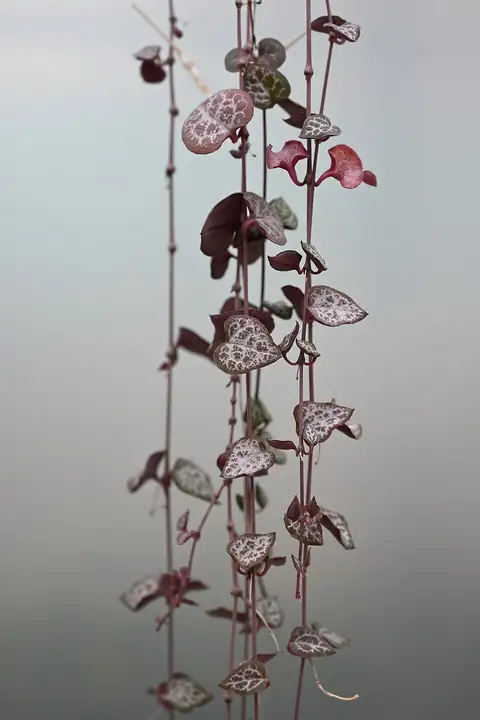
String of hearts
Ceropegia woodii (sometimes C. linearis subsp. woodii) · Dogbane family (Apocynaceae)
| Hardiness zones | 10 to 12 |
|---|---|
| Sun | part shade |
| Water | low |
| Life cycle | perennial |
| Frost | Tender: killed by frost |
About String of hearts
String of hearts, also called rosary vine or chain of hearts, is a trailing succulent vine from southern Africa, Zimbabwe to South Africa, with thread-thin purplish stems strung with small heart-shaped leaves marbled silver on top and purple underneath (NC State, Wisconsin). Little bead-like tubers form along the stems, and in summer and fall it bears odd lantern-shaped flowers that briefly trap tiny flies to pollinate them. It drapes about 3 ft from a hanging pot and is easy as long as it is never kept wet.
Hardy outdoors only in zones 10-12, where it can spread (NC State); it is grown indoors everywhere and can summer outdoors in light shade once nights stay above about 60 F, coming in well before frost (Wisconsin).
When to plant
Timing is counted from your average last spring frost (and first fall frost). Sow & Tell works out the actual dates for your ZIP code.
Usually bought as a nursery plant or started from vine cuttings or the bead-like aerial tubers pressed into moist mix (Wisconsin, NC State).
Growing it indoors
- Light: A west or south window keeps the leaves dark and well marbled, while dim light gives pale leaves with long gaps between them; harsh sun can scorch, so ease it into stronger light (Wisconsin, NC State).
- Water: Water deeply, then wait until the mix has dried out completely before watering again; it handles drought far better than soggy soil and is easily killed by overwatering (Wisconsin, NC State). Water even less during its winter rest.
- Temperature: Keep it relatively warm in winter, above 60 F, even while it rests (Wisconsin).
- Feeding: Feed sparingly: half-strength houseplant fertilizer no more than once a month while it is actively growing, and none during the winter rest (Wisconsin).
- Repotting: Repot only when it is really needed, in spring before new growth starts; it does best a little crowded (Wisconsin, NC State).
Soil
A fast-draining cactus and succulent mix, or potting mix with extra perlite (Wisconsin, NC State).
Pot in a fast-draining cactus and succulent mix, or potting mix with extra perlite, in a pot with a drainage hole (Wisconsin).
Feeding
- Spring through summer, during active growth: houseplant fertilizer at half strength. No more than once a month (Wisconsin).
- Winter rest: none. Don't fertilize, and cut back on water (Wisconsin).
Too much water does far more harm than too little food; keep feedings light and infrequent (Wisconsin).
Varieties (5)
NC State names 5 cultivars and forms; Wisconsin mentions only the variegated form.
| Variety | Type | Days | Notes |
|---|---|---|---|
| Orange River | Green | Green leaves with an orange tint. | |
| Silver Glory | Silver | Silver-variegated, apple-shaped leaves, each marked with a dark green line. | |
| String of Arrows | Silver | Narrow, pointed lime-green and silver leaves and pink flowers. | |
| Heartless | Solid green | Bright green leaves with pink undersides. | |
| Variegata | Variegated | Leaves variegated cream and pink (forma variegata). |
Pests to watch for
Mealybugs, Aphids, Scale insects
Diseases and problems
Root and crown rot
In the kitchen
Safety: Neither NC State nor Wisconsin lists it as poisonous or gives it a toxicity rating; still, keep it away from small children who might chew the leaves or tubers.
Pets: Not listed by the ASPCA (no entry under string of hearts, rosary vine or hearts entangled).
Sources
Photo: Photo: Agnieszka Kwiecień, Nova, CC BY-SA 4.0, via Wikimedia Commons (CC BY-SA 4.0). Photo resized for the web.

Planting dates and advice are general guidance; check with your local Cooperative Extension office for your area.