
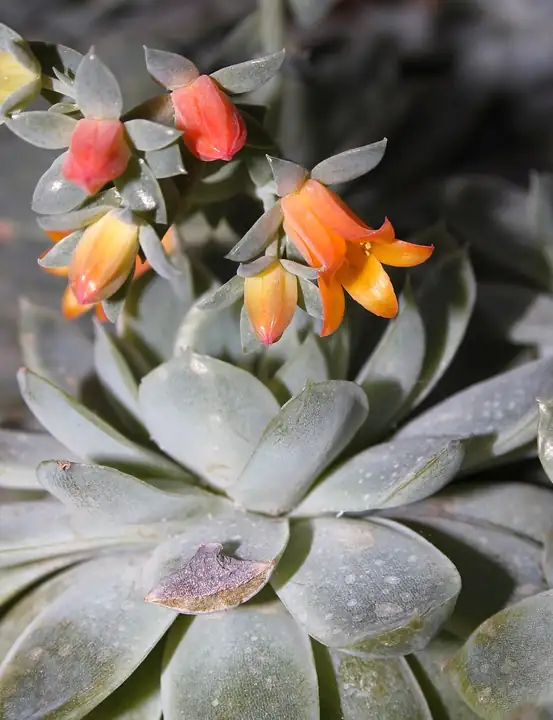
Succulents (echeveria, haworthia, sedum)
Echeveria spp., Haworthia spp., Sedum spp. and similar small rosette and trailing succulents · Mostly stonecrop family (Crassulaceae); haworthia is in the asphodel family (Asphodelaceae)
| Hardiness zones | 9 to 11 |
|---|---|
| Sun | full sun to part shade |
| Water | low |
| Life cycle | perennial |
| Frost | Tender: killed by frost |
About Succulents (echeveria, haworthia, sedum)
The small succulents sold in dish gardens and 2-inch pots are a mixed group: echeverias from Mexico and South America form tight, often pastel rosettes; haworthias from South Africa are little striped or translucent-tipped rosettes that take less sun than most; tender sedums like burro's tail trail from baskets (NC State, Wisconsin Horticulture, Iowa State). They all store water in their leaves, so they want bright light, a gritty mix and long dry spells between drinks, and most will root from a single leaf.
Soft (tender) succulents survive outdoors only in zones 9-11 (Illinois Extension); they are grown indoors everywhere and can summer outdoors in part sun once nights stay above about 45-50 F, moved into brighter light slowly so they don't sunburn (Iowa State, Wisconsin Horticulture).
When to plant
Timing is counted from your average last spring frost (and first fall frost). Sow & Tell works out the actual dates for your ZIP code.
Usually bought as small nursery plants or started from an offset, a stem cutting or a single leaf laid on dry mix (Iowa State, NC State).
Growing it indoors
- Light: Iowa State asks for at least 6-8 hours of bright light, ideally 10, or a grow light 12 in away for 12-16 hours; pale, stretched growth means too little, while haworthias are happy in an east or west window with a few hours of direct sun (Wisconsin Horticulture).
- Water: Water until it runs out the drainage hole, then let the mix dry completely, checking several inches down; start at every 2-3 weeks and stretch to once every few weeks in winter (Iowa State, Illinois Extension). Never leave water in the saucer, and skip pots without a drainage hole, since a layer of gravel is no substitute.
- Humidity: Dry air is normal and good for them; if leaves shrivel in very dry heated rooms, a pebble tray or humidifier helps (Iowa State).
- Temperature: Iowa State says most tolerate about 45-85 F and do best at 55-75 F with cooler nights; haworthias survive the low 40s if the mix is dry (Wisconsin Horticulture). Keep them off icy windowsills and away from heat vents.
- Feeding: An all-purpose or succulent fertilizer at a quarter to half the label rate every 3-4 waterings in spring and summer, or one early dose of slow-release, and nothing in winter (Iowa State); Illinois Extension uses a low-nitrogen fertilizer at half rate about monthly.
- Repotting: Only when a plant has outgrown its pot, in spring, into a pot just big enough for the roots; haworthias every 2-3 years in a shallow pot (Iowa State, Wisconsin Horticulture).
Soil
A fast-draining mix of about 1 part organic material (potting soil, bark or coir) to 2 parts mineral grit (perlite, coarse sand, pumice or fine gravel), or a bagged cactus-and-succulent mix, in a small clay pot with a drainage hole (Iowa State, Wisconsin Horticulture).
Pot in a gritty mix of 1 part potting soil or bark to 2 parts perlite, coarse sand or pumice, or a bagged cactus-and-succulent mix, in a small pot with a drainage hole (Iowa State).
Feeding
- Spring and summer, during active growth: all-purpose or succulent fertilizer at a quarter to half the label rate. Feed every 3rd or 4th watering, or apply slow-release fertilizer once early in the season (Iowa State); Illinois Extension uses a low-nitrogen fertilizer at half rate about once a month.
- Fall and winter: none. Don't fertilize while the plants are not growing (Iowa State).
Over-fertilizing gives weak, watery growth that rots easily (Illinois Extension).
Varieties (11)
NC State names echeveria species and cultivars and Wisconsin Horticulture names haworthia species; sedum houseplant cultivars aren't named by the pages we opened.
| Variety | Type | Days | Notes |
|---|---|---|---|
| Echeveria derenbergii (painted lady) | Echeveria | Small clustering rosettes with red-tipped leaves and orange-yellow flowers. | |
| Echeveria elegans (Mexican snowball) | Echeveria | Tight pale blue-green rosettes that offset freely; the 'hens and chickens' echeveria the ASPCA lists as non-toxic. | |
| Echeveria secunda (blue echeveria) | Echeveria | Blue-gray rosettes that spread into clumps. | |
| Lola | Echeveria | A compact hybrid with pale, waxy, pointed leaves. | |
| Perle von Nurnberg | Echeveria | A popular hybrid with pink-purple dusted rosettes; color deepens in bright light. | |
| Topsy Turvy (Echeveria runyonii) | Echeveria | Blue-gray leaves that curl backward, giving an upside-down look. | |
| Haworthia cooperi | Haworthia | Plump translucent-tipped leaves that let light into the leaf; takes less sun than most succulents. | |
| Haworthia retusa | Haworthia | Flat-topped, windowed leaves in a star-shaped rosette. | |
| Haworthia truncata | Haworthia | Leaves look chopped off square at the tip, lined up like a row of windows; a slow collector's plant. | |
| Haworthiopsis attenuata (zebra plant) | Haworthia | Dark green pointed leaves banded with raised white dots; the common 'zebra plant' sold everywhere, often confused with aloe (NC State). | |
| Burro's tail (Sedum morganianum) | Trailing sedum | Long trailing stems packed with plump blue-green leaves that drop at a touch and root easily; grown in hanging baskets (Iowa State). |
Pests to watch for
Mealybugs, Twospotted spider mite, Fungus gnats
Diseases and problems
Root and crown rot
In the kitchen
Safety: Echeveria and haworthia are not listed as poisonous to people (NC State tags echeveria pet-friendly and non-toxic). The 'succulent' label covers toxic plants too, such as kalanchoe and jade, so keep an unidentified one away from small children.
Pets: Echeveria (ASPCA lists Echeveria elegans as 'hens and chickens') is non-toxic to dogs, cats and horses, and haworthia is non-toxic to dogs and cats (ASPCA). Not every succulent is safe: the ASPCA lists kalanchoe and jade plant as toxic, so check each plant by name.
Sources
- yardandgarden.extension.iastate.edu
- yardandgarden.extension.iastate.edu
- yardandgarden.extension.iastate.edu
- plants.ces.ncsu.edu
- hort.extension.wisc.edu
- extension.illinois.edu
- aspca.org
- aspca.org
Photo: Photo: Holger Krisp, CC BY 3.0, via Wikimedia Commons (CC BY 3.0). Photo resized for the web.

Planting dates and advice are general guidance; check with your local Cooperative Extension office for your area.