
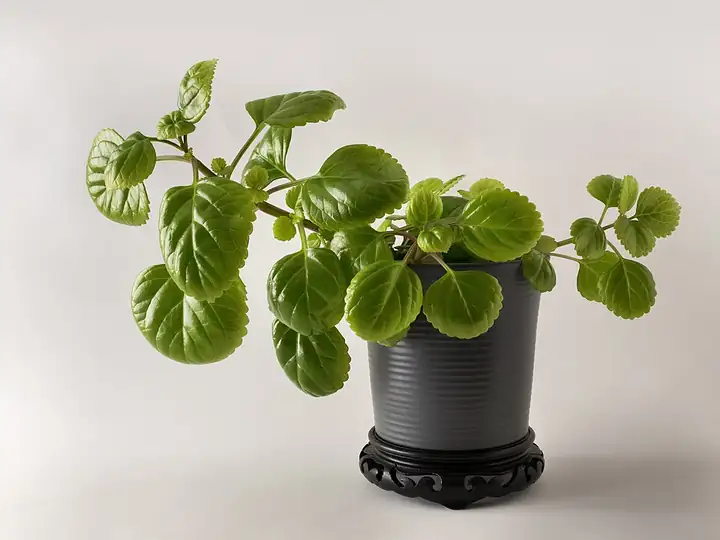
Swedish ivy
Plectranthus verticillatus (usually sold as P. australis; NC State files the white-edged Swedish ivy under P. parviflorus) · Mint family (Lamiaceae)
| Hardiness zones | 10 to 11 |
|---|---|
| Sun | part shade |
| Water | moderate |
| Life cycle | perennial |
| Frost | Tender: killed by frost |
About Swedish ivy
Swedish ivy is not an ivy at all but a trailing member of the mint family with round, scalloped, glossy leaves, a classic for hanging baskets and an easy plant to root and share (UF/IFAS, NC State). It likes bright light without hot sun and puts out spikes of small white or pale purple flowers now and then through the year. It is also one of the first houseplants mealybugs find, so check it often.
NC State gives zones 10-11 for the closely related white-edged Swedish ivy, and UF/IFAS says it takes only brief dips to 40 F; it is grown indoors everywhere and can summer outdoors in shade once nights stay above about 55 F (UF/IFAS Nassau County).
When to plant
Timing is counted from your average last spring frost (and first fall frost). Sow & Tell works out the actual dates for your ZIP code.
Usually bought as a hanging basket or started from a stem tip cutting, which roots in about a month (UF/IFAS).
Growing it indoors
- Light: Bright light indoors, but no direct sun, especially in summer; dull, droopy leaves are a sign of too much light (UF/IFAS, UF/IFAS Nassau County).
- Water: Water thoroughly when the top inch of mix is dry and never let the pot sit in water (UF/IFAS). Keep it evenly moist in summer and drier in winter; overwatering leads to root rot (UF/IFAS Nassau County).
- Humidity: NC State suggests misting the leaves now and then.
- Temperature: Best with nights of 55-60 F and days up to 80 F (UF/IFAS Nassau County); it takes short spells near 40 F but not frost (UF/IFAS).
- Feeding: Feed a houseplant fertilizer by the label from spring through fall (UF/IFAS Nassau County); too much nitrogen stops it blooming, so UF/IFAS suggests a high-phosphorus, low-nitrogen feed in spring if you want flowers.
- Repotting: Repot every year in spring or midsummer, into fresh, well-drained potting mix (UF/IFAS).
Soil
Any good, well-drained potting mix (UF/IFAS).
Pot in any good, well-drained potting mix in a hanging basket or pot with drainage (UF/IFAS).
Feeding
- Spring, for flowers: high-phosphorus, low-nitrogen fertilizer. Feed by the label in spring if you want it to bloom (UF/IFAS).
- Spring through fall: houseplant fertilizer. Feed regularly following the label (UF/IFAS Nassau County).
- Winter: none. Water less and skip feeding while growth is slow (UF/IFAS Nassau County; MU Extension).
Too much nitrogen keeps it from blooming, and overwatering rots the roots (UF/IFAS).
Varieties (2)
UF/IFAS and NC State name 1 cultivar and 1 related species sold under the same common name.
| Variety | Type | Days | Notes |
|---|---|---|---|
| White-edged Swedish ivy (Plectranthus parviflorus) | Related species | An Australian and Pacific relative, 2-3 ft tall and 2-4 ft wide in the ground, with fleshy leaves and pale mauve to white flower spikes; frost tender. | |
| Variegata | White-edged | Leaves marked with white along the edges. |
Pests to watch for
Mealybugs, Twospotted spider mite, Whiteflies, Aphids
Diseases and problems
Root and crown rot, Leaf spots, Stem rot
In the kitchen
Safety: Not listed as poisonous to people or pets in the sources we opened (ASPCA; NC State tags the white-edged form non-toxic); the leaves give off a strong smell when crushed.
Pets: Non-toxic to dogs, cats and horses (ASPCA, listed as Swedish ivy, Plectranthus australis).
Sources
- gardeningsolutions.ifas.ufl.edu
- blogs.ifas.ufl.edu
- extensiongardener.ces.ncsu.edu
- plants.ces.ncsu.edu
- extension.missouri.edu
- aspca.org
Photo: Photo: W.carter, CC0, via Wikimedia Commons (CC0). Photo resized for the web.

Planting dates and advice are general guidance; check with your local Cooperative Extension office for your area.