
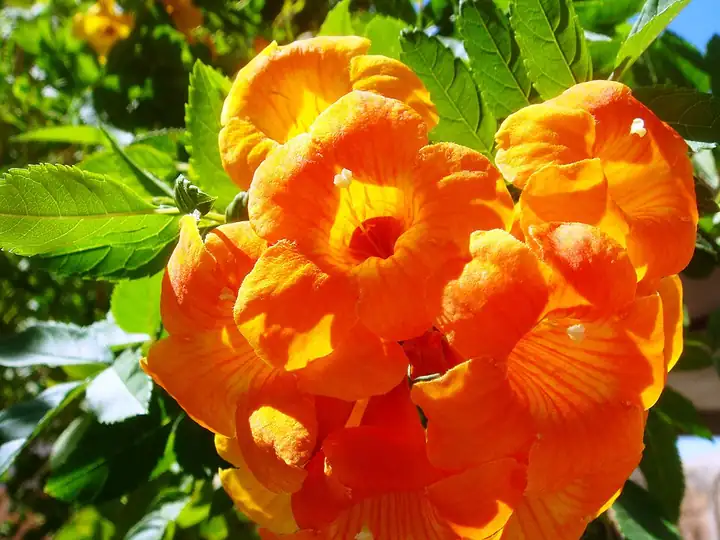
Trumpet vine (trumpet creeper)
Campsis radicans and its cultivars; also the hybrid C. x tagliabuana ('Madame Galen') · Trumpet-creeper family (Bignoniaceae)
| Hardiness zones | 4 to 10 |
|---|---|
| Sun | full sun to part shade |
| Water | low |
| Life cycle | perennial |
| Frost | Hardy: takes frost |
| Spacing | 72 to 144 inches |
About Trumpet vine (trumpet creeper)
Trumpet vine is a native woody vine that climbs 30-40 ft by clinging rootlets and covers itself in 3-inch orange-red trumpets from early summer to September; hummingbirds are its main pollinators, and it feeds the caterpillars of the plebeian sphinx moth (NC State, Wildflower Center). It is native across the central and eastern U.S., from New Jersey, Ohio and Indiana south to Florida and East Texas and north to South Dakota (Wildflower Center). It is aggressive: it suckers from spreading roots, self-seeds freely, its rootlets can damage wood, brick and stone, and its sap can make skin red and itchy, which is why it's called cow-itch. If it's coming up where you don't want it, see the Trumpet creeper weed page.
Hardy in zones 4-10 (NC State; Illinois Extension says 4-8). Native to the central and eastern U.S.
When to plant
Timing is counted from your average last spring frost (and first fall frost). Sow & Tell works out the actual dates for your ZIP code.
Set out a nursery vine beside a very sturdy support (a mature vine is heavy) where suckers can be mowed, such as next to pavement or lawn, and not on a wooden house wall; give it 6-12 ft of room (NC State, Wildflower Center). Seed needs 30-60 days of cold, moist chilling before it sprouts (Wildflower Center). New vines may take several years to bloom (Illinois Extension); no sourced day count to first bloom.
Soil
Almost any well-drained soil, sandy to clay and acid to alkaline; it does best in lean to average soil and is very drought tolerant once established (NC State, Wildflower Center).
No special prep: trumpet vine does best in lean to average, well-drained soil (NC State).
Feeding
Rich soil and feeding aren't needed; the bigger problem is too much growth. Don't plant it against a wooden wall or where suckers can run into beds, and water deeply only during droughts (NC State, Wildflower Center, Illinois Extension).
Harvest
Blooms in summer, about June or July through September, on new growth (NC State, Illinois Extension). Prune hard in late winter or early spring without losing flowers, cutting side branches back to two buds to keep it bushy and full of blooms (Illinois Extension, Wildflower Center). Wear gloves: the sap can irritate skin.
Varieties (9)
NC State and Illinois Extension document these 9 cultivars.
| Variety | Type | Days | Notes |
|---|---|---|---|
| Apricot | C. radicans | A more compact, easier-to-manage vine. | |
| Atropurpurea | C. radicans | Deep scarlet-red flowers. | |
| Crimson Trumpet | C. radicans | Crimson to orange-red flowers. | |
| Flava | C. radicans | Orange-yellow to yellow flowers on a 20-40 ft vine. | |
| Indian Summer | C. radicans | A more compact, easier-to-manage vine. | |
| Judy | C. radicans | Yellow flowers with reddish-orange throats. | |
| Minnesota Red | C. radicans | Deep red, velvety flowers on a vine about 30 ft long. | |
| Stromboli | C. radicans | Dark red buds open to orange flowers on a 20-30 ft vine. | |
| Madame Galen | Hybrid (C. x tagliabuana) | Deep apricot flowers about 3 inches long and wide on a smaller vine, 15-20 ft. |
In the kitchen
Safety: Not for eating: NC State rates it low in toxicity and lists the flowers and leaves as mildly poisonous if eaten. Touching the sap, leaves or flowers can cause red, swollen, itchy skin in sensitive people (contact dermatitis), so wear gloves and long sleeves when pruning (NC State, Wildflower Center).
Pets: Not listed by the ASPCA (no trumpet vine or trumpet creeper entry on its dog, cat or horse plant lists).
Sources
- plants.ces.ncsu.edu
- wildflower.org
- extension.illinois.edu
- plantsservices.sc.egov.usda.gov
- aspca.org
- aspca.org
- aspca.org
- aspca.org
- extension.rutgers.edu
Photo: Photo: Miwasatoshi, CC BY-SA 4.0, via Wikimedia Commons (CC BY-SA 4.0). Photo resized for the web.

Planting dates and advice are general guidance; check with your local Cooperative Extension office for your area.