
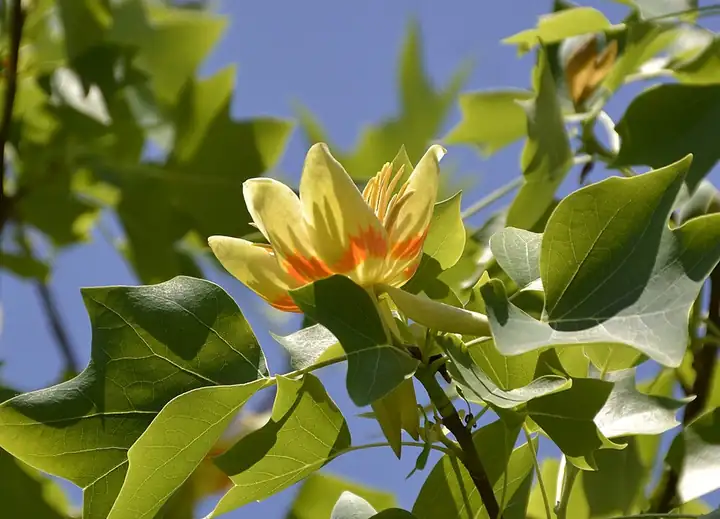
Tulip tree
Liriodendron tulipifera · Magnolia family (Magnoliaceae)
| Hardiness zones | 4 to 9 |
|---|---|
| Sun | full sun |
| Water | moderate |
| Life cycle | perennial |
| Frost | Hardy: takes frost |
About Tulip tree
Tulip tree, also called tulip poplar or yellow poplar, is one of the largest native hardwood trees in the US, with square-tipped leaves, golden fall color and green, yellow and orange tulip-shaped flowers high in the crown in late spring. It feeds hummingbirds and bees and hosts eastern tiger swallowtail caterpillars. It is too big and weak-wooded for small yards.
Zones 4-9 (NC State).
When to plant
Timing is counted from your average last spring frost (and first fall frost). Sow & Tell works out the actual dates for your ZIP code.
Plant container or balled-and-burlapped trees. Container trees can go in any time the ground can be worked, but fall is the best season in the South because roots keep growing through mild weather (Clemson). Dig the hole no deeper than the root ball and at least twice as wide, keep the top roots level with the soil, and mulch 2-4 inches without touching the trunk. Needs a big space (60 ft or more) and isn't suited to small yards or streets. Weak wood breaks in wind, ice and snow, and shallow roots limit planting beneath it (NC State).
Soil
Deep, moist, well-drained loam, ideally acidic; sensitive to heat, drought and compaction, and it drops yellow leaves in dry spells (NC State).
Test the soil first. Loosen a wide planting area and mix 10-20 percent compost into the native soil you dig out; don't use uncomposted bark, and don't dig deeper than the root ball (Clemson).
Feeding
- Spring to early summer, after the tree is established, and only if a soil test or pale leaves and weak twig growth show a need: slow-release nitrogen fertilizer with a ratio near 3-1-1 or 3-1-2 (3-0-1 or 3-0-2 if the soil test shows enough phosphorus). Spread it evenly from just outside the trunk flare to the dripline and water it in. Clemson cites 2-4 lb of slow-release nitrogen per 1,000 sq ft per year, split into a spring and a late-summer feeding; follow your soil test.
- Late summer to early fall, the second half of the year's split feeding (only if a soil test calls for it): slow-release nitrogen fertilizer, same as spring. Apply the rest of the year's amount over the root zone and water in. Don't feed a drought-stressed tree in summer (Clemson).
First-year watering matters far more than fertilizer: water daily for the first 1-2 weeks, every 2-3 days until week 12, then weekly, using about 1-1.5 gallons per inch of trunk diameter, until the tree is established, roughly 1.5 years per inch of trunk (UMN). Don't count on rain unless it was over an inch. It is sensitive to drought and compaction; water deeply in dry spells, especially while young, or it drops yellow leaves early (NC State). Too much fertilizer can burn roots and push soft growth that pests and cold injure (Clemson).
Harvest
Flowers from May to early June after the leaves are full size, often too high to notice; no deadheading needed. Winged seeds ripen in September-October (NC State).
Varieties (6)
NC State documents 6 cultivars, mostly for smaller or unusual forms.
| Variety | Type | Days | Notes |
|---|---|---|---|
| Fastigiatum | Columnar | Columnar habit. | |
| Little Volunteer | Dwarf | Smaller form, up to about 35 ft. | |
| Arnold | Narrow | Narrow tree about 25 ft tall and 8 ft wide. | |
| Crispum | Unusual leaf | Twisted leaves with wavy edges. | |
| Aureomarginatum | Variegated | Leaves edged in gold. | |
| Mediopictum | Variegated | Green leaves with a yellow center blotch. |
Pests to watch for
Scale insects, Aphids
Diseases and problems
Verticillium wilt, Powdery mildew, Leaf spot, Canker, Sooty mold, Overwatering and waterlogged soil, Drought stress
In the kitchen
Pets: Non-toxic to dogs, cats and horses (ASPCA, listed as tulip poplar).
Sources
Photo: Photo: High Contrast / Wikimedia Commons, CC BY 3.0 DE (CC BY 3.0 DE). Photo resized for the web.

Planting dates and advice are general guidance; check with your local Cooperative Extension office for your area.