
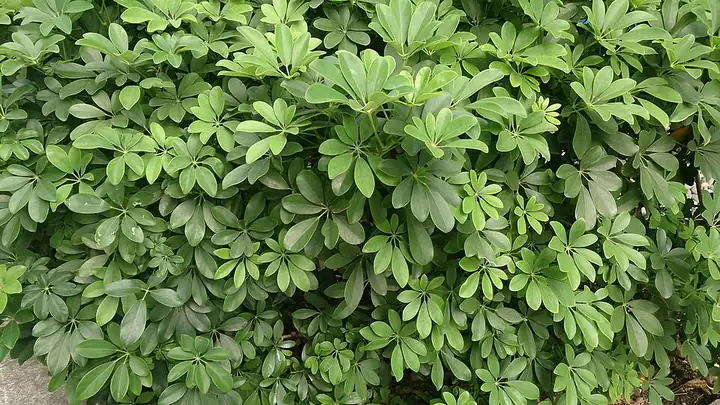
Umbrella plant (schefflera)
Schefflera arboricola (dwarf umbrella plant, now Heptapleurum arboricola) and S. actinophylla (umbrella tree, now Heptapleurum actinophyllum) · Ginseng family (Araliaceae)
| Hardiness zones | 10 to 12 |
|---|---|
| Sun | part shade |
| Water | moderate |
| Life cycle | perennial |
| Frost | Tender: killed by frost |
About Umbrella plant (schefflera)
Scheffleras are glossy evergreen shrubs whose leaflets fan out from the stalk like the spokes of an umbrella. The dwarf umbrella plant, S. arboricola from Taiwan and south China, has 7-9 small leaflets and stays a dense 3-6 ft bush indoors, often sold in gold- or cream-variegated forms; the umbrella tree, S. actinophylla from Australia and New Guinea, has bigger, longer leaflets and grows into a fast 4-6 ft (Clemson says up to 8-10 ft) indoor tree (NC State, Clemson). Both are easy in medium to bright light and drop leaves when they are too wet, too dry or chilled. Outdoors in central and south Florida the umbrella tree escapes into natural areas and UF/IFAS rates it invasive.
The umbrella tree is hardy outdoors in zones 10-12 and the dwarf kind from about 9b (NC State); both are grown indoors everywhere and can summer outdoors in a sheltered, shaded spot once nights stay above about 60 F. In central and south Florida keep the umbrella tree in a pot, since it is invasive there (UF/IFAS).
When to plant
Timing is counted from your average last spring frost (and first fall frost). Sow & Tell works out the actual dates for your ZIP code.
Usually bought as a nursery plant 2-3 ft tall; it can be started from stem cuttings, air layering or seed (Clemson, NC State).
Growing it indoors
- Light: Medium to bright light with 3-4 hours of filtered sun from an east, west or south window suits it; low light yellows the leaves and makes spindly stems, and hot direct sun through glass scorches the leaves (NC State, Clemson).
- Water: Water thoroughly, then let the top half inch to inch of mix dry before watering again, and never let the pot stand in its saucer (Clemson, NC State); MU Extension's table says the umbrella tree likes to drench and dry while the dwarf kind prefers evenly moist. Leaves drop when the mix stays soggy or goes bone dry, and soggy mix leads to root rot, so water less in winter.
- Humidity: It prefers humid air and drops leaves in very dry rooms; set the pot on a tray of wet pebbles with the water below the pebble tops (NC State, Clemson).
- Temperature: Clemson gives 65-75 F days and nights above 60 F, never below 50 F, since chilling kills patches of leaf; keep it away from heat vents, radiators, air conditioners and open windows.
- Feeding: Feed a water-soluble or time-release houseplant fertilizer by the label during spring and summer growth, less often for a plant in low light, and none in winter (Clemson, MU Extension).
- Repotting: Repot an overcrowded plant in any season into general-purpose potting mix one size up; prune just above a leaf to keep it small (Clemson).
Soil
A well-drained general-purpose potting mix rich in organic matter, in a pot with a drainage hole (NC State, Clemson).
Pot in a well-drained general-purpose potting mix rich in organic matter, in a container with a drainage hole (NC State, Clemson).
Feeding
- Spring and summer, while new leaves are coming: water-soluble or time-release houseplant fertilizer. Clemson says feed regularly by the label directions, less often for a plant in low light; MU Extension's general rule is about once a month, watering first.
- Winter: none. Skip feeding while no new growth is showing (MU Extension).
Don't feed a plant that is dropping leaves; that is a water, humidity or chill problem, not a nutrient one (Clemson, MU Extension).
Varieties (11)
NC State and Clemson Extension name 2 species and 9 cultivars.
| Variety | Type | Days | Notes |
|---|---|---|---|
| Dwarf umbrella plant (Schefflera arboricola) | Dwarf umbrella plant | The small-leaved bushy kind with 7-11 glossy leaflets up to 4 in long; dense and rounded, 3-6 ft in a pot. | |
| Compacta | Dwarf, green | Smaller plant with dense clusters of glossy green leaflets. | |
| Dwarf | Dwarf, green | Dark green leaflets on a plant to about 4 ft. | |
| Pittman's Pride | Dwarf, green | A dwarf, compact green form. | |
| Dazzle | Dwarf, variegated | Heavily variegated, with some leaflets almost creamy white. | |
| Gold Capella | Dwarf, variegated | Leaflets splashed yellow-gold and green. | |
| Green Gold | Dwarf, variegated | Gold-splashed leaflets. | |
| Trinette | Dwarf, variegated | Cream and green variegated leaflets. | |
| Variegata | Dwarf, variegated | Medium green leaflets marked cream to yellow; more compact than the green plant. | |
| Amate | Umbrella tree | A compact, rounded umbrella tree to about 10 ft that resists Alternaria leaf spot and spider mites and holds its shape in low light. | |
| Umbrella tree (Schefflera actinophylla) | Umbrella tree | The big-leaved tree form with glossy leaflets 4-6 in long indoors; fast, reaching 4-6 ft or more in a pot and 40 ft outdoors in the tropics. |
Pests to watch for
Twospotted spider mite, Mealybugs, Scale insects, Aphids, Thrips
Diseases and problems
Root and crown rot, Bacterial leaf spot, Alternaria leaf spot
In the kitchen
Safety: Chewed leaves cause intense burning of the mouth and throat, drooling, trouble swallowing and vomiting from calcium oxalate crystals, and the sap irritates sensitive skin, so wear gloves when pruning (NC State rates the dwarf kind low severity and the umbrella tree medium severity, with terpenoids and saponins as well). Keep it away from young children.
Pets: Toxic to dogs and cats (ASPCA, Schefflera): calcium oxalate crystals cause oral irritation, intense burning of the mouth, lips and tongue, heavy drooling, vomiting and trouble swallowing. NC State also lists the umbrella tree as a problem for horses.
Sources
- plants.ces.ncsu.edu
- plants.ces.ncsu.edu
- hgic.clemson.edu
- extension.missouri.edu
- assessment.ifas.ufl.edu
- aspca.org
Photo: Photo: Mokkie, CC BY-SA 3.0, via Wikimedia Commons (CC BY-SA 3.0). Photo resized for the web.

Planting dates and advice are general guidance; check with your local Cooperative Extension office for your area.