
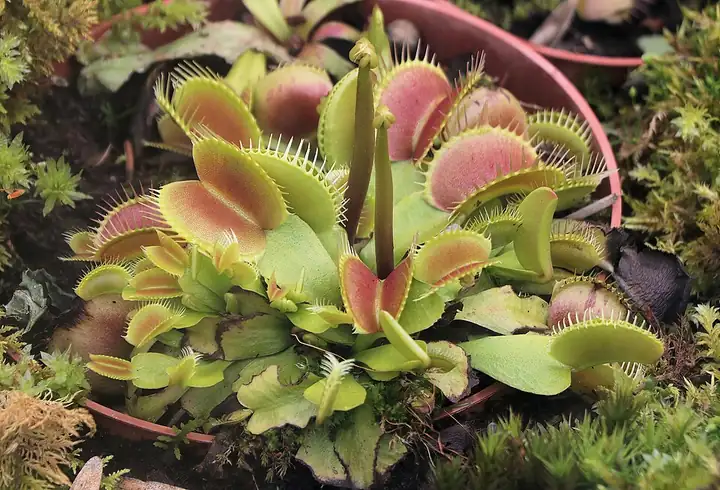
Venus flytrap
Dionaea muscipula · Sundew family (Droseraceae)
| Hardiness zones | 7 to 10 |
|---|---|
| Sun | full sun to part shade |
| Water | high |
| Life cycle | perennial |
| Frost | Hardy: takes frost |
About Venus flytrap
The Venus flytrap is a small carnivorous plant whose leaves end in hinged traps that snap shut when an insect touches the trigger hairs inside twice, then digest it over 3-5 days (NC State, Penn State). It grows wild only in wet longleaf pine savannas of the Carolinas, within about 90 miles of Wilmington, N.C., and taking plants or seeds from land you don't own is a Class H felony in North Carolina, so buy nursery-grown or tissue-culture plants only (NC Botanical Garden, N.C. G.S. 14-129.3, U.S. Fish and Wildlife Service). It needs full sun, constantly wet acid moss, rain or distilled water and a winter rest, so it is harder to keep on a windowsill than most houseplants.
Hardy outdoors in zones 7-10, and in 5-6 with winter protection, in a bog garden or wet container (NC State); it is grown in pots indoors anywhere and does best summered outdoors in sun, as it needs a cool winter rest.
When to plant
Timing is counted from your average last spring frost (and first fall frost). Sow & Tell works out the actual dates for your ZIP code.
Buy a nursery-propagated or tissue-culture plant; never dig one from the wild (NC State, U.S. Fish and Wildlife Service). Division and seed also work.
Growing it indoors
- Light: It needs full sun or at least several hours of direct sun; in good light the inside of the traps turns red, and in poor light they stay green and weak (NC State).
- Water: Never let the moss dry out; use only rainwater or distilled water, because chlorinated or hard tap water can kill it (NC State). It is a bog plant that tolerates standing water, so the pot can sit in a shallow tray of rain or distilled water.
- Humidity: It needs high humidity (NC State); dry indoor air is one reason it struggles on a windowsill.
- Temperature: It is a temperate perennial that loses leaves and rests in winter (NC State), so it does poorly kept warm all year; the sources we opened give no exact rest temperature.
- Feeding: Don't fertilize it, and don't feed it meat; it gets its nutrients from the insects and spiders it catches (NC State).
- Repotting: The sources we opened give no schedule; when you repot, use fresh sphagnum or the peat-and-sand mix and rain or distilled water (NC State).
Soil
Whole-fiber sphagnum moss, or equal parts peat moss and coarse vermiculite or sharp sand, kept wet; it needs acid conditions (pH below 6) and no fertilizer (NC State).
Pot in whole-fiber sphagnum moss, or equal parts peat moss and coarse vermiculite or sharp sand, wetted with rain or distilled water (NC State).
Feeding
- Any season: none. Don't fertilize; it gets nutrients from the insects and spiders it catches (NC State).
Fertilizer, tap water and potting soil all harm it; use only bog-type media and rain or distilled water (NC State).
Varieties (4)
NC State Extension names 4 cultivars, all nursery-propagated.
| Variety | Type | Days | Notes |
|---|---|---|---|
| Red Dragon | All-red | Turns red all over in full sun. | |
| King Henry | Large trap | Large chartreuse-to-yellow traps with orange-red insides; fast growing. | |
| Cupped Trap | Red trap | Rounder, cup-shaped traps with bright red centers. | |
| Dente | Toothed trap | Guard hairs shaped like shark teeth, deep red traps and green leaf stalks. |
Pests to watch for
Aphids, Twospotted spider mite
In the kitchen
Safety: Not poisonous to people or pets (NC State, ASPCA). The legal risk is real: digging, pulling or carrying off wild plants or seed from someone else's land or public land is a Class H felony in North Carolina unless you carry the landowner's signed permit (N.C. G.S. 14-129.3).
Pets: Non-toxic to dogs, cats and horses (ASPCA).
Sources
Photo: Photo: ImagePerson, CC BY 4.0, via Wikimedia Commons (CC BY 4.0). Photo resized for the web.

Planting dates and advice are general guidance; check with your local Cooperative Extension office for your area.