
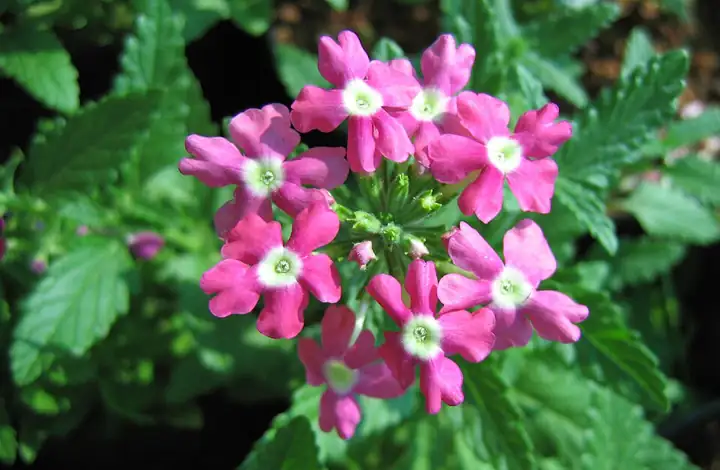
Verbena (garden verbena)
Glandularia x hybrida (Verbena x hybrida); also Verbena bonariensis · Verbena family (Verbenaceae)
| Hardiness zones | 7 to 11 |
|---|---|
| Sun | full sun |
| Water | low |
| Life cycle | tender perennial (grown as an annual) |
| Frost | Half-hardy: takes a light frost |
About Verbena (garden verbena)
Garden verbenas are low, spreading plants with rounded clusters of small flowers in white, pink, red, lavender, blue and purple that bloom from spring to frost, great for edging and baskets. Tall verbena (Verbena bonariensis) sends up 2-5-foot wiry stems topped with purple clusters. Both draw butterflies, bumblebees and hummingbirds (Clemson). The blue vervain entry in this app is a different, native species.
Most garden verbenas are short-lived and grown as annuals; some are perennial in zone 7b and warmer, and V. bonariensis is hardy in 7-11 (NC State). Invasive: V. bonariensis reseeds heavily and is on the Cal-IPC 'Watch' list in California and listed by the Georgia Exotic Pest Plant Council and the Native Plant Society of Oregon, so keep it out of natural areas.
When to plant
Timing is counted from your average last spring frost (and first fall frost). Sow & Tell works out the actual dates for your ZIP code.
Plant in spring or summer (in fall on the South Carolina coast), and pinch the branch tips at planting to make a fuller plant (Clemson). Verbenas bloom well their first season; most are short-lived, so plan to replace them after two or three years.
Soil
Well-drained soil is a must; verbenas rot in soggy soil, shade or crowded spots with poor air flow.
Plant in well-drained soil in full sun; follow a soil test.
Feeding
- Mid- to late spring: complete fertilizer such as 16-4-8. Scatter around plants and water in (Clemson). Container plants can instead get controlled-release fertilizer or a liquid fertilizer once a month.
- After trimming plants back in midsummer: complete fertilizer such as 16-4-8. Feed again to push new growth and flowers (Clemson).
Overwatering and crowding cause root rot and mildew; water deeply once a week in bloom only if there's been less than an inch of rain.
Harvest
Blooms from spring to frost. If flowering slows in midsummer, trim the whole plant back by about a quarter; trim lightly in fall and save hard pruning for spring (Clemson).
Varieties (16)
| Variety | Type | Days | Notes |
|---|---|---|---|
| Aztec series | Garden verbena | ||
| Beats Purple+White | Garden verbena | Purple-and-white bicolor flowers; blooms early. | |
| Lanai series | Garden verbena | ||
| Meteor Shower | Garden verbena | ||
| Obsession series | Garden verbena | ||
| Quartz XP series | Garden verbena | ||
| Tuscany series | Garden verbena | ||
| Superbena series | Garden verbena (vegetative) | ||
| Appleblossom | Spreading garden verbena | Large cotton-candy pink flowers with a white eye. | |
| Greystone Daphne | Spreading garden verbena | Fragrant pinkish-lavender flowers starting very early in spring. | |
| Homestead Purple | Spreading garden verbena | Big dark purple clusters; about 1 ft tall and 3 ft wide. | |
| Sissinghurst | Spreading garden verbena | Coral-pink; spreads to a 3-4 ft mound in one season. | |
| Summer Blaze | Spreading garden verbena | Cherry-red clusters from late spring to frost. | |
| Blue Princess | Spreading perennial verbena | Lavender-blue; about 1 ft tall and 3 ft wide; blooms early spring to late fall. | |
| Lollipop | Verbena bonariensis | Natural dwarf, 2-3 ft tall. | |
| Vanity | Verbena bonariensis | Deep blue-purple flowers 1-1.5 in across on a compact, sturdy plant; handles hot, dry weather. |
Pests to watch for
Aphids, Whiteflies, Thrips, Leafminers, Twospotted spider mite, Slugs, Brown garden snail, Tobacco budworm (geranium or petunia budworm)
Diseases and problems
Powdery mildew, Gray mold, Root rot, Tobacco mosaic and tomato mosaic
In the kitchen
Pets: We found no ASPCA entry for garden verbena, so we can't say it is pet-safe; discourage pets from chewing it. (The ASPCA's 'Lantana' and 'Lemon Verbena' entries are different plants.)
Sources
Photo: Photo: Vinayaraj, CC BY-SA 3.0, via Wikimedia Commons (CC BY-SA 3.0). Photo resized for the web.

Planting dates and advice are general guidance; check with your local Cooperative Extension office for your area.