
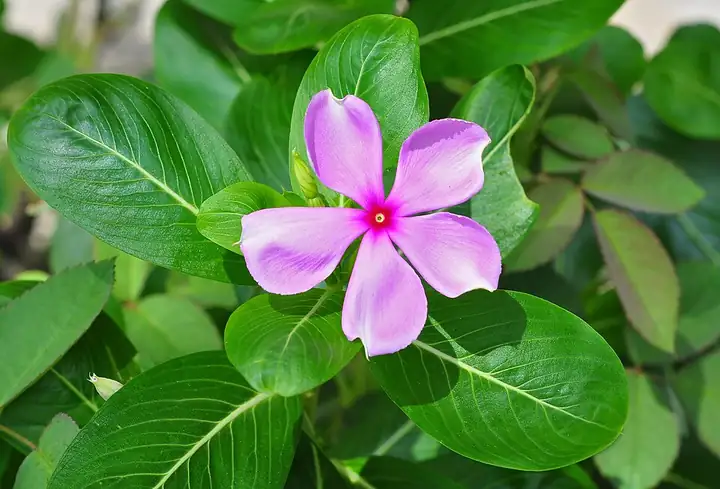
Vinca (annual vinca, Madagascar periwinkle)
Catharanthus roseus (formerly Vinca rosea) · Dogbane family (Apocynaceae)
| Hardiness zones | 10 to 11 |
|---|---|
| Sun | full sun |
| Water | low |
| Life cycle | tender perennial (grown as an annual) |
| Frost | Tender: killed by frost |
| Soil pH | 5.5–6.0 |
| Spacing | 8 to 18 inches |
| Soil temperature to plant | at least 60°F |
About Vinca (annual vinca, Madagascar periwinkle)
Annual vinca is a tough summer bedding plant with glossy leaves and flat, five-petaled flowers that keep coming through the hottest, driest weather. It wants full sun, warm soil and good drainage; wet, cool soil brings on root and stem rots, so the disease-resistant Cora and Nirvana series are worth seeking out (Clemson, LSU). It is not the same plant as the groundcover periwinkles Vinca minor and Vinca major, which spread aggressively and are on many states' invasive lists (NC State).
Grown as a warm-season annual in every zone; it lives through winter only in zones 10-11 (NC State, UF/IFAS). UF/IFAS rates it 'caution - manage to prevent escape' in South Florida (advisory), and it can reseed.
When to plant
Timing is counted from your average last spring frost (and first fall frost). Sow & Tell works out the actual dates for your ZIP code.
Plant only after the ground is warm, above 60 F, usually May in South Carolina; early planting invites root rot (Clemson). Seed sprouts in about a week at 70-75 F in the dark (UF/IFAS), but plants are slow to flower from seed, so most people buy transplants; no days-to-bloom count is sourced. Set the root ball level with or a bit above the soil, 8-18 inches apart, and don't replant vinca in the same bed year after year (LSU, UF/IFAS). Most gardeners replant each spring; we found no extension advice on bringing it indoors for winter.
Soil
Well-drained soil with some organic matter such as composted pine bark; best at pH 5.5-6.0, since high pH makes disease worse. Raise beds if drainage is poor (Clemson, LSU).
Dig the whole bed and work in organic matter such as composted pine bark for drainage; aim for pH 5.5-6.0 and add lime only if a soil test calls for it (Clemson).
Feeding
- Only if a soil test shows a need: fertilizer chosen by soil test, avoiding ammonium-type nitrogen. Fertilize by soil test results and skip high-ammonium fertilizers such as ammonium nitrate or ammonium sulfate (Clemson).
Too much fertilizer and frequent watering both bring on disease; water only when rain gives less than about an inch a week, and plant only after the soil is above 60 F (Clemson).
Harvest
Blooms from May or June until frost. Vinca needs no deadheading or pinching (Clemson, NC State); remove plants after a hard frost to cut down on diseases next year.
Varieties (14)
Extension sources document 14 annual vinca series; groundcover periwinkles (Vinca minor, V. major) are different plants and not listed.
| Variety | Type | Days | Notes |
|---|---|---|---|
| Blue Pearl | Annual vinca (Catharanthus roseus) | Lavender flowers over dark green leaves. | |
| Cooler series | Annual vinca (Catharanthus roseus) | An older series in many colors that still does well with good care. | |
| Cora series | Annual vinca (Catharanthus roseus) | Bred to resist Phytophthora aerial blight and root rot; Cora XDR resists several strains. 12-16 in tall and wide with large pink, purple, white and bicolor flowers. | |
| Heatwave series | Annual vinca (Catharanthus roseus) | Compact, about 10 in tall; blooms early with big flowers and grows in cooler weather than most vincas. | |
| Jams 'N Jellies Blackberry | Annual vinca (Catharanthus roseus) | Dark purple flowers. | |
| Mediterranean series | Annual vinca (Catharanthus roseus) | Spreading, about 6 in tall and up to 2 ft wide; for hanging baskets, window boxes and pots. | |
| Mega Bloom series | Annual vinca (Catharanthus roseus) | Biggest flowers of the seed-grown vincas; 8-10 in tall; handles heat and humidity. Halo colors have white centers. | |
| Nirvana series | Annual vinca (Catharanthus roseus) | Compact and resistant to Phytophthora. | |
| Pacifica series | Annual vinca (Catharanthus roseus) | About 14 in tall with 2-inch flowers; early, well branched, heat and drought tolerant. | |
| SunStorm series | Annual vinca (Catharanthus roseus) | Very compact and well branched. | |
| Tattoo series | Annual vinca (Catharanthus roseus) | 10-14 in tall and upright; petals look airbrushed with darker color. | |
| Titan series | Annual vinca (Catharanthus roseus) | 14-16 in tall and 10-12 in wide with very large flowers; handles heat, drought and cooler, wetter spells. | |
| Valiant series | Annual vinca (Catharanthus roseus) | 14-20 in tall and well branched; takes hot sun, drought and salt air. | |
| Victory series | Annual vinca (Catharanthus roseus) |
Pests to watch for
Thrips
Diseases and problems
Phytophthora aerial blight and root rot, Pythium root rot, Rhizoctonia stem and root rot, Alternaria leaf spot, Gray mold, Tomato spotted wilt
In the kitchen
Safety: All parts contain vinca alkaloids; NC State rates it low severity, but eating large amounts can cause vomiting, low blood pressure, hallucinations, seizures and worse. Don't eat any part. Its compounds led to important leukemia drugs, which is no reason to use the plant itself.
Pets: Toxic to dogs, cats and horses (ASPCA, listed as periwinkle, Vinca rosea): vinca alkaloids can cause vomiting, diarrhea, low blood pressure, depression, tremors, seizures, coma and death.
Sources
- plants.ces.ncsu.edu
- hgic.clemson.edu
- hgic.clemson.edu
- ask.ifas.ufl.edu
- apps.lsuagcenter.com
- plants.ces.ncsu.edu
- assessment.ifas.ufl.edu
- aspca.org
- rutgersgardens.rutgers.edu
Photo: Photo: Joydeep / Wikimedia Commons, CC BY-SA 3.0 (CC BY-SA 3.0). Photo resized for the web.

Planting dates and advice are general guidance; check with your local Cooperative Extension office for your area.