
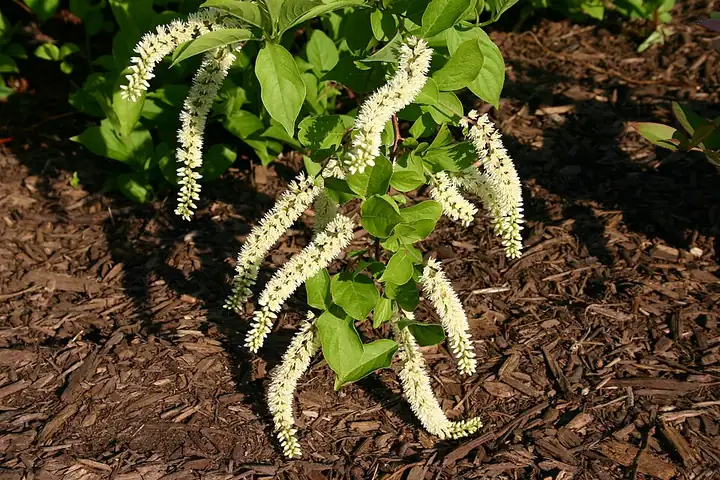
Virginia sweetspire
Itea virginica · Sweetspire family (Iteaceae)
| Hardiness zones | 5 to 9 |
|---|---|
| Sun | full sun to part shade |
| Water | high |
| Life cycle | perennial |
| Frost | Hardy: takes frost |
About Virginia sweetspire
Virginia sweetspire is a native shrub with arching branches tipped in drooping, bottlebrush-like spikes of small, lightly fragrant white flowers in late spring, then red, orange and purple fall color that can hang on into early winter (Clemson, NC State). It grows wild from southern New Jersey to Florida, west to Texas and Oklahoma and north through Missouri and southern Illinois, in swamps, wet woods and stream banks (Wildflower Center). It handles wet soil and short floods, so it suits rain gardens and creek banks, and it slowly spreads by root suckers into thickets.
Hardy in zones 5-9 (NC State, Clemson, Morton Arboretum). In the warmer part of its range some leaves stay on through winter, but they drop once it gets below about 15-20 F (Clemson).
When to plant
Timing is counted from your average last spring frost (and first fall frost). Sow & Tell works out the actual dates for your ZIP code.
Plant container shrubs in spring or fall and water deeply until the roots spread, which takes at least two growing seasons (UMN). Leave room between plants: it fills gaps by sending up suckers from spreading roots (Clemson). Outside wet sites, water during droughts (Wildflower Center).
Soil
Moist, acid soil rich in organic matter is best; it takes clay, poor drainage and periodic flooding, and once settled it tolerates drier sites, though high-pH soil can cause yellow leaves (chlorosis) (Wildflower Center, NC State, Morton Arboretum).
Test the soil first; work organic matter into moist, slightly acid soil, since high-pH soil can yellow the leaves (NC State, Morton Arboretum, Clemson).
Feeding
- Spring to early summer after new growth starts, only if a soil test shows a need: slow-release complete fertilizer in a 3:1:2 ratio, or what the soil test calls for. Spread it evenly from the stems out to the drip line and water it in; a typical soil-test rate for shrubs is about 2 lb of 12-6-6 per 100 sq ft (Clemson). Follow a soil test.
NC State warns against over-fertilizing. Water matters more than food: water daily for the first 2 weeks, every 2-3 days through week 12, then weekly until established (at least two growing seasons), using a quarter to a third of the nursery pot's volume each time (UMN); outside wet sites, keep watering in droughts (Wildflower Center).
Harvest
Blooms in May and June; each spike opens from the base upward, so the show lasts for weeks (Clemson). Flower buds form by late summer on that year's shoots, so prune right after flowering if at all; removing a few of the oldest, thickest stems now and then brings vigorous new shoots and more flowers (Clemson, NC State).
Varieties (12)
Clemson, NC State and the Morton Arboretum document these 12 cultivars; all have white flowers.
| Variety | Type | Days | Notes |
|---|---|---|---|
| Beppu | Compact, about 3 ft tall, with wine-red to reddish-purple fall color; suckers well, good for slopes and erosion control. | ||
| Fizzy Mizzy ('SMNIVMM') | Upright and narrow, 2-3 ft tall and wide, with cone-shaped flower spikes and scarlet to burgundy fall color. | ||
| Henry's Garnet | Reddish-purple fall color; usually 4-6 ft tall and wide, though the Morton Arboretum gives 2-3 ft tall and 4-6 ft wide. The easiest sweetspire to find. | ||
| Little Henry ('Sprich') | Compact, 3-5 ft tall and wide, with 3-4 inch flower spikes and bright red to burgundy fall color. | ||
| Long Spire | 3-5 ft tall, with long drooping flower clusters 6-8 inches; fall color in yellow, orange, red and purple. | ||
| Love Child ('Bailteaone') | Compact, 3-4 ft tall and wide, with dark red fall color. | ||
| Merlot (Short N' Sweet) | 3-4 ft tall and wide, with burgundy-red fall color; leaves hang on into winter. | ||
| Sarah Eve | 4-6 ft tall and wide; pink flower stalks give the white spikes a pinkish look. Fall color is inconsistent. | ||
| Saturnalia | About 3-4 ft tall and wide with a loose, irregular habit and orange, red and yellow fall color. | ||
| Scarlet Beauty ('Morton') | Upright-rounded, 3-4 ft tall and wide, with lots of flowers and orange-red fall color. | ||
| Scentlandia ('SMNIVDFC') | 3-5 ft tall and wide with fragrant flowers and burgundy-red fall color. | ||
| Shirley's Compact | Miniature, about 18 in tall and 3 ft wide after 10 years, with small twisted leaves and red, orange and yellow fall color. |
Diseases and problems
Leaf spot, Mildew, Iron chlorosis in high-pH soil
In the kitchen
Safety: The extension sources we used give no poison rating or toxicity warning for Virginia sweetspire. It is grown for looks, not food.
Pets: Not listed by the ASPCA (no Itea, sweetspire or Virginia willow entry on its dog, cat or horse plant lists).
Sources
- plants.ces.ncsu.edu
- hgic.clemson.edu
- wildflower.org
- mortonarb.org
- extension.umn.edu
- aspca.org
- aspca.org
- aspca.org
- extension.rutgers.edu
- hgic.clemson.edu
Photo: Photo: SB_Johnny, CC BY-SA 3.0, via Wikimedia Commons (CC BY-SA 3.0). Photo resized for the web.

Planting dates and advice are general guidance; check with your local Cooperative Extension office for your area.