
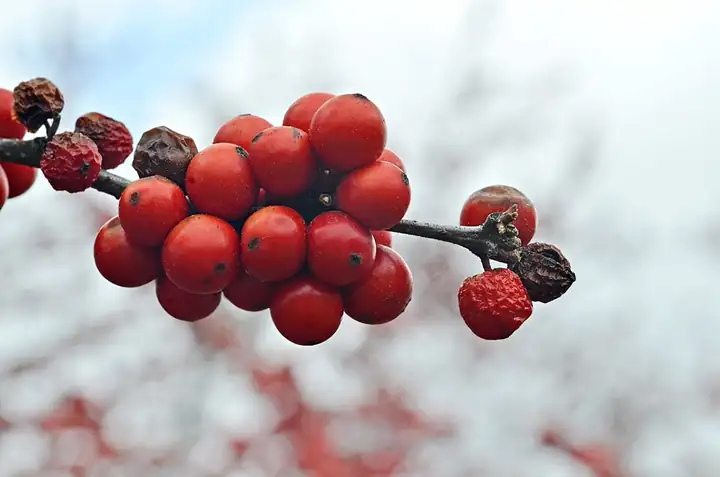
Winterberry
Ilex verticillata · Holly family (Aquifoliaceae)
| Hardiness zones | 3 to 9 |
|---|---|
| Sun | full sun to part shade |
| Water | high |
| Life cycle | perennial |
| Frost | Hardy: takes frost |
About Winterberry
Winterberry is a native deciduous holly that drops its leaves in fall and then shows off bright red berries on bare stems all winter. Unlike most hollies it thrives in wet, boggy soil, and more than 48 kinds of birds eat the fruit (NC State, Clemson). Only female plants have berries, and they need a male winterberry that blooms at the same time nearby.
Native to eastern North America and hardy in zones 3-9 (NC State).
When to plant
Timing is counted from your average last spring frost (and first fall frost). Sow & Tell works out the actual dates for your ZIP code.
Plant one male for every 5-10 females, within about 50 feet, and match bloom times: 'Jim Dandy' is an early-blooming male and 'Southern Gentleman' a late one.
Soil
Moist to wet, acid soil; it handles boggy spots and occasional flooding, but neutral to alkaline soil causes yellowing and can kill it (NC State).
Pick a moist to wet spot with acid soil; neutral to alkaline soil causes yellowing (NC State). Test the soil first.
Feeding
- Spring to early summer after new growth starts, only if a soil test shows a need: slow-release complete fertilizer in a 3:1:2 ratio, or what the soil test calls for. Spread evenly from the trunk out to the drip line and water it in; a typical soil-test rate for shrubs is about 2 lb of 12-6-6 per 100 sq ft (Clemson). Follow a soil test.
Water is what new shrubs need most: daily for the first 2 weeks, every 2-3 days through week 12, then weekly until the roots spread (at least two growing seasons), using about a quarter to a third of the nursery pot's volume each time (UMN). Dry soil can make the fruit drop (NC State). Extra nitrogen can reduce berry set on hollies (Clemson).
Harvest
Small greenish-white flowers open in late spring (April-June); berries ripen August to December and hang on into winter. Cut berried branches for winter decorations; fruit may drop early if the soil gets too dry (NC State).
Varieties (11)
NC State documents these. Plant one male of matching bloom time for every 10-20 females.
| Variety | Type | Days | Notes |
|---|---|---|---|
| Afterglow | Female | Compact globe; pollinated by 'Apollo', 'Jim Dandy' or 'Raritan'. | |
| Berry Heavy | Female | Pollinated by 'Jim Dandy'. | |
| Berry Nice | Female | Low flammability; pollinated by 'Jim Dandy'. | |
| Bright Horizon | Female | Compact, turban-shaped shrub with dark red-orange fruit. | |
| Jolly Red | Female | Vivid red fruit. | |
| Red Sprite | Female | Dwarf with vivid red fruit; pollinated by 'Jim Dandy' or 'Raritan'. | |
| Sunset | Female | Spreading, vigorous habit. | |
| Winter Gold | Female | Persistent orange-yellow fruit. | |
| Winter Red | Female | Red fruit. | |
| Jim Dandy | Male | Early-blooming male pollinizer. | |
| Southern Gentleman | Male | Late-blooming male pollinizer. |
Pests to watch for
Scale insects, Twospotted spider mite, Deer, Rabbits
Diseases and problems
Leaf spots, Powdery mildew
In the kitchen
Safety: NC State lists the fruit and leaves as mildly toxic (saponins): eating them can cause vomiting and diarrhea.
Pets: Toxic to dogs, cats and horses (ASPCA lists winterberry under holly): saponins cause vomiting, diarrhea and depression; low toxicity.
Sources
Photo: Photo: Derek Ramsey (Ram-Man) / Wikimedia Commons, CC BY-SA 4.0 (CC BY-SA 4.0). Photo resized for the web.

Planting dates and advice are general guidance; check with your local Cooperative Extension office for your area.