
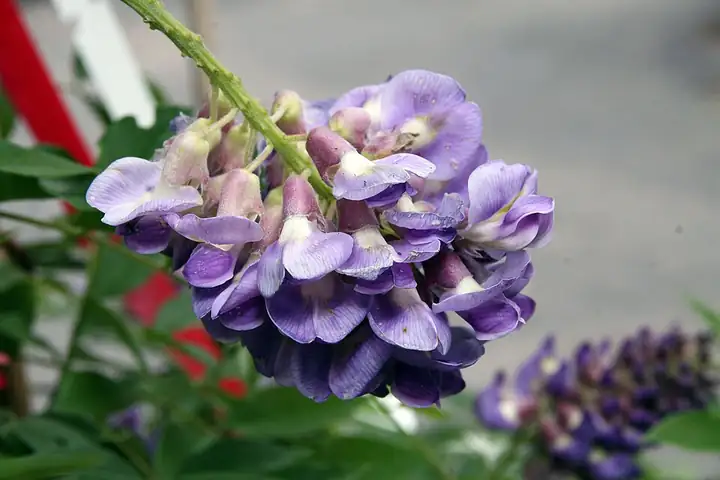
Wisteria
Wisteria frutescens (American wisteria, incl. Kentucky wisteria, var. macrostachya); W. sinensis (Chinese) and W. floribunda (Japanese) · Pea family (Fabaceae)
| Hardiness zones | 3 to 9 |
|---|---|
| Sun | full sun |
| Water | moderate |
| Life cycle | perennial |
| Frost | Hardy: takes frost |
About Wisteria
Wisteria is a long-lived woody vine with hanging clusters of pea-like flowers in purple, lavender, blue, pink or white. Chinese and Japanese wisteria are invasive in much of the East and South: they climb over trees, can break limbs and form dense thickets, and Connecticut now prohibits planting or selling them (NC State; Clemson; Connecticut invasive plant list). Native American and Kentucky wisteria are the better-behaved choice, with shorter clusters that open after the leaves. Every wisteria grows heavy and needs a very sturdy support.
American wisteria is hardy in zones 5-9, Japanese in 4-9 and Chinese in 5-8 (NC State); Kentucky wisteria such as 'Blue Moon' is hardy to about zone 3 (USU). Chinese and Japanese wisteria are invasive: prohibited in Connecticut and listed in Florida, Maryland, Virginia and New York.
When to plant
Timing is counted from your average last spring frost (and first fall frost). Sow & Tell works out the actual dates for your ZIP code.
Plant a grafted or cutting-grown plant of a named variety: seedlings can take up to 15 years to bloom (USU). Build the support first, with 6x6 posts or steel, because wisteria hates being moved and can crush lattice and damage gutters and siding (USU, NC State). Keep the soil moist while it blooms and when next year's buds form in August and September (USU).
Soil
Moist, well-drained, moderately fertile soil that's slightly acidic; high-pH soil can cause yellow leaves from iron chlorosis (NC State, USU).
Moderately fertile, well-drained, slightly acidic soil; test first, since high pH can cause iron chlorosis (NC State, USU).
Feeding
- Early spring, only if a soil test shows a need: a light feeding low in nitrogen; phosphorus only if the soil lacks it. NC State notes an early-spring feeding can help flowering but overfeeding prevents it; USU says added nitrogen usually isn't needed.
Too much nitrogen gives leafy vines and few flowers (USU, NC State).
Harvest
Blooms in spring: Asian wisterias in April-May as the leaves open, American wisteria in April-May after leaf-out, and Kentucky wisteria around June with some later rebloom (NC State, Illinois Extension). Prune twice a year: right after bloom cut the long new shoots back by about half, and in late winter before leaf-out shorten the side shoots to 6-12 inches (USU).
Varieties (19)
| Variety | Type | Days | Notes |
|---|---|---|---|
| Alba | American wisteria (W. frutescens), native | White, mildly fragrant flowers. | |
| Amethyst Falls | American wisteria (W. frutescens), native | Lightly fragrant lavender-purple flowers in short clusters; the most common American wisteria in the trade. | |
| Dam B | American wisteria (W. frutescens), native | A Texas selection with bright blue flowers. | |
| Magnifica | American wisteria (W. frutescens), native | Denser and showier, with deeper lavender-purple flowers in often slightly larger clusters. | |
| Nivea | American wisteria (W. frutescens), native | Snow-white flowers on shorter clusters. | |
| Swantly Purple | American wisteria (W. frutescens), native | Fragrant, deep purple-violet flowers. | |
| Chinese wisteria (W. sinensis) | Chinese wisteria (W. sinensis), invasive | Mildly fragrant blue-violet flowers in 6-12 inch clusters that open almost all at once before the leaves; fuzzy pods; very vigorous. | |
| Jako | Chinese wisteria (W. sinensis), invasive | White flowers. | |
| Prolific | Chinese wisteria (W. sinensis), invasive | Starts flowering at a younger age than most. | |
| Carnea (Kuchibeni) | Japanese wisteria (W. floribunda), invasive | White flowers with pink tips. | |
| Issai | Japanese wisteria (W. floribunda), invasive | Violet to blue-violet flowers in 12-inch clusters. | |
| Japanese wisteria (W. floribunda) | Japanese wisteria (W. floribunda), invasive | Very fragrant pink to purple flowers in 12-18 inch clusters that open from the base outward as the leaves emerge; longer bloom period than Chinese wisteria. | |
| Longissima Alba | Japanese wisteria (W. floribunda), invasive | Very fragrant white flowers in clusters up to 2 ft. | |
| Macrobotrys | Japanese wisteria (W. floribunda), invasive | Fragrant red-violet flowers in clusters 2-4 ft long. | |
| Rosea | Japanese wisteria (W. floribunda), invasive | Fragrant rose-pink flowers. | |
| Violacea Plena | Japanese wisteria (W. floribunda), invasive | Very fragrant double violet-blue flowers in clusters under 1 ft. | |
| Aunt Dee | Kentucky wisteria (W. frutescens var. macrostachya), native | Light purple flowers; blooms reliably in Iowa. | |
| Blue Moon | Kentucky wisteria (W. frutescens var. macrostachya), native | Fragrant light blue flowers on 8-12 inch clusters; a Minnesota selection known for extreme cold hardiness. | |
| Clara Mack | Kentucky wisteria (W. frutescens var. macrostachya), native | White flowers; blooms reliably in Iowa. |
Diseases and problems
Root rot, Iron chlorosis, Armillaria root rot
In the kitchen
Safety: Seeds and pods are poisonous: eating even one or two pods can cause nausea, vomiting, stomach pain and diarrhea, and the roots, bark and stems are listed as toxic too (NC State). Keep children away from the pods.
Pets: Toxic to dogs, cats and horses (NC State lists all three as at risk): wisterin (a saponin) and lectin, mainly in the seeds and pods, can cause nausea, vomiting, belly pain, depression and diarrhea.
Sources
- plants.ces.ncsu.edu
- plants.ces.ncsu.edu
- plants.ces.ncsu.edu
- extension.usu.edu
- extension.illinois.edu
- yardandgarden.extension.iastate.edu
- blogs.clemson.edu
- cipwg.uconn.edu
- fnai.org
- mda.maryland.gov
- dcr.am.virginia.gov
- libanswers.nybg.org
- extension.rutgers.edu
Photo: Photo: David J. Stang / Wikimedia Commons, CC BY-SA 4.0 (CC BY-SA 4.0). Photo resized for the web.

Planting dates and advice are general guidance; check with your local Cooperative Extension office for your area.