
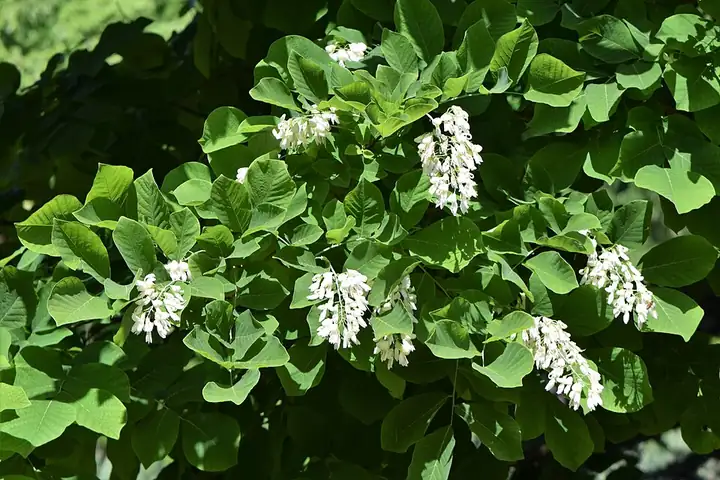
Yellowwood
American yellowwood (Cladrastis kentukea, formerly C. lutea) · Pea family (Fabaceae)
| Hardiness zones | 4 to 8 |
|---|---|
| Sun | full sun to part shade |
| Water | moderate |
| Life cycle | perennial |
| Frost | Hardy: takes frost |
About Yellowwood
Yellowwood is a medium-sized native shade tree with smooth gray, beech-like bark, bright green compound leaves that turn clear yellow in fall, and foot-long hanging clusters of fragrant white flowers in late spring that look like white wisteria. It is native in scattered spots from southern Indiana and southern Missouri south to North Carolina and eastern Oklahoma, centered on Kentucky, Tennessee and North Carolina, and is rare in the wild (wildflower.org, Morton Arboretum). It often blooms heavily only every two or three years, and its weak forks split in ice storms.
Hardy in zones 4-8 (NC State, Morton Arboretum).
When to plant
Timing is counted from your average last spring frost (and first fall frost). Sow & Tell works out the actual dates for your ZIP code.
Plant container or balled-and-burlapped trees; container trees can go in any time the ground can be worked, but fall is best in the South because roots keep growing through mild winters (Clemson). Dig no deeper than the root ball and at least twice as wide, set the top roots level with the soil, and mulch 2-4 inches deep without touching the trunk (Clemson). Its deep roots make it hard to transplant, so set out young trees (NC State, wildflower.org). Prune out weak, narrow forks while the tree is young (Morton Arboretum).
Soil
Moist, well-drained soil; it tolerates high pH, clay and road salt, and handles dry spells once established (Morton Arboretum, NC State).
Test the soil first. Loosen a wide planting area and mix 10-20 percent compost into the native soil you dig out; use only composted material, and don't dig deeper than the root ball (Clemson).
Feeding
- Spring to early summer, after the tree is established, and only if a soil test or weak growth shows a need: slow-release nitrogen fertilizer with a ratio near 3-1-1 or 3-1-2 (3-0-1 or 3-0-2 if the soil test shows enough phosphorus). Spread it evenly from just outside the trunk flare to the drip line and water it in. Clemson cites 2-4 lb of slow-release nitrogen per 1,000 sq ft per year, split between spring and late summer; follow your soil test.
- Late summer to early fall, the second half of the split feeding (only if a soil test calls for it): slow-release nitrogen fertilizer, same as spring. Water it in, and skip it if the tree is drought-stressed, since roots can't take up fertilizer from dry soil (Clemson).
First-year watering matters far more than fertilizer: water daily for the first 2 weeks, every 2-3 days through week 12, then weekly, using 1-1.5 gallons per inch of trunk diameter, until the tree is established (about 1.5 years for a 1-inch trunk). Skip a watering only after more than an inch of rain (UMN). Yellowwood is moderately sensitive to drought while young, so keep up the watering; don't prune in late winter or spring, when cuts bleed heavily (Morton Arboretum, NC State).
Harvest
Blooms in late spring (April-June) once the tree is mature, often heavily only every 2-3 years; flat pods follow in summer (NC State, wildflower.org, Morton Arboretum). Prune only in summer: cut in late winter or spring, it bleeds sap heavily (NC State, Morton Arboretum).
Varieties (1)
Only one cultivar is documented by NC State and the Morton Arboretum; it may be hard to find.
| Variety | Type | Days | Notes |
|---|---|---|---|
| Rosea (Perkins Pink) | American yellowwood (native) | Fragrant light pink flowers in hanging clusters 8-15 inches long; rounded crown about 20-25 ft tall. |
Diseases and problems
Verticillium wilt
In the kitchen
Safety: NC State gives no poison information, and we found no toxicity listing for yellowwood.
Pets: Not listed by the ASPCA.
Sources
- plants.ces.ncsu.edu
- wildflower.org
- mortonarb.org
- aspca.org
- aspca.org
- hgic.clemson.edu
- hgic.clemson.edu
- extension.umn.edu
Photo: Photo: Krzysztof Ziarnek, Kenraiz / Wikimedia Commons, CC BY-SA 4.0 (CC BY-SA 4.0). Photo resized for the web.

Planting dates and advice are general guidance; check with your local Cooperative Extension office for your area.