
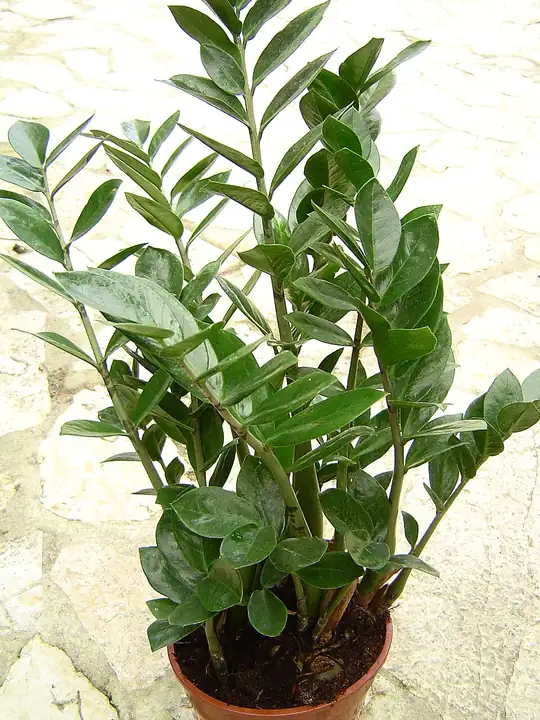
ZZ plant
Zamioculcas zamiifolia · Arum family (Araceae)
| Hardiness zones | 9 to 10 |
|---|---|
| Sun | shade |
| Water | low |
| Life cycle | perennial |
| Frost | Tender: killed by frost |
About ZZ plant
The ZZ plant is a slow, glossy, almost plastic-looking plant from East Africa, where it lives through heavy rains followed by long drought by storing water in a fat underground rhizome and thick leaf stalks (NC State, Illinois Extension). Its arching, pinnate leaves stay dark green in offices and dim corners that defeat most plants, and it asks for water only every couple of weeks. Treat it like a succulent and it will outlast your furniture.
Hardy outdoors only in zones 9-10 (NC State); it is grown indoors everywhere and can summer outdoors in shade once nights stay above 60 F.
When to plant
Timing is counted from your average last spring frost (and first fall frost). Sow & Tell works out the actual dates for your ZIP code.
Usually bought as a nursery plant; it can also be started from a division of the rhizome or, slowly, from a leaf cutting (Illinois Extension).
Growing it indoors
- Light: Tolerates very low light, even fluorescent office light, but direct afternoon sun scalds and browns the leaves (NC State, Iowa State).
- Water: Water thoroughly until it runs out the drainage holes, empty the saucer, and let the mix dry out completely before watering again, usually every 7-14 days in summer and only about once a month in fall and winter (Iowa State, NC State, Illinois Extension). The rhizome stores water, so constantly wet soil rots it.
- Humidity: Adapts to whatever humidity the room has (Illinois Extension).
- Temperature: Bring potted plants indoors once temperatures fall below 60 F (NC State); keep it away from cold drafts.
- Feeding: A light dose of balanced liquid fertilizer once or twice a month in spring and summer, applied with a watering (Iowa State, Illinois Extension); NC State says once or twice a year is enough. None in fall and winter.
- Repotting: No page we opened gives a schedule; follow MU Extension's general rule and repot in spring when the rhizomes and roots fill the pot, one size up, in fast-draining mix.
Soil
A well-drained potting or cactus mix in a pot with drainage holes; wet feet are not tolerated (NC State).
Pot in a well-drained potting or cactus mix in a container with drainage holes; treat it like a succulent (NC State).
Feeding
- Spring and summer, while new shoots are pushing: balanced liquid houseplant fertilizer, diluted. Once or twice a month with a watering (Iowa State, Illinois Extension); NC State says once or twice a year is plenty, so err on the light side.
- Fall and winter: none. Stop feeding and cut watering to about once a month (Illinois Extension, NC State).
It grows slowly by nature; extra fertilizer won't speed it up, and wet mix rots the rhizome (NC State, Illinois Extension).
Varieties (3)
NC State Extension names 3 cultivars.
| Variety | Type | Days | Notes |
|---|---|---|---|
| Raven (Dowon) | Dark-leaved | New growth is lime green and ages to dark purple-black. | |
| Chameleon | Golden new growth | Leaves emerge golden-yellow and turn dark green as they mature. | |
| Lucky | Round-leaved | Wide green leaflets with rounded tips. |
Pests to watch for
Scale insects, Mealybugs, Aphids, Thrips, Whiteflies
Diseases and problems
Root and crown rot
In the kitchen
Safety: The leaves contain calcium oxalate and cause vomiting and diarrhea if eaten in quantity (NC State, medium severity); the sap is not listed as a skin irritant, but wash your hands after handling it and keep it from small children.
Pets: The ASPCA lists ZZ plant (Zamioculcas spp.) among the insoluble calcium oxalate houseplants that are toxic to pets: the needle-like crystals in the leaves and stems cause mouth irritation and pain when chewed. NC State rates it medium toxicity to cats and dogs.
Sources
- plants.ces.ncsu.edu
- yardandgarden.extension.iastate.edu
- extension.illinois.edu
- extension.missouri.edu
- aspca.org
Photo: Photo: WeFt, CC BY-SA 3.0, via Wikimedia Commons (CC BY-SA 3.0). Photo resized for the web.

Planting dates and advice are general guidance; check with your local Cooperative Extension office for your area.