
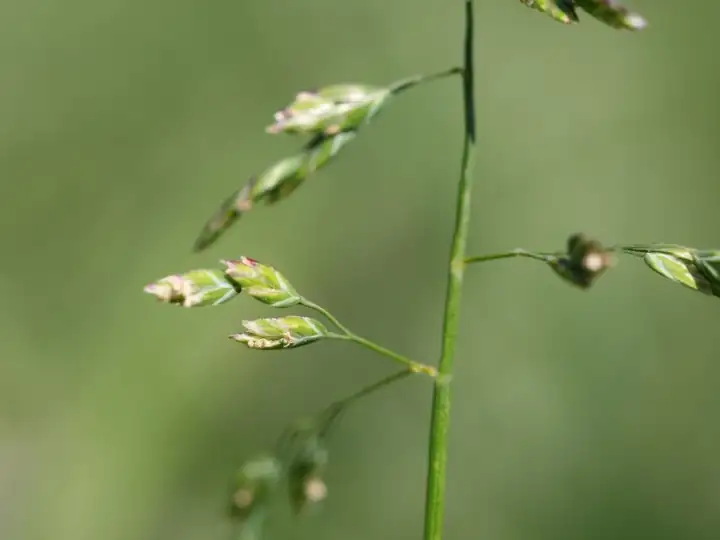
Annual bluegrass
Poa annua
| Type | Grass |
|---|---|
| Life cycle | Winter annual |
| Family | Grass family (Poaceae) |
| Origin | Introduced from elsewhere |
| Most common in | Northeast, Southeast, Midwest, Pacific Northwest, California |
About
A soft, light green grass that sprouts in fall and covers lawns with whitish seedheads in spring. When summer heat arrives it often thins and dies, leaving brown patches.
Also called Poa annua, poa
How to identify it
Look for
Low tufts 3 to 12 inches tall, lighter green than most lawn grasses. Leaf tips are boat-shaped with two clear lines along the midrib, leaves are often crinkled partway down, and the ligule is a pointed membrane. Small, whitish, triangular seedheads show up even on plants mowed very short.
Look-alikes
It is lighter green than Kentucky bluegrass and perennial ryegrass and flowers at mowing height. Rough bluegrass looks similar but forms light green patches that spread by creeping above-ground stems.
Where it grows
Short-mowed, overwatered, compacted, shady or poorly drained lawns, plus garden beds and vegetable plots.
When
Sprouts in late summer and fall as soil cools below 70 degrees F, grows through winter, seeds heavily in spring, and dies back in summer heat.
How it spreads
Spreads by seed; one plant can make over 360 seeds, and in mild coastal areas it can go through several generations a year.
Most common in
| Northeast | Very common here |
|---|---|
| Southeast | Very common here |
| South Central | Common here |
| Midwest | Very common here |
| Great Plains | Common here |
| Mountain West | Common here |
| Southwest | Common here |
| Pacific Northwest | Very common here |
| California | Very common here |
| Alaska | Common here |
| Hawaii | Occasional here |
What to do, gentlest first
Start at the top. Weed killers are a last step; always read and follow the label.
Mow higher and water deeply Prevent
Mow at the right height for your grass (3 inches or more for cool-season lawns), water deeply and less often, fix drainage and compaction, and feed cool-season lawns in fall. Bag clippings while it is seeding.
Pull small patches By hand
Hand-pull small infestations when the soil is moist so the roots come out.
Mulch beds Barrier
Keep about 3 inches of mulch on landscape beds to stop seedlings.
Late-summer pre-emergent Conventional spray
Apply a pre-emergent such as prodiamine or dithiopyr in late summer or early fall, when daytime highs drop to about 75 degrees F, and repeat 8 to 10 weeks later. It may take several years to thin a heavy stand. Alternate herbicide groups, because resistant annual bluegrass has appeared.
Read and follow the label. Many lawn herbicides kill garden plants, so keep spray and drift off beds and vegetables. Don't use a pre-emergent where you plan to overseed in fall.
Uses, wildlife and pets
Pets
Not listed as toxic to dogs, cats or horses by the ASPCA.
Sources
- ipm.ucanr.edu
- content.ces.ncsu.edu
- hgic.clemson.edu
- extension.purdue.edu
- hgic.clemson.edu
- plantsservices.sc.egov.usda.gov
- aspca.org
- aspca.org
- aspca.org
Photo: Photo: Kristian Peters / Wikimedia Commons, CC BY-SA 3.0 (CC BY-SA 3.0). Photo resized for the web.

Planting dates and advice are general guidance; check with your local Cooperative Extension office for your area.