
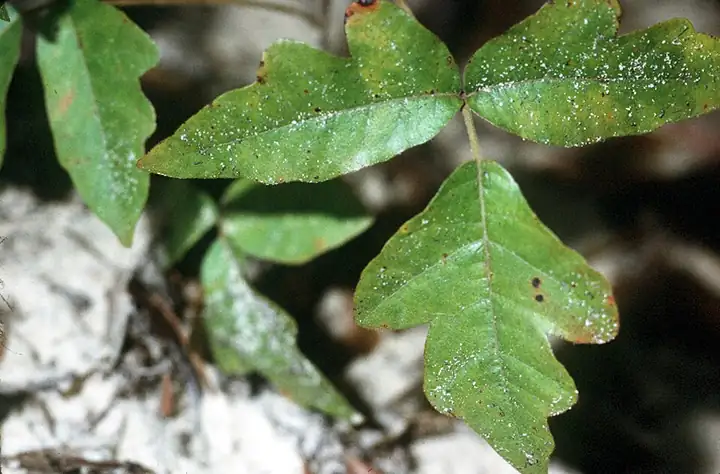
Atlantic poison oak
Toxicodendron pubescens
| Type | Shrub or tree |
|---|---|
| Life cycle | Perennial |
| Family | Sumac family (Anacardiaceae) |
| Origin | Native to the US |
| Most common in | Southeast |
About
A low native shrub of the Southeast with the same rash-causing oil as poison ivy. It hides in sandy pine and scrub-oak woods, where people brush against it without noticing.
Also called eastern poison oak, poison oak, Atlantic poison-oak
How to identify it
Look for
Leaves have three leaflets with rounded, oak-like lobes, and the stems and leaves are finely fuzzy. It grows as an upright, non-climbing shrub, usually 2 to 4 feet tall. Small yellow-green flowers appear in spring, followed by pale, tan-white berries.
Look-alikes
Poison ivy looks very similar but usually climbs or trails and has more pointed teeth, while Atlantic poison oak stays an upright, fuzzy shrub with rounded lobes. Fragrant sumac also has three lobed leaflets, but it bears red berries instead of pale ones.
Where it grows
Dry, sandy soils in pine and scrub-oak woods, thickets and woodland edges.
When
Flowers in spring (about March to June), and the pale berries ripen from late summer through fall.
How it spreads
Spreads by underground stems and by seeds that birds carry.
Most common in
| Northeast | Occasional here |
|---|---|
| Southeast | Very common here |
| South Central | Common here |
| Midwest | Occasional here |
| Great Plains | Occasional here |
| Mountain West | Not found here |
| Southwest | Not found here |
| Pacific Northwest | Not found here |
| California | Not found here |
| Alaska | Not found here |
| Hawaii | Not found here |
What to do, gentlest first
Protect yourself first. Weed killers are a last step; always read and follow the label.
Gear up before you weed Prevent
Wear gloves, long sleeves, long pants and eye protection, and learn the fuzzy, three-lobed leaf. Work on a still day, not a windy one.
Clean tools after every job; the oil stays active on surfaces for years.
Dig out small plants By hand
Dig up small plants with their roots, which is easiest in winter when there is less sap.
Bag it for the trash. Never burn, mow or string-trim it. Hire a professional for large patches.
Spot-treat with glyphosate or triclopyr Conventional spray
Spot-spray the leaves while the plant is actively growing. More than one treatment is usually needed.
Read and follow the label. Many lawn and brush herbicides also kill garden plants, so keep spray and drift off anything you want to keep.
Uses, wildlife and pets
For wildlife
Birds eat the berries, and deer eat the leaves and fruit.
Pets
Poison oak rarely bothers dogs, cats or horses, but pets can carry the oil on their fur to people. Bathe a pet that brushed through it while wearing gloves.
Sources
Photo: Photo: USDA NRCS PLANTS Database / Wikimedia Commons, Public domain. Photo resized for the web.

Planting dates and advice are general guidance; check with your local Cooperative Extension office for your area.