
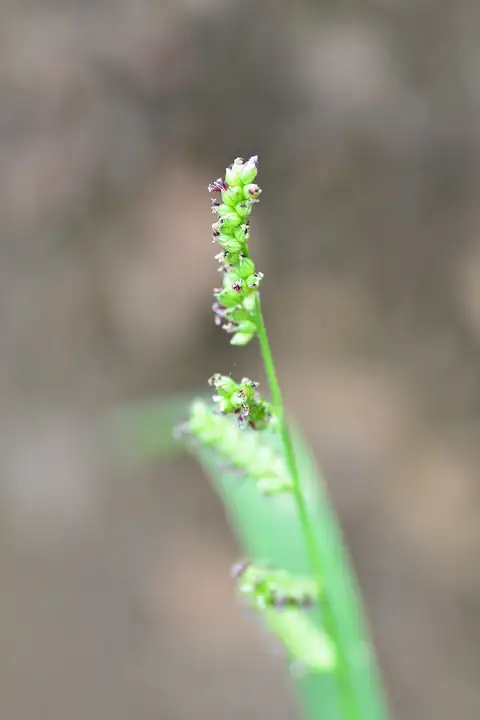
Barnyardgrass
Echinochloa crus-galli
| Type | Grass |
|---|---|
| Life cycle | Summer annual |
| Family | Grass family (Poaceae) |
| Origin | Introduced from elsewhere |
| Most common in | Midwest, California |
About
A big, coarse summer annual grass of wet, rich soil. It can reach 5 feet in gardens and ditches and mostly bothers new or thin lawns.
Also called barnyard grass, cockspur grass
How to identify it
Look for
There is no ligule or hair at the collar, which is the best clue among summer grasses. Stems are flattened near the base, which is often maroon, and the leaves are smooth. Seedheads are 2 1/2 to 10 inches long with dense, bristly branches.
Look-alikes
Junglerice is a close relative with purple bands across the leaves. Crabgrass and foxtails both have a ligule where blade meets stem.
Where it grows
Moist, disturbed ground: vegetable gardens, irrigated beds, ditches, pond edges and new lawns.
When
Sprouts from late winter or spring through summer, flowers from June to October, and dies at frost.
How it spreads
Spreads by seed, with large amounts packed into each seedhead.
Most common in
| Northeast | Common here |
|---|---|
| Southeast | Common here |
| South Central | Common here |
| Midwest | Very common here |
| Great Plains | Common here |
| Mountain West | Common here |
| Southwest | Common here |
| Pacific Northwest | Common here |
| California | Very common here |
| Alaska | Not found here |
| Hawaii | Occasional here |
What to do, gentlest first
Start at the top. Weed killers are a last step; always read and follow the label.
Keep lawns thick Prevent
Barnyardgrass mainly invades new or thin turf. Mow at least 2 inches high, water deeply but not often, and fertilize so grass stays dense.
Pull or hoe before it seeds By hand
Pull or hoe plants while small, and never let them flower and set seed.
Bag plants with seedheads instead of composting them.
Mulch garden beds Barrier
Mulch beds and vegetable rows to block seedlings, and watch for sprouts in planting holes of plastic mulch.
Corn gluten meal before seeds sprout Organic spray
Corn gluten meal is labeled to stop barnyardgrass seeds from sprouting. Spread it in early spring and water it in lightly.
Don't use it where you plan to sow seed.
Spring pre-emergent; quinclorac in lawns Conventional spray
A spring pre-emergent such as prodiamine or pendimethalin stops seedlings in lawns, and quinclorac treats young plants.
Read and follow the label. Many lawn herbicides kill garden plants, so keep spray and drift off beds and vegetables.
Uses, wildlife and pets
Pets
Not listed as toxic to dogs, cats or horses by the ASPCA.
Sources
- ipm.ucanr.edu
- extension.umn.edu
- extension.psu.edu
- extension.umn.edu
- yardandgarden.extension.iastate.edu
- plantsservices.sc.egov.usda.gov
- aspca.org
- aspca.org
- aspca.org
Photo: Photo: JustineToul / Wikimedia Commons, CC BY-SA 4.0 (CC BY-SA 4.0). Photo resized for the web.

Planting dates and advice are general guidance; check with your local Cooperative Extension office for your area.