
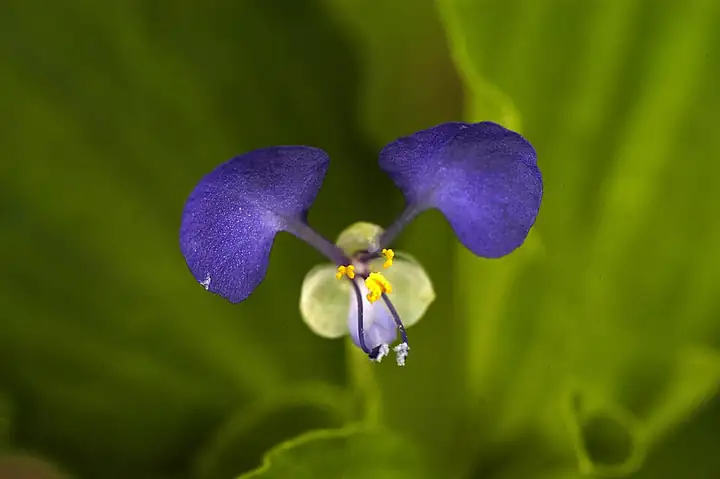
Benghal dayflower
Commelina benghalensis
| Type | Broadleaf |
|---|---|
| Life cycle | Annual |
| Family | Spiderwort family (Commelinaceae) |
| Origin | Introduced from elsewhere |
About
Benghal dayflower, also called tropical spiderwort, is a federal noxious weed from Africa and tropical Asia that smothers Southern crop fields and gardens. It even flowers and sets seed underground, so report it and keep it from spreading.
Also called tropical spiderwort, Bengal dayflower
How to identify it
Look for
Leaves are broad, about 2 inches long and nearly as wide, with short hairs and longer reddish hairs on the leaf sheath. Small flowers have two larger purple-blue petals and sit in folded leafy cups. Dig a plant: underground runners carry tiny white flowers and seeds.
Look-alikes
Native Virginia dayflower also has red hairs and underground stems, but its petals are blue and its leaves are longer for their width; Benghal dayflower has broader leaves with short hairs on top.
Where it grows
Moist, rich soil in gardens, crop fields, ditch banks, roadsides and pastures.
When
It sprouts over a long stretch of the warm season and flowers from spring through fall.
How it spreads
One plant can make about 1,600 seeds above and below ground, and stem pieces root at the joints; hoeing or light tilling can break it up and spread it.
Most common in
| Northeast | Not found here |
|---|---|
| Southeast | Common here |
| South Central | Occasional here |
| Midwest | Not found here |
| Great Plains | Not found here |
| Mountain West | Not found here |
| Southwest | Not found here |
| Pacific Northwest | Not found here |
| California | Occasional here |
| Alaska | Not found here |
| Hawaii | Occasional here |
Where it is regulated
It is a federal noxious weed, and Alabama, Florida, Mississippi and North Carolina list it as a state noxious weed.
What to do, gentlest first
Start at the top. Weed killers are a last step; always read and follow the label.
Report it and keep it contained Prevent
Report suspected plants to your county Extension office or EDDMapS. Clean tools and equipment, and check potted plants from infested areas.
It's illegal to move it across state lines.
Pull small patches and bag everything By hand
Hand-remove small infestations, digging out the underground runners, flowers and seeds too. Bag and trash plants.
Don't hoe or lightly till: broken stems reroot. Don't compost it.
Pre-emergent plus spot sprays Conventional spray
Mississippi State lists S-metolachlor as a long-lasting pre-emergent and glyphosate or 2,4-D after it comes up. Ask Extension for help with larger patches.
Read and follow the label. Many lawn weed killers also kill garden plants, so keep spray and drift off beds and vegetables.
Uses, wildlife and pets
Pets
Not listed by the ASPCA.
Sources
- ecfr.gov
- gri.msstate.edu
- invasive-species.extension.org
- journals.flvc.org
- plantsservices.sc.egov.usda.gov
- aspca.org
Photo: Photo: Herb Pilcher, USDA ARS / Wikimedia Commons, Public domain. Photo resized for the web.

Planting dates and advice are general guidance; check with your local Cooperative Extension office for your area.