
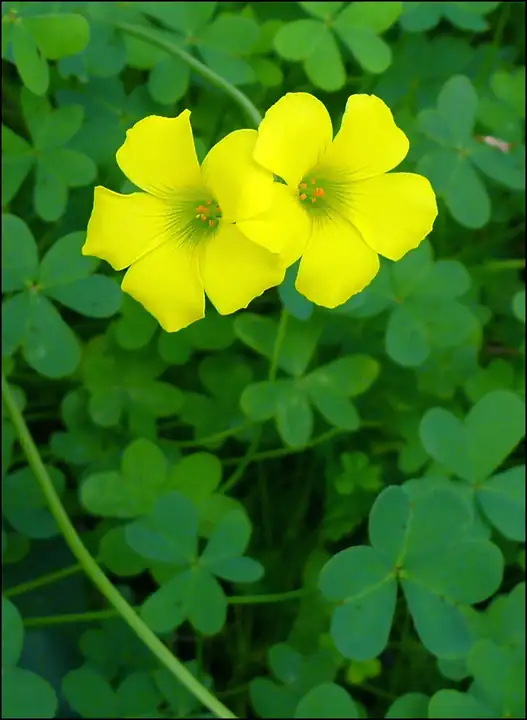
Bermuda buttercup
Oxalis pes-caprae
| Type | Broadleaf |
|---|---|
| Life cycle | Perennial |
| Family | Woodsorrel family (Oxalidaceae) |
| Origin | Introduced from elsewhere |
| Most common in | California |
About
Bermuda buttercup is a South African oxalis that fills coastal California gardens with clover-like leaves and bright yellow flowers each winter. It grows from small bulbs that survive pulling and most sprays, so beating it takes years of steady work.
Also called buttercup oxalis, Bermuda buttercup oxalis
How to identify it
Look for
It grows in a loose rosette up to about 14 inches tall. Leaves have three heart-shaped leaflets, often with purple or brown spots. Clusters of bright yellow, five-petaled flowers, 3/4 to 1 1/2 inches wide, sit on leafless stalks; underground are small bulbs.
Look-alikes
Creeping woodsorrel is a smaller, less showy oxalis that creeps along the ground. Clovers and bur clover have pea-like flowers, not five open petals.
Where it grows
Home landscapes, groundcovers, field-grown flowers and disturbed areas, in full sun near the coast and part shade inland; it's rarely a problem in mowed lawns.
When
Bulbs sprout in fall, plants flower from late winter into spring, and the tops die back to dormant bulbs in late spring and summer.
How it spreads
By bulbs and bulblets (about a dozen new ones per plant each year) moved in soil, plant divisions and yard waste; it isn't known to set viable seed in California.
Most common in
| Northeast | Not found here |
|---|---|
| Southeast | Not found here |
| South Central | Not found here |
| Midwest | Not found here |
| Great Plains | Not found here |
| Mountain West | Not found here |
| Southwest | Not found here |
| Pacific Northwest | Not found here |
| California | Very common here |
| Alaska | Not found here |
| Hawaii | Not found here |
What to do, gentlest first
Start at the top. Weed killers are a last step; always read and follow the label.
Don't move infested soil Prevent
Don't share plant divisions or soil from infested beds, and don't compost plants with bulbs. UC IPM calls prevention the best control.
Dig out bulbs, or pull tops again and again By hand
Dig when the soil is moist and sift out every bulb and bulblet. Pulling or mowing the tops before flowering, over and over, slowly starves the bulbs.
It takes several years; bulbs left behind regrow.
Smother with cardboard and mulch, or solarize Barrier
Cover patches with stiff cardboard topped with thick organic mulch until it rots, then plant. Before planting, solarizing moist soil under clear plastic for at least 4 weeks in summer also helps.
Spot-spray actively growing plants Conventional spray
Glyphosate, glufosinate or triclopyr kill the tops while it grows in winter and early spring.
Read and follow the label. Many lawn weed killers also kill garden plants, so keep spray and drift off beds and vegetables. These don't kill the bulbs, so expect regrowth and repeat.
Uses, wildlife and pets
Pets
Toxic to dogs, cats and horses (ASPCA, listed as Oxalis species). It contains soluble oxalates that can cause drooling and tremors, and rarely kidney failure.
Sources
Photo: Photo: MathKnight and Zachi Evenor / Wikimedia Commons, CC BY-SA 4.0 (CC BY-SA 4.0). Photo resized for the web.

Planting dates and advice are general guidance; check with your local Cooperative Extension office for your area.