
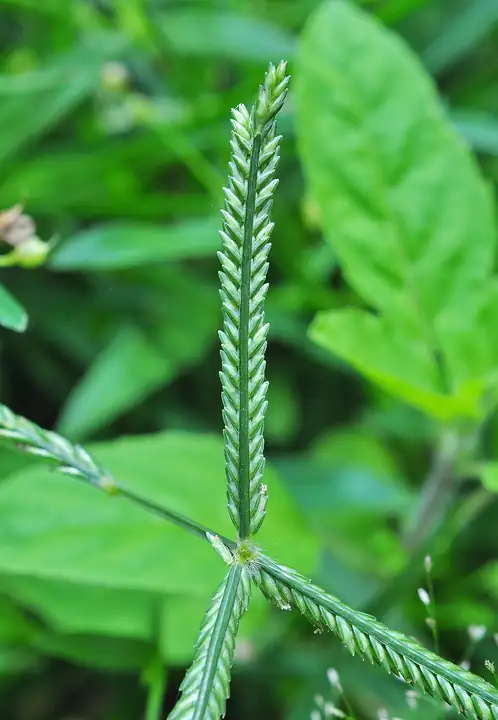
Bermudagrass
Cynodon dactylon
| Type | Grass |
|---|---|
| Life cycle | Perennial |
| Family | Grass family (Poaceae) |
| Origin | Introduced from elsewhere |
| Most common in | Southeast, South Central, Southwest, California, Hawaii |
About
A warm-season perennial grass that is a popular lawn grass in the South but a tough weed in flower beds, vegetable gardens and northern or cool-season lawns. It creeps above and below ground, and in cooler lawns it turns brown and dormant each fall.
Also called bermuda grass, manienie
How to identify it
Look for
Fine, gray-green, wiry blades with a ring of white hairs where the blade meets the stem. It runs along the ground on stolons and spreads underground by rhizomes. Seedheads are 3 to 7 finger-like spikes that fan out from one point.
Look-alikes
Crabgrass has similar seedheads, but its spikes come from different points and it dies at frost. Nimblewill is also wiry and browns in winter, but it has a tiny membrane ligule instead of a ring of hairs.
Where it grows
Southern lawns (on purpose), and as a weed in beds, borders, vegetable gardens, cool-season lawns, roadsides and orchards.
When
Greens up in late spring, grows fast through summer heat, and goes brown and dormant after frost.
How it spreads
Spreads by stolons, by rhizomes usually 1 to 6 inches deep (deeper in sandy soil), and by seed that lasts several years; cut pieces left on moist soil can root.
Most common in
| Northeast | Occasional here |
|---|---|
| Southeast | Very common here |
| South Central | Very common here |
| Midwest | Common here |
| Great Plains | Common here |
| Mountain West | Occasional here |
| Southwest | Very common here |
| Pacific Northwest | Occasional here |
| California | Very common here |
| Alaska | Not found here |
| Hawaii | Very common here |
What to do, gentlest first
Start at the top. Weed killers are a last step; always read and follow the label.
Dig it out when soil is dry By hand
Dig out plants with every runner and rhizome you can find. Work when soil is dry, and rake up the pieces.
Don't till wet soil; it chops stems into bits that root. Short shrubs or ground covers won't shade it out.
Smother or solarize Barrier
Cover patches with black plastic for at least 6 to 8 weeks in summer, or solarize with clear plastic for 4 to 6 weeks in the sunniest months. Overlapped landscape fabric can keep runners out of beds.
Solarizing in cool spring weather can actually help it grow.
Grass-selective spray in beds, glyphosate for spots Conventional spray
In beds of flowers and shrubs, fluazifop or sethoxydim kill bermudagrass without hurting most broadleaf plants; spray again before regrowth reaches 6 inches. Glyphosate works best in late summer on green, growing plants; wait 7 days before digging or mowing.
Read and follow the label. Many lawn herbicides kill garden plants, so keep spray and drift off beds and vegetables.
Uses, wildlife and pets
For wildlife
A caterpillar host plant for the southern skipperling butterfly.
Pets
Not listed as toxic to dogs, cats or horses by the ASPCA. NC State Extension notes it can be toxic to livestock.
Sources
- ipm.ucanr.edu
- plants.ces.ncsu.edu
- content.ces.ncsu.edu
- plantsservices.sc.egov.usda.gov
- aspca.org
- aspca.org
- aspca.org
Photo: Photo: Joydeep / Wikimedia Commons, CC BY-SA 3.0 (CC BY-SA 3.0). Photo resized for the web.

Planting dates and advice are general guidance; check with your local Cooperative Extension office for your area.