
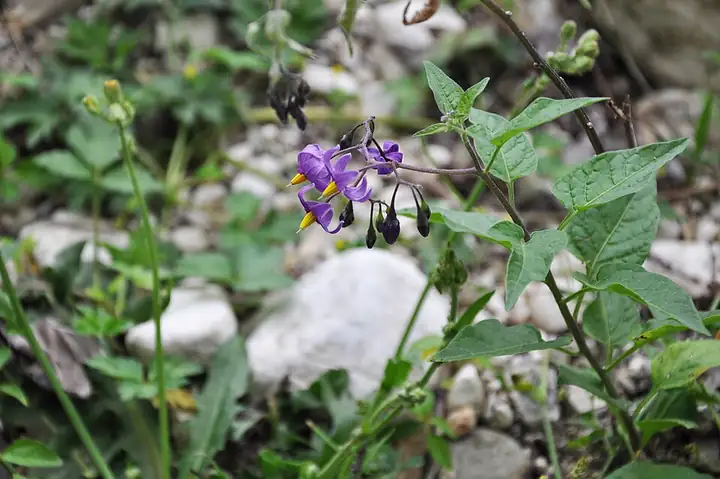
Bittersweet nightshade
Solanum dulcamara
| Type | Vine |
|---|---|
| Life cycle | Perennial |
| Family | Nightshade family (Solanaceae) |
| Origin | Introduced from elsewhere |
| Most common in | Northeast, Midwest, Pacific Northwest |
About
A scrambling, semi-woody vine from Europe and Asia that climbs through shrubs, hedges, fences and trees, up to 30 feet. Its bright red berries are poisonous to people, pets and livestock, which makes it worth removing where children play.
Also called climbing nightshade, bitter nightshade, woody nightshade, European bittersweet, bittersweet
How to identify it
Look for
Leaves are dark green, sometimes purple-tinged, and many have one or two small ear-like lobes at the base. Star-shaped purple flowers have petals that bend back and a yellow cone in the center, and the berries turn from green to orange to shiny red, often with all colors on one plant. The base is woody, while the upper branches die back each year.
Look-alikes
Black nightshade and silverleaf nightshade are related weeds that can be mistaken for it. Take photos and get an ID if you're unsure, and treat all nightshade berries as unsafe to eat.
Where it grows
Hedges, fence lines, thickets, tree trunks and garden borders, as single plants or dense patches.
When
Flowers from about May to September, with berries from July to October, so flowers and fruit show up together.
How it spreads
Birds spread the seeds, and stems root at the nodes and from pieces left on moist soil; it also spreads by rhizomes.
Most common in
| Northeast | Very common here |
|---|---|
| Southeast | Occasional here |
| South Central | Occasional here |
| Midwest | Very common here |
| Great Plains | Occasional here |
| Mountain West | Occasional here |
| Southwest | Occasional here |
| Pacific Northwest | Very common here |
| California | Occasional here |
| Alaska | Not found here |
| Hawaii | Not found here |
What to do, gentlest first
Protect yourself first. Weed killers are a last step; always read and follow the label.
Pull it before berries ripen Prevent
Remove plants early in the season so birds can't spread the seeds, and check damp hedges and fences each year.
Hand-pull and dig small patches By hand
Pull or dig small patches (under about 200 square feet), getting as much root as you can.
Put root balls and berry-bearing stems in the trash. Don't leave stems on moist soil, where they can re-root.
Cut, then smother Barrier
For bigger patches, cut the vines back and cover the area with a thick layer of mulch or landscape fabric.
Spot-spray the leaves Conventional spray
Spray the foliage with a herbicide labeled for it; near lawns, a broadleaf-selective product spares the grass.
Read and follow the label. Many lawn and brush killers also harm garden plants, so keep spray and drift off anything you want to keep. Don't spray near water unless you use a product approved for aquatic sites.
Uses, wildlife and pets
For wildlife
Birds and mammals eat the berries, and bumblebees pollinate the flowers.
Pets
Toxic to dogs, cats and horses (ASPCA lists it as climbing nightshade or European bittersweet, Solanum dulcamara).
Sources
Photo: Photo: Lazaregagnidze / Wikimedia Commons, CC BY-SA 3.0 (CC BY-SA 3.0). Photo resized for the web.

Planting dates and advice are general guidance; check with your local Cooperative Extension office for your area.