
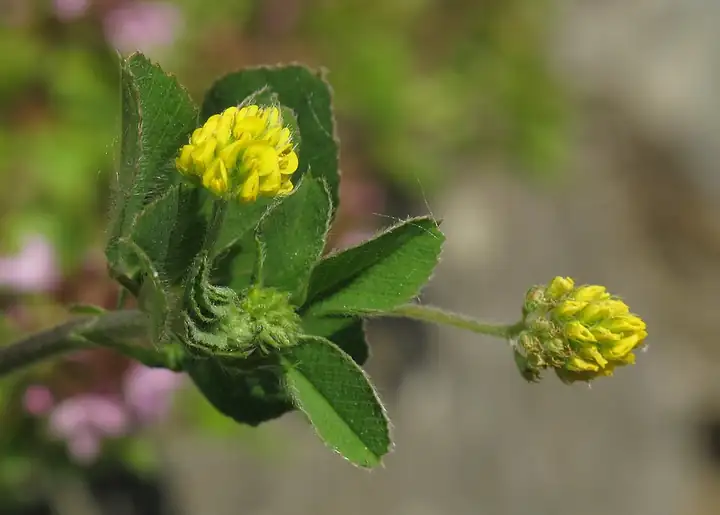
Black Medic
Medicago lupulina
| Type | Broadleaf |
|---|---|
| Life cycle | Annual |
| Family | Pea family (Fabaceae) |
| Origin | Introduced from elsewhere |
| Most common in | Midwest |
About
Black medic is a low, clover-like plant with small yellow flower clusters that spreads over thin, poorly fed lawns. It is usually noticed once it blooms, and the seed pods turn black when ripe.
Also called black medick, nonesuch
How to identify it
Look for
Leaves have three small, egg-shaped, finely toothed leaflets. Stems are hairy, branch from the base and trail along the ground. Tiny yellow pea-like flowers form small round heads that ripen into clusters of black, one-seeded pods.
Look-alikes
White clover has white flowers and hairless leaves; yellow woodsorrel has heart-shaped leaflets; California burclover is similar but nearly hairless.
Where it grows
Thin lawns low in nitrogen, gardens, roadsides, pastures and fields.
When
Seeds sprout mainly in fall, and it acts as a summer or winter annual; it flowers from about April to July.
How it spreads
By seed only; the hard-coated seeds can sprout over many years.
Most common in
| Northeast | Common here |
|---|---|
| Southeast | Common here |
| South Central | Common here |
| Midwest | Very common here |
| Great Plains | Common here |
| Mountain West | Common here |
| Southwest | Occasional here |
| Pacific Northwest | Common here |
| California | Common here |
| Alaska | Occasional here |
| Hawaii | Occasional here |
What to do, gentlest first
Start at the top. Weed killers are a last step; always read and follow the label.
Feed the lawn Prevent
Black medic thrives where nitrogen is low; fertilizing properly and keeping turf dense helps grass crowd it out.
Pull before the pods form By hand
Pull or dig plants when the soil is moist, before the black seed pods ripen.
Thick mulch in beds Barrier
In beds, about 4 inches of organic mulch keeps seedlings from coming up; renew it yearly.
Vinegar on seedlings Organic spray
Horticultural vinegar can kill young seedlings.
Strong vinegar (over about 11% acetic acid) can burn skin and eyes, so wear gloves and eye protection. It browns any leaves it touches, grass included.
Broadleaf lawn herbicide Conventional spray
Spot-treat actively growing plants with a lawn product containing 2,4-D, MCPP (mecoprop), dicamba or triclopyr.
Read and follow the label. Many lawn weed killers also harm vegetables, flowers and shrubs, so don't let spray drift into beds, and keep dicamba products off the root zones of trees and shrubs.
Uses, wildlife and pets
Pets
Not listed by the ASPCA.
Sources
- extension.umd.edu
- ipm.ucanr.edu
- ipm.ucanr.edu
- ipm.ucanr.edu
- extension.umd.edu
- plantsservices.sc.egov.usda.gov
Photo: Photo: Robert Flogaus-Faust / Wikimedia Commons, CC BY 4.0 (CC BY 4.0). Photo resized for the web.

Planting dates and advice are general guidance; check with your local Cooperative Extension office for your area.