
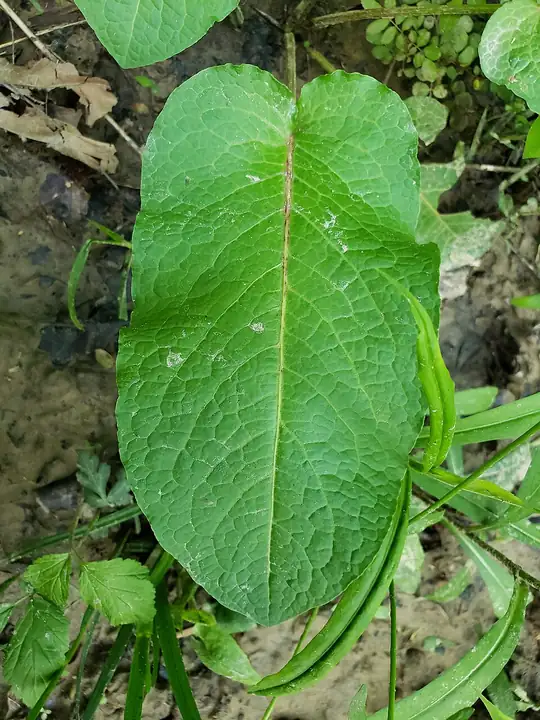
Broadleaf dock
Rumex obtusifolius
| Type | Broadleaf |
|---|---|
| Life cycle | Perennial |
| Family | Buckwheat family (Polygonaceae) |
| Origin | Introduced from elsewhere |
| Most common in | Northeast, Pacific Northwest |
About
Broadleaf dock is a big-leaved, taprooted perennial related to curly dock. It handles frequent mowing well, so it hangs on in lawns, pastures and field edges.
Also called bitter dock, broad-leaved dock
How to identify it
Look for
Leaves are large (up to about 12 inches long and 6 inches wide), flat and broad with a heart-shaped base and short white hairs under the leaf stalks and veins. Flower stalks reach 3 to 4 feet, and the seed wings have small spiny teeth. The taproot is thick and usually branched.
Look-alikes
Curly dock has narrower, strongly wavy leaves that taper at the base and seed wings without teeth.
Where it grows
Lawns, pastures, meadows, ditch banks and damp waste areas on most soils; most common east of the Mississippi and in the Pacific Northwest.
When
Rosettes grow in cool weather; plants seldom flower their first season and bloom from late spring into summer after that.
How it spreads
By seed (about 100 to over 60,000 per plant, lasting 40 years or more in soil) and by regrowth from the crown and branched taproot.
Most common in
| Northeast | Very common here |
|---|---|
| Southeast | Common here |
| South Central | Occasional here |
| Midwest | Common here |
| Great Plains | Occasional here |
| Mountain West | Occasional here |
| Southwest | Occasional here |
| Pacific Northwest | Very common here |
| California | Occasional here |
| Alaska | Occasional here |
| Hawaii | Occasional here |
What to do, gentlest first
Start at the top. Weed killers are a last step; always read and follow the label.
Keep lawns dense Prevent
Healthy, well-fed turf leaves little room for dock seedlings. Don't let seed stalks ripen.
Dig out crowns By hand
Dig when the soil is moist, taking the crown and upper root. Cutting plants back often (weekly for a few months) also drains the root.
Replant or mulch the hole so new seedlings don't fill it.
Broadleaf lawn herbicide or spot spray Conventional spray
In lawns use a 2,4-D product; in beds and bare ground, spot-treat leaves with glyphosate.
Read and follow the label; many lawn and brush herbicides also kill garden plants.
Uses, wildlife and pets
Pets
Toxic to dogs, cats and horses (ASPCA lists dock and sorrel, Rumex, as toxic); livestock can be poisoned if they eat a lot of it.
Sources
Photo: Photo: HoosierMan1816 / Wikimedia Commons, Public domain. Photo resized for the web.

Planting dates and advice are general guidance; check with your local Cooperative Extension office for your area.