
Buckhorn Plantain
Plantago lanceolata
| Type | Broadleaf |
|---|---|
| Life cycle | Perennial |
| Family | Plantain family (Plantaginaceae) |
| Origin | Introduced from elsewhere |
| Most common in | Northeast, Southeast, Midwest, Pacific Northwest |
About
Buckhorn plantain is a clump of long, narrow, ribbed leaves with flower spikes on tall, wiry stalks. It is very common in poorly kept lawns and survives mowing.
Also called narrowleaf plantain, English plantain, ribwort plantain, ribgrass, lanceleaf plantain
How to identify it
Look for
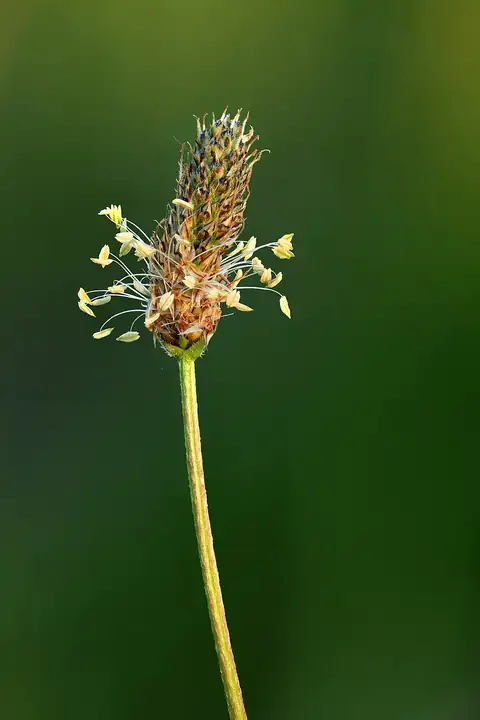
Leaves are lance-shaped, under an inch wide and often 6 inches or more long, with a few strong parallel veins and sometimes curled edges. Short, dense flower spikes sit on top of long, hairy, leafless stalks that stand above the leaves. The root is a short taproot with many fibrous roots.
Look-alikes
Broadleaf plantain has the same ribbed leaves but they are broad and oval, and its flower spikes are long and slim.
Where it grows
Thin, poorly kept lawns, compacted or overwatered spots, pastures and roadsides.
When
Seeds sprout from late spring to midsummer; flower stalks show up from about June to September.
How it spreads
By seed only; each capsule holds a couple of small dark seeds.
Most common in
| Northeast | Very common here |
|---|---|
| Southeast | Very common here |
| South Central | Common here |
| Midwest | Very common here |
| Great Plains | Common here |
| Mountain West | Common here |
| Southwest | Occasional here |
| Pacific Northwest | Very common here |
| California | Common here |
| Alaska | Occasional here |
| Hawaii | Occasional here |
Where it is regulated
Listed as a restricted noxious weed seed (a limit in seed for sale) in many states, including Alabama, Arkansas, Colorado, Delaware, Florida, Georgia, Idaho, Illinois, Indiana, Iowa and Kansas.
What to do, gentlest first
Start at the top. Weed killers are a last step; always read and follow the label.
Keep the lawn thick Prevent
Fertilize, water and mow correctly with a grass suited to your site so there are no thin spots for seeds to fill.
Dig before it seeds By hand
Pull or dig plants when the soil is moist, taking the crown and root, before the flower heads ripen.
Mulch beds Barrier
Keep 2 to 3 inches of mulch in garden beds.
Vinegar on young plants Organic spray
Horticultural vinegar kills small seedlings; established clumps usually regrow.
Strong vinegar (over about 11% acetic acid) can burn skin and eyes, so wear gloves and eye protection. It browns any leaves it touches, grass included.
Broadleaf lawn herbicide in fall Conventional spray
Spot-treat with a lawn broadleaf weed killer labeled for plantain; mid-fall is the best time. Sulfentrazone is another option in lawns.
Read and follow the label. Many lawn weed killers also harm vegetables, flowers and shrubs, so don't let spray drift into beds, and keep dicamba products off the root zones of trees and shrubs.
Uses, wildlife and pets
Edible?
NC State lists the leaves as edible. Pick only from unsprayed ground away from roads.
Not 100% sure? Don't eat it. Never pick from ground that may have been sprayed, or along roads and railways.
For wildlife
Its flowers are pollinated by wind, flies and beetles, and bumblebees visit them.
Pets
Not listed by the ASPCA.
Sources
- turffiles.ncsu.edu
- hgic.clemson.edu
- plants.ces.ncsu.edu
- ipm.ucanr.edu
- extension.umd.edu
- ams.usda.gov
- npgsweb.ars-grin.gov
- plantsservices.sc.egov.usda.gov
Photo: Photo: Ivar Leidus / Wikimedia Commons, CC BY-SA 4.0 (CC BY-SA 4.0). Photo resized for the web.

Planting dates and advice are general guidance; check with your local Cooperative Extension office for your area.