
Buffalobur
Solanum rostratum
| Type | Broadleaf |
|---|---|
| Life cycle | Summer annual |
| Family | Nightshade family (Solanaceae) |
| Origin | Native to the US |
| Most common in | South Central, Great Plains, Mountain West, Southwest |
About
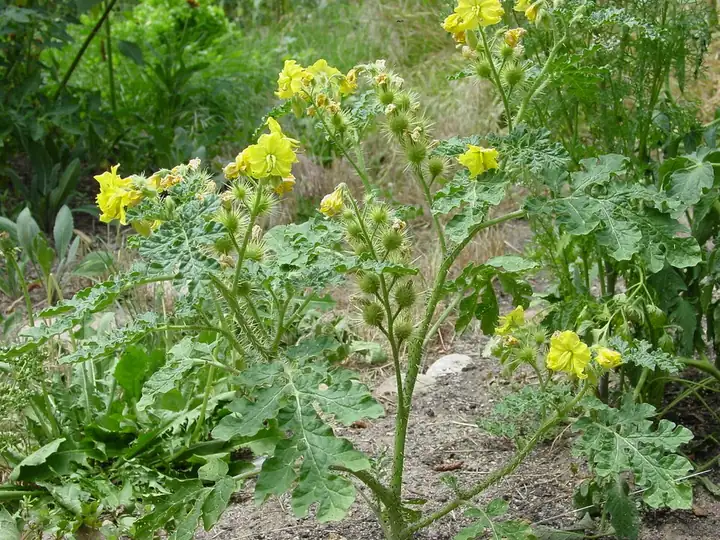
A very spiny annual nightshade with bright yellow star flowers and berries sealed inside spiny burs. Native to the western plains, it has become an aggressive weed across much of the country, and its foliage and green berries poison livestock.
Also called buffalo-bur, buffalobur nightshade, spiny nightshade, Colorado bur
How to identify it
Look for
Bushy plants 1/2-3 feet tall are covered almost everywhere with straight yellow spines up to about 1/2 inch long. Leaves are 2-6 inches and deeply cut into 5-7 rounded lobes, prickly on the veins. Yellow flowers about 1 inch across grow in clusters, and each berry is wrapped tightly in a spiny husk.
Look-alikes
Horsenettle is also prickly but has white to violet flowers, shallower lobes and smooth, uncovered yellow berries. Buffalobur seedlings have a clear central vein under the seed leaves and deeply round-lobed young leaves.
Where it grows
Overgrazed pastures, barnyards, fencerows, yards, gardens, roadsides and waste areas, especially in sandy, dry soil.
When
Grows through the warm season and blooms all summer, with spiny burs forming as the flowers fade.
How it spreads
By seed from the spiny burs, which also catch in wool and fur.
Most common in
| Northeast | Occasional here |
|---|---|
| Southeast | Occasional here |
| South Central | Very common here |
| Midwest | Common here |
| Great Plains | Very common here |
| Mountain West | Very common here |
| Southwest | Very common here |
| Pacific Northwest | Occasional here |
| California | Occasional here |
| Alaska | Not found here |
| Hawaii | Not found here |
Where it is regulated
Washington lists buffalobur as a Class C noxious weed and Oregon as a Class B noxious weed; Idaho prohibits it as a noxious weed seed.
What to do, gentlest first
Protect yourself first. Weed killers are a last step; always read and follow the label.
Mow before it blooms Prevent
Mowing close and often, before flowers open, stops seed production and works very well.
Hoe or pull before flowering By hand
Hoeing or rototilling young plants eliminates them. Pull or hoe out plants before the first flowers appear.
Wear thick gloves.
Treat seedlings before bloom Conventional spray
Glyphosate works in landscape beds and bare ground, and a 2,4-D, MCPP and dicamba mix works in lawns; spray young plants before they flower.
Read and follow the label. Many lawn weed killers also kill vegetables and flowers, and glyphosate harms any plant it touches.
Uses, wildlife and pets
Pets
Nightshades (Solanum species) are listed by the ASPCA as toxic to dogs, cats and horses; signs include drooling, severe stomach upset, diarrhea, drowsiness, weakness, dilated pupils and a slow heart rate. Sheep, goats, calves, pigs, chickens and ducks can be poisoned, mostly while green berries are on the plant, and the burs lower the value of wool.
Sources
- hortsense.cahnrs.wsu.edu
- nwcb.wa.gov
- nrcs.usda.gov
- cals.cornell.edu
- plantsservices.sc.egov.usda.gov
- aspca.org
- poison.org
- poison.org
- ams.usda.gov
Photo: Photo: leighannemcc / Wikimedia Commons, CC BY-SA 2.0 (CC BY-SA 2.0). Photo resized for the web.

Planting dates and advice are general guidance; check with your local Cooperative Extension office for your area.