
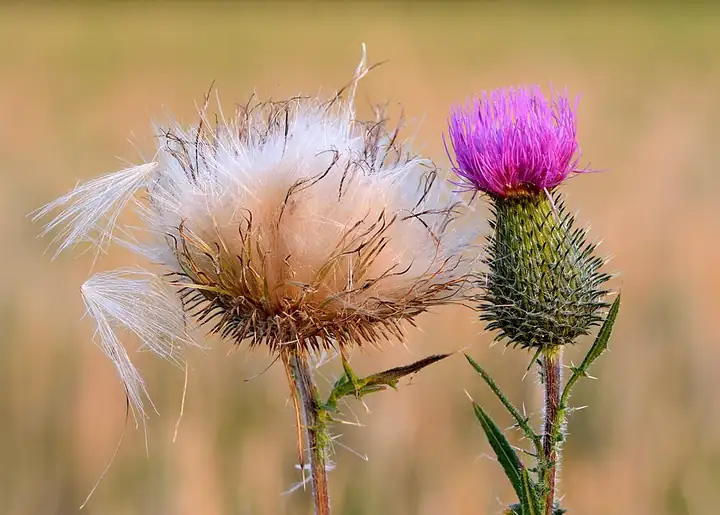
Bull thistle
Cirsium vulgare
| Type | Broadleaf |
|---|---|
| Life cycle | Biennial |
| Family | Aster family (Asteraceae) |
| Origin | Introduced from elsewhere |
| Most common in | Pacific Northwest |
About
Bull thistle is a very spiny biennial thistle from Europe, Asia and North Africa. It spreads only by seed, so cutting it out before it blooms keeps it under control.
Also called spear thistle
How to identify it
Look for
The first year it makes a flat rosette of deeply lobed leaves with a spine at each lobe tip, rough and prickly on top and white-woolly underneath. The second year it bolts to 3 to 7 feet with spiny wings running down the stems and purple flower heads 1.5 to 2 inches across.
Look-alikes
Musk thistle has larger nodding heads with broad, spine-tipped bracts; Canada thistle has small clustered flowers, few stem spines and spreads in patches from roots.
Where it grows
Pastures, roadsides, ditch banks, hayfields, logged areas and neglected corners of yards and gardens.
When
Seeds sprout in spring or fall and form rosettes; plants flower in their second summer (about July to September), set seed and die.
How it spreads
By wind-blown seed only (up to 10,000 per plant, some lasting up to nine years); it does not spread by roots.
Most common in
| Northeast | Common here |
|---|---|
| Southeast | Common here |
| South Central | Common here |
| Midwest | Common here |
| Great Plains | Common here |
| Mountain West | Common here |
| Southwest | Occasional here |
| Pacific Northwest | Very common here |
| California | Common here |
| Alaska | Occasional here |
| Hawaii | Occasional here |
Where it is regulated
Listed as a noxious weed in Colorado (List B) and Washington (Class C).
What to do, gentlest first
Start at the top. Weed killers are a last step; always read and follow the label.
Never let it seed Prevent
Keep lawns and pastures thick, and remove plants before they flower so the seed bank runs out.
Cut below the crown By hand
With a spade or hoe, cut the rosette off just below the soil line, ideally the first year or before it bolts. If plants are already flowering, cut them and bag the heads.
Wear heavy gloves; don't compost flowering heads, which can still ripen seed.
Seed-head gall fly Natural enemies
A gall fly (Urophora stylata) that feeds in the flower heads can cut seed production by up to 60 percent in larger infestations.
Treat rosettes before bolting Conventional spray
Spot-spray rosettes in fall or early spring with a broadleaf herbicide such as 2,4-D; treat before the stems bolt.
Read and follow the label; many lawn and brush herbicides also kill garden plants.
Uses, wildlife and pets
Pets
Not listed by the ASPCA.
Sources
Photo: Photo: Ivar Leidus / Wikimedia Commons, CC BY-SA 4.0 (CC BY-SA 4.0). Photo resized for the web.

Planting dates and advice are general guidance; check with your local Cooperative Extension office for your area.