
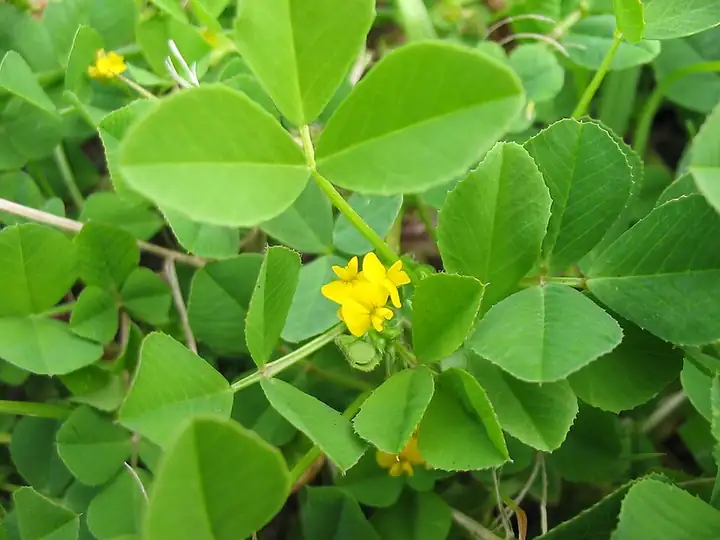
Bur clover
Medicago polymorpha
| Type | Broadleaf |
|---|---|
| Life cycle | Winter annual |
| Family | Pea family (Fabaceae) |
| Origin | Introduced from elsewhere |
| Most common in | California |
About
Bur clover is a Mediterranean clover relative that sprawls through lawns in mild-winter areas. It feeds the soil with nitrogen, but its spiny burs stick to bare feet, clothes and pets.
Also called burclover, California burclover, bur medic, toothed burclover, toothed medick
How to identify it
Look for
Trailing stems spread from one taproot. Each leaf has three toothed, rounded leaflets like clover, sometimes with reddish veins. Small bright yellow pea-like flowers sit in clusters, followed by tightly coiled pods (2 to 6 coils), often spiny.
Look-alikes
Black medic looks close but has a single seed in a small, smooth pod. Oxalis has five-petaled flowers and no stipules at the leaf base, and white and strawberry clovers never make coiled burs.
Where it grows
Lawns, roadsides, fields, pastures, orchards and other disturbed ground.
When
Seeds sprout from fall through early spring once soil cools to the 50s F; it flowers from about March to June.
How it spreads
By seed; the hard-coated seeds can wait in the soil for years and the burs hitch rides on fur and clothes.
Most common in
| Northeast | Occasional here |
|---|---|
| Southeast | Common here |
| South Central | Common here |
| Midwest | Occasional here |
| Great Plains | Not found here |
| Mountain West | Occasional here |
| Southwest | Common here |
| Pacific Northwest | Occasional here |
| California | Very common here |
| Alaska | Occasional here |
| Hawaii | Occasional here |
What to do, gentlest first
Start at the top. Weed killers are a last step; always read and follow the label.
Feed the lawn Prevent
Clovers move in when lawns are low on nitrogen. UC IPM suggests regular nitrogen feeding during the growing season to help grass crowd it out.
Pull or hoe before burs form By hand
Pull or hoe small patches in winter and early spring, before the burs ripen.
Hard seeds last for years, so keep at it each fall.
Thick mulch in beds Barrier
UC IPM says a 4-inch layer of organic mulch such as wood chips can stop it from getting started.
Pre-emergent in beds, spray seedlings young Conventional spray
In landscape beds, isoxaben, oryzalin, trifluralin or pendimethalin pre-emergents work before fall germination. Glyphosate works on small seedlings in open areas; plants over 3 to 4 inches are hard to kill.
Read and follow the label. Many lawn weed killers also kill garden plants, so keep spray and drift off beds and vegetables.
Uses, wildlife and pets
Edible?
NC State notes the plant is edible and is eaten as a vegetable in China. Only eat plants you're sure of from unsprayed ground.
Not 100% sure? Don't eat it. Never pick from ground that may have been sprayed, or along roads and railways.
For wildlife
Its flowers draw pollinators and bees, and quail and deer eat the dry burs (NC State; UC IPM).
Pets
Not listed by the ASPCA. UC IPM notes the burs cling to pets' fur.
Sources
- ipm.ucanr.edu
- ipm.ucanr.edu
- plants.ces.ncsu.edu
- plants.sc.egov.usda.gov
- plantsservices.sc.egov.usda.gov
- aspca.org
Photo: Photo: Ixitixel / Wikimedia Commons, CC BY-SA 3.0 (CC BY-SA 3.0). Photo resized for the web.

Planting dates and advice are general guidance; check with your local Cooperative Extension office for your area.