
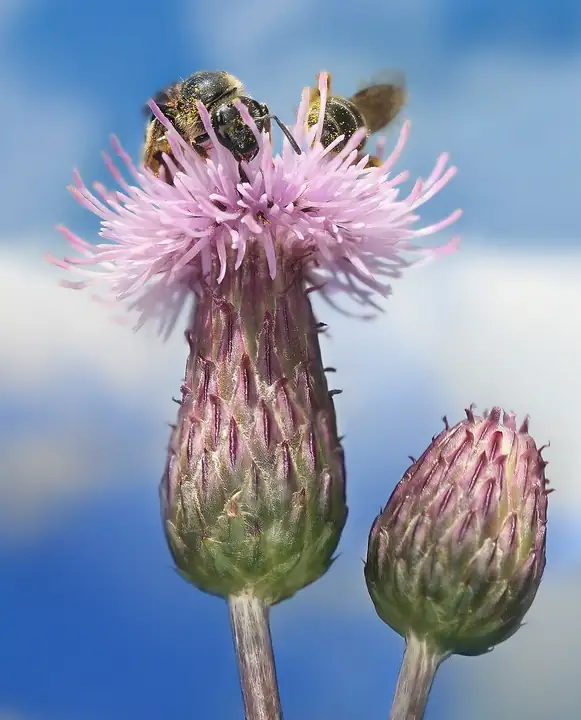
Canada thistle
Cirsium arvense
| Type | Broadleaf |
|---|---|
| Life cycle | Perennial |
| Family | Aster family (Asteraceae) |
| Origin | Introduced from elsewhere |
| Most common in | Northeast, Midwest, Great Plains, Mountain West, Pacific Northwest |
About
Canada thistle is a prickly introduced perennial (despite the name, it is not native to Canada) that forms dense patches from creeping roots. It is one of the most widely listed noxious weeds and crowds out garden plants and lawn grass.
Also called creeping thistle
How to identify it
Look for
Stems are 2 to 5 feet tall, slender and mostly spineless, with prickly, wavy-edged, lance-shaped leaves 2 to 8 inches long. Small pink-purple (sometimes white) flower heads, only 1/2 to 1 inch across, sit in clusters at the top, and the bracts under them have no spiny tips. It grows in patches of many stems joined by roots.
Look-alikes
Bull and musk thistles are biennials with big single flower heads (1.5 inches or more) and spiny winged stems; Canada thistle has small clustered heads and grows in spreading patches.
Where it grows
Gardens, lawns, crop fields, pastures, roadsides, stream banks and other sunny, disturbed ground, especially moist soil.
When
Shoots come up in spring from roots, and it flowers from June into October, then sets fluffy seed.
How it spreads
Mostly by horizontal roots that can spread 10 feet or more in a season and regrow from tiny pieces, plus wind-blown seeds (about 1,500 per plant on average) that can live in soil 20 years.
Most common in
| Northeast | Very common here |
|---|---|
| Southeast | Occasional here |
| South Central | Occasional here |
| Midwest | Very common here |
| Great Plains | Very common here |
| Mountain West | Very common here |
| Southwest | Common here |
| Pacific Northwest | Very common here |
| California | Common here |
| Alaska | Occasional here |
| Hawaii | Not found here |
Where it is regulated
Listed as a noxious weed in Colorado (List B), Minnesota (Prohibited - Control), Washington (Class C) and California.
What to do, gentlest first
Start at the top. Weed killers are a last step; always read and follow the label.
Keep turf and beds thick Prevent
Dense lawns and well-planted beds shade out seedlings; shading has helped remove Canada thistle. Don't let flowers go to seed.
Cut or pull shoots before bloom, repeatedly By hand
Wearing thick gloves, pull or cut shoots with as much root as possible before they flower, and keep doing it every time they regrow. It takes several seasons to starve the roots; mowing alone only stops seed.
Don't till; root pieces become new plants.
Competitive plantings Natural enemies
Thick, vigorous plantings such as lawn grass or dense perennials make it much harder for thistle to spread.
Spot-spray in spring and fall Conventional spray
In gardens, spot-treat leaves with glyphosate, 2,4-D or triclopyr; in lawns, broadleaf products with 2,4-D, dicamba, MCPA, clopyralid or triclopyr work best with a fall treatment followed up in spring.
Read and follow the label; many lawn and brush herbicides also kill garden plants.
Uses, wildlife and pets
Pets
Not listed by the ASPCA.
Sources
- ipm.ucanr.edu
- extension.umn.edu
- nwcb.wa.gov
- ag.colorado.gov
- mda.state.mn.us
- plantsservices.sc.egov.usda.gov
- aspca.org
Photo: Photo: Richard Bartz / Wikimedia Commons, CC BY-SA 2.5 (CC BY-SA 2.5). Photo resized for the web.

Planting dates and advice are general guidance; check with your local Cooperative Extension office for your area.