
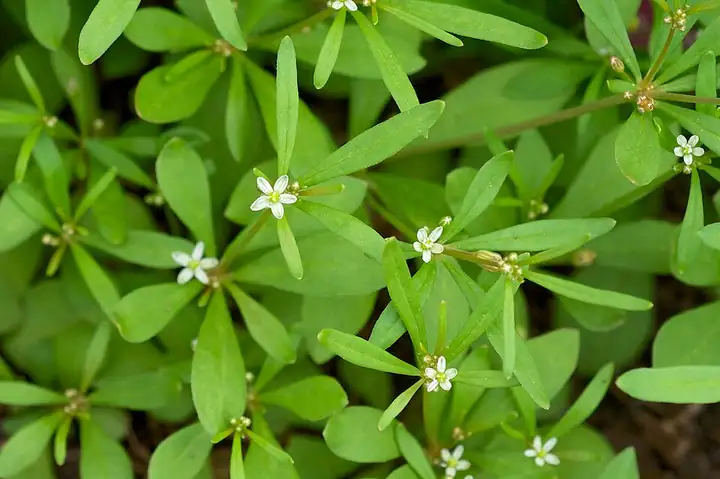
Carpetweed
Mollugo verticillata
| Type | Broadleaf |
|---|---|
| Life cycle | Summer annual |
| Family | Carpetweed family (Molluginaceae) |
| Origin | Native to the US |
| Most common in | Northeast, Southeast, South Central, Midwest |
About
Carpetweed is a flat, mat-forming summer annual that shows up in warm, bare soil later than most weeds. It is shallow-rooted and easy to pull, but it spreads into circles up to 2 feet across and reseeds freely.
Also called green carpetweed
How to identify it
Look for
Smooth, green stems radiate flat from the center, rarely more than 5 inches high. Narrow, smooth leaves grow in whorls of 3 to 8 at each joint, and tiny white five-parted flowers sit at the joints from midsummer to early fall.
Look-alikes
Catchweed bedstraw has a similar whorled look, but its square stems and leaves are bristly, it grows more upright, and its flowers have four parts instead of five.
Where it grows
Tilled vegetable gardens, new lawns, flower beds, roadsides and dry, sandy, disturbed ground.
When
Sprouts late in spring or early summer once the soil is warm, then flowers and seeds from midsummer into early fall.
How it spreads
Seed only; each small capsule holds up to 35 seeds and plants reseed readily into colonies.
Most common in
| Northeast | Very common here |
|---|---|
| Southeast | Very common here |
| South Central | Very common here |
| Midwest | Very common here |
| Great Plains | Common here |
| Mountain West | Occasional here |
| Southwest | Common here |
| Pacific Northwest | Occasional here |
| California | Occasional here |
| Alaska | Not found here |
| Hawaii | Not found here |
What to do, gentlest first
Start at the top. Weed killers are a last step; always read and follow the label.
Keep turf and beds full Prevent
It can't handle shade, so a thick, well-kept lawn and full plantings crowd it out. Pull it before it flowers to stop seed.
Pull or hoe By hand
The roots are shallow, so plants pull or hoe out easily; do it before midsummer flowering.
Mulch Barrier
Mulch greatly reduces or prevents it in gardens.
Burn down seedlings with a contact spray Organic spray
Horticultural vinegar (acetic acid), fatty-acid soap, pelargonic acid or clove-oil sprays burn what they touch within hours. They work best on young mats in warm, sunny weather, and you will need to repeat, because they don't move into roots and bigger plants regrow.
They kill any plant they touch, so shield crops. Strong vinegar can burn skin and eyes; wear goggles and gloves and follow the label.
Pre- or post-emergent herbicide Conventional spray
Purdue lists S-metolachlor, flumioxazin and DCPA as pre-emergents and flumioxazin, glyphosate or 2,4-D after it's up, for crops they are labeled for. Carpetweed can also host root-knot nematodes.
Read and follow the label. Many lawn weed killers also kill or damage vegetables and flowers, so keep spray and drift off garden plants.
Uses, wildlife and pets
Edible?
Wisconsin Extension notes the leaves are edible when cooked. Only eat plants you are sure of, from soil that hasn't been sprayed.
Not 100% sure? Don't eat it. Never pick from ground that may have been sprayed, or along roads and railways.
For wildlife
Birds and small mammals eat the seeds, and small flies and bees visit the flowers (Wisconsin Extension).
Pets
Not listed by the ASPCA.
Sources
- crops.extension.iastate.edu
- hort.extension.wisc.edu
- vegcropshotline.org
- plantsservices.sc.egov.usda.gov
- ucanr.edu
Photo: Photo: Eric in SF / Wikimedia Commons, CC BY-SA 3.0 (CC BY-SA 3.0). Photo resized for the web.

Planting dates and advice are general guidance; check with your local Cooperative Extension office for your area.