
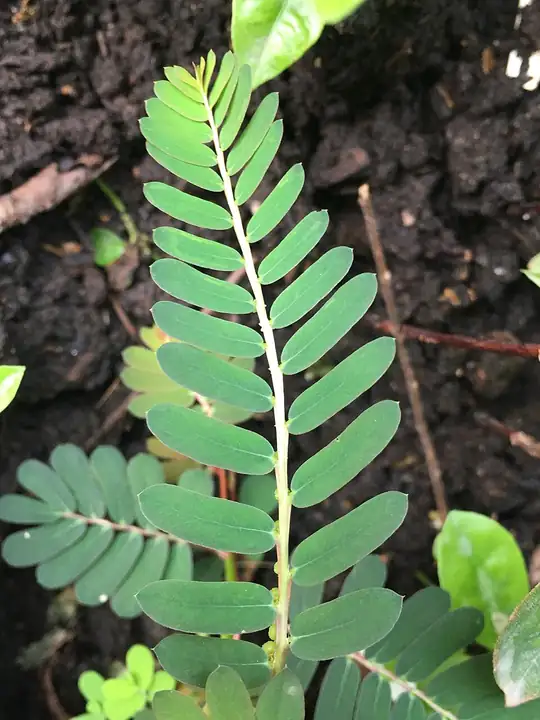
Chamberbitter
Phyllanthus urinaria
| Type | Broadleaf |
|---|---|
| Life cycle | Summer annual |
| Family | Leafflower family (Phyllanthaceae) |
| Origin | Introduced from elsewhere |
| Most common in | Southeast |
About
Chamberbitter is an Asian summer weed that pops up in warm lawns and beds across the Southeast. It looks delicate, but it flings its seeds and most pre-emergents don't stop it well.
Also called gripeweed, leafflower, little mimosa, shatterstone, stonebreaker
How to identify it
Look for
It is an upright, branching plant up to 1 to 2 feet tall with reddish stems. Small oblong leaves, about 1/2 to 3/4 inch long, line up in two neat rows like a mimosa leaf. Flip a branch over to see tiny round, warty green fruits hanging under it.
Look-alikes
Seedlings look like mimosa seedlings; the little round fruits under the branches set chamberbitter apart. Its stems don't ooze milky sap when broken.
Where it grows
Sunny, warm lawns, landscape beds, and nursery containers.
When
Seeds sprout in early summer once soil passes about 70 to 75 F; plants flower and fruit all summer and fall, then die at frost.
How it spreads
By seed only; the ripe fruits burst and throw seeds a short distance.
Most common in
| Northeast | Not found here |
|---|---|
| Southeast | Very common here |
| South Central | Common here |
| Midwest | Not found here |
| Great Plains | Not found here |
| Mountain West | Not found here |
| Southwest | Not found here |
| Pacific Northwest | Not found here |
| California | Not found here |
| Alaska | Not found here |
| Hawaii | Not found here |
What to do, gentlest first
Start at the top. Weed killers are a last step; always read and follow the label.
Keep turf thick and healthy Prevent
A dense, well-kept lawn leaves little room for it to start.
Pull young plants before fruit forms By hand
Pull seedlings when the soil is moist and get the taproot. Do it early in summer, before the fruits under the branches ripen.
Don't compost plants that already have fruit.
Spring mulch Barrier
Spread 2 to 3 inches of mulch in beds in spring. The seeds need light to sprout, so mulch blocks many of them.
Pre-emergent before soil warms, then spot sprays Conventional spray
Clemson lists isoxaben or atrazine (centipedegrass and St. Augustinegrass) before seeds sprout, and 2,4-D, mecoprop and dicamba products on tall fescue, bermudagrass and zoysiagrass. In beds, spot-spray glyphosate and shield nearby plants.
Read and follow the label. Many lawn weed killers also kill garden plants, so keep spray and drift off beds and vegetables. Avoid lawn herbicides during warm-season grass green-up.
Uses, wildlife and pets
Pets
Not listed by the ASPCA.
Sources
Photo: Photo: Monarchatto / Wikimedia Commons, CC BY-SA 4.0 (CC BY-SA 4.0). Photo resized for the web.

Planting dates and advice are general guidance; check with your local Cooperative Extension office for your area.