
Cheatgrass
Bromus tectorum
| Type | Grass |
|---|---|
| Life cycle | Winter annual |
| Family | Grass family (Poaceae) |
| Origin | Introduced from elsewhere |
| Most common in | Mountain West, Pacific Northwest, California |
About
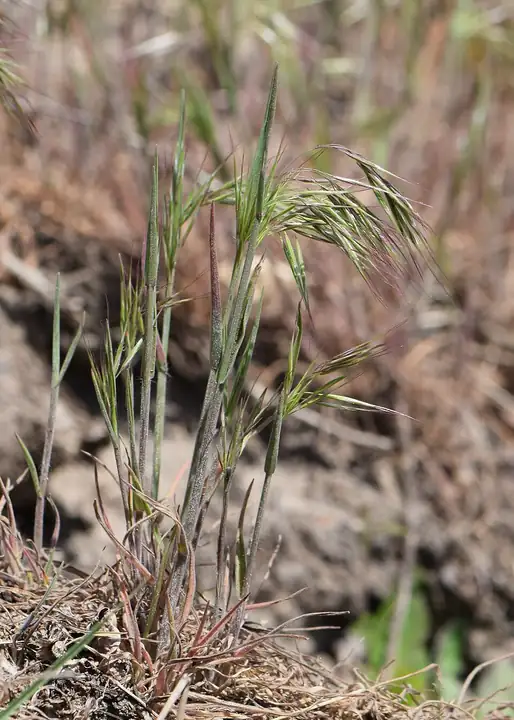
Cheatgrass is a soft, hairy Eurasian annual grass that covers huge areas of the dry West. It dries out by early summer into a carpet of fuel that makes wildfires start easily and spread fast, and its seeds stick in pets.
Also called downy brome, downy chess, bronco grass, drooping brome
How to identify it
Look for
Plants are soft and covered in fine hairs, usually under 2 feet tall. Young leaves are green with a purple tinge. The drooping, one-sided seedhead is 2 to 6 inches long with bristly awns, and it ripens from purple to tan or reddish-brown.
Look-alikes
Medusahead is a similar western annual grass, but it has much longer awns (1 to 4 inches), matures a few weeks later and dries brown rather than reddish.
Where it grows
Dry roadsides, vacant lots, rangeland, pastures, and thin spots in landscapes and gardens, especially on lower, drier ground.
When
Seeds sprout in fall and winter, plants grow again in early spring, set seed in late spring and die by early summer.
How it spreads
By seed only; the awned seeds travel on wind, water and animals, and in wet years a stand can reach more than 10,000 plants per square yard.
Most common in
| Northeast | Occasional here |
|---|---|
| Southeast | Occasional here |
| South Central | Occasional here |
| Midwest | Occasional here |
| Great Plains | Common here |
| Mountain West | Very common here |
| Southwest | Common here |
| Pacific Northwest | Very common here |
| California | Very common here |
| Alaska | Occasional here |
| Hawaii | Occasional here |
Where it is regulated
Colorado lists it as a Class C noxious weed.
What to do, gentlest first
Start at the top. Weed killers are a last step; always read and follow the label.
Keep ground covered with healthy plants Prevent
After you remove it, reseed bare ground with competitive perennial plants so there's no room for new seedlings.
Seeds last in the soil for years, so plan on follow-up for 4 to 5 years.
Pull or hoe before seedheads turn purple By hand
Pull, hoe or shallowly till plants in spring or fall, before the seedheads ripen.
Bag plants that already have seed and don't compost them.
Mulch beds Barrier
WSU suggests organic mulch at least 2 inches deep in landscape beds.
Early heavy grazing on larger acreage Natural enemies
On pasture, Colorado State describes two heavy grazings in early spring, three weeks apart, for at least two years.
Spot-spray glyphosate in beds or bare ground Conventional spray
Spray young, green plants in beds or bare ground with glyphosate, or use a product that lists cheatgrass on its label. WSU notes no products are approved for cheatgrass in home lawns.
Read and follow the label. Many lawn weed killers also kill garden plants, so keep spray and drift off beds and vegetables.
Uses, wildlife and pets
Pets
Not listed by the ASPCA. Washington State University warns the seeds can work into dogs' ears and between their toes. Check dogs and cats after walks: UC Davis vet school says foxtail-type seeds work into ears, eyes, noses, paws and skin. Watch for head shaking, sneezing, pawing, limping or eye swelling, and see a vet if a seed is embedded.
Sources
- hortsense.cahnrs.wsu.edu
- extension.colostate.edu
- extension.sdstate.edu
- plantsservices.sc.egov.usda.gov
- healthtopics.vetmed.ucdavis.edu
- aspca.org
Photo: Photo: Krzysztof Ziarnek, Kenraiz / Wikimedia Commons, CC BY-SA 4.0 (CC BY-SA 4.0). Photo resized for the web.

Planting dates and advice are general guidance; check with your local Cooperative Extension office for your area.