
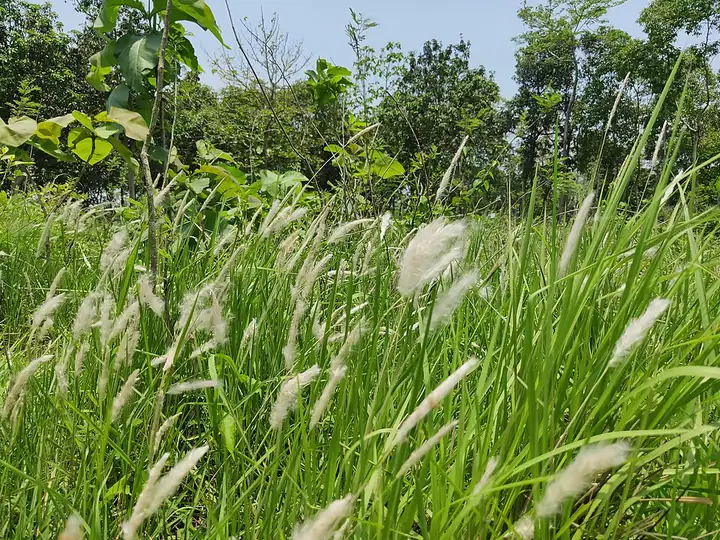
Cogongrass
Imperata cylindrica
| Type | Grass |
|---|---|
| Life cycle | Perennial |
| Family | Grass family (Poaceae) |
| Origin | Introduced from elsewhere |
| Most common in | Southeast |
About
Cogongrass is a federal noxious weed from Asia that forms dense, fire-prone stands across the Gulf South. If you think you have it, report it and get help, because digging, tilling or mowing seedheads usually spreads it.
Also called cogon grass, Japanese bloodgrass, Red Baron grass
How to identify it
Look for
Leaves rise straight from the ground with no visible stem. Each leaf is long and narrow with a white midrib set off-center and rough, sandpapery edges. In spring it shows fluffy, silvery-white seedheads 2 to 8 inches long, and underground are white, segmented rhizomes with sharp tips.
Look-alikes
Johnsongrass has wider leaves and a branched seedhead, and broomsedge grows in bunches with visible stems. The red ornamental 'Red Baron' Japanese bloodgrass is a form of this same species.
Where it grows
Roadsides, pastures, pine stands and open fields, spreading into yards; it grows in sun or part shade and many soils.
When
It flowers and sheds seed from about March through June, and the leaves turn straw-colored and very flammable in winter.
How it spreads
By wind-blown seed and by rhizomes carried in soil, on equipment, shoes and clothes.
Most common in
| Northeast | Not found here |
|---|---|
| Southeast | Very common here |
| South Central | Common here |
| Midwest | Not found here |
| Great Plains | Not found here |
| Mountain West | Not found here |
| Southwest | Not found here |
| Pacific Northwest | Not found here |
| California | Not found here |
| Alaska | Not found here |
| Hawaii | Not found here |
Where it is regulated
It is on the USDA federal noxious weed list, so moving it across state lines without a permit is illegal.
What to do, gentlest first
Start at the top. Weed killers are a last step; always read and follow the label.
Report it and don't move soil Prevent
Report suspected cogongrass to your county Extension office or EDDMapS (in South Carolina, Clemson's Department of Plant Industry). Clean shoes, clothes and equipment after walking through it, and don't move soil or plants from infested ground.
Never plant any form of this grass.
Don't dig, till or mow seedheads By hand
Rhizome pieces regrow and much of the plant lives underground, so digging and tilling spread it. Don't mow when seedheads are present.
Don't burn it: burning spurs new growth, and its dry leaves are a wildfire hazard.
Professional herbicide program over several years Conventional spray
Extension services recommend repeated glyphosate and imazapyr treatments over several years, well timed and combined with other steps. For most homeowners, get help from Extension or a licensed applicator.
Read and follow the label. Many lawn weed killers also kill garden plants, so keep spray and drift off beds and vegetables. These sprays kill any plant they touch.
Uses, wildlife and pets
For wildlife
Poor forage: Mississippi State notes animals that eat it tend to lose weight.
Pets
Not listed by the ASPCA.
Sources
- ecfr.gov
- aphis.usda.gov
- invasivespeciesinfo.gov
- hgic.clemson.edu
- aces.edu
- extension.msstate.edu
- blogs.ifas.ufl.edu
- aspca.org
Photo: Photo: Apurv013 / Wikimedia Commons, CC0 (CC0). Photo resized for the web.

Planting dates and advice are general guidance; check with your local Cooperative Extension office for your area.