
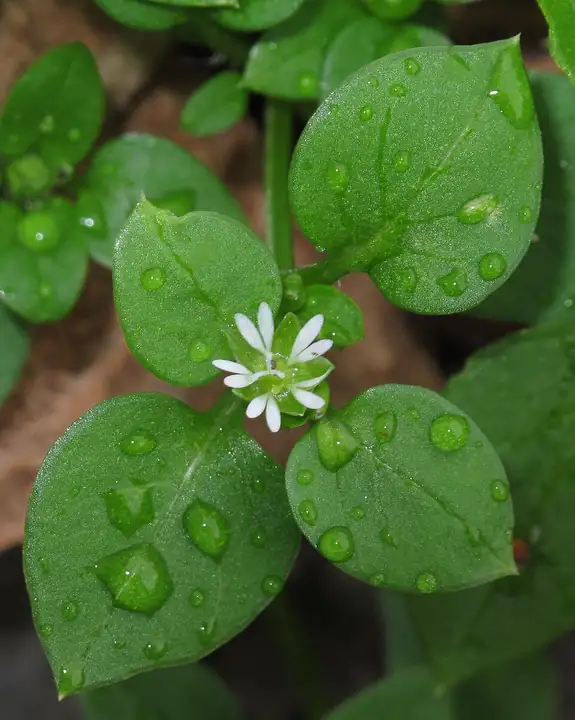
Common Chickweed
Stellaria media
| Type | Broadleaf |
|---|---|
| Life cycle | Winter annual |
| Family | Pink family (Caryophyllaceae) |
| Origin | Introduced from elsewhere |
| Most common in | Northeast, Southeast, Midwest, Pacific Northwest, California |
About
Common chickweed is a soft, bright green, mat-forming weed that fills thin lawns and bare garden soil in the cool months. It grows fast in cool, damp weather, sets seed in spring and fades when summer heat arrives.
Also called chickweed, starwort, winterweed, starweed, birdweed
How to identify it
Look for
Small, smooth, egg-shaped leaves with pointed tips grow in pairs along weak, sprawling stems. Look closely at a stem for a line of fine hairs running along it. Tiny white flowers have five petals split so deeply they look like ten.
Look-alikes
Mouseear chickweed is similar but its leaves and stems are covered in soft hairs and its leaves are darker, gray-green.
Where it grows
Thin lawns, shady and damp spots, garden beds and poorly drained ground.
When
Seeds sprout in fall, plants grow through winter, flower and seed in spring, then die out by early summer; in cool, wet places it can have several generations a year.
How it spreads
Seeds that stay alive in soil for up to 10 years, plus stems that root where they touch the ground.
Most common in
| Northeast | Very common here |
|---|---|
| Southeast | Very common here |
| South Central | Common here |
| Midwest | Very common here |
| Great Plains | Common here |
| Mountain West | Common here |
| Southwest | Common here |
| Pacific Northwest | Very common here |
| California | Very common here |
| Alaska | Common here |
| Hawaii | Occasional here |
What to do, gentlest first
Start at the top. Weed killers are a last step; always read and follow the label.
Keep turf dense; ease up on shade and water Prevent
Fertilize, mow and water properly so grass stays thick, and cut back on frequent watering in shady spots.
Pull or hoe before spring seed By hand
In beds, pull or hoe plants in late winter or early spring before they flower and set seed; the shallow roots come up easily.
Mulch beds Barrier
Keep 2 to 3 inches of mulch in garden beds to stop fall seedlings.
Vinegar on young plants Organic spray
Horticultural vinegar works best on small seedlings with just a few leaves.
Strong vinegar (over about 11% acetic acid) can burn skin and eyes, so wear gloves and eye protection. It browns any leaves it touches, grass included.
Pre-emergent in late summer or a broadleaf spray in spring Conventional spray
A pre-emergent applied in late summer or early fall stops seeds from sprouting. For plants already up, spot-treat in early spring with a lawn broadleaf product containing 2,4-D, MCPP (mecoprop), dicamba or triclopyr.
You can't seed grass for a while after a pre-emergent. Read and follow the label. Many lawn weed killers also harm vegetables, flowers and shrubs, so don't let spray drift into beds, and keep dicamba products off the root zones of trees and shrubs.
Uses, wildlife and pets
Edible?
NC State says the stems, leaves and flowers are edible, with a mild, spinach-like taste. Harvest only from unsprayed ground and make sure of the ID first.
Not 100% sure? Don't eat it. Never pick from ground that may have been sprayed, or along roads and railways.
For wildlife
It draws bees and small butterflies, feeds songbirds, and hosts many moth caterpillars.
Pets
Not listed by the ASPCA.
Sources
- turffiles.ncsu.edu
- extension.umd.edu
- hgic.clemson.edu
- plants.ces.ncsu.edu
- extension.umd.edu
- npgsweb.ars-grin.gov
- plantsservices.sc.egov.usda.gov
Photo: Photo: Robert Flogaus-Faust / Wikimedia Commons, CC BY 4.0 (CC BY 4.0). Photo resized for the web.

Planting dates and advice are general guidance; check with your local Cooperative Extension office for your area.