
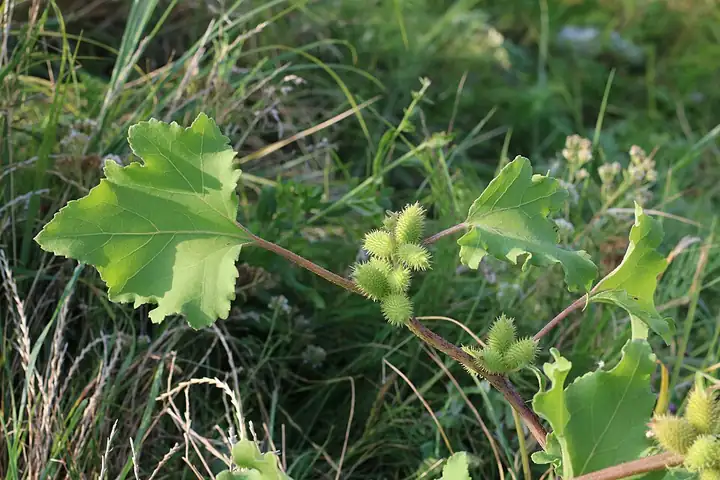
Common cocklebur
Xanthium strumarium
| Type | Broadleaf |
|---|---|
| Life cycle | Summer annual |
| Family | Aster family (Asteraceae) |
| Origin | Native to the US |
| Most common in | Southeast, South Central, Midwest, Great Plains |
About
A coarse, bushy native summer annual best known for its hooked burs that cling to fur, wool and clothing. Its seedlings and seeds are poisonous to livestock.
Also called cocklebur, rough cocklebur, clotbur
How to identify it
Look for
Seedlings have long, narrow, shiny seed leaves and a purple stem base. Grown plants reach 1-4 feet with thick stems spotted purple or black, and rough, sandpapery, triangular to heart-shaped leaves with toothed edges on long stalks. Egg-shaped woody burs about 1 inch long are covered in hooked prickles, end in two beaks, and hold two seeds.
Where it grows
Moist, disturbed ground such as ditches, river bottoms, pastures, crop fields, gardens and roadsides; it handles both flooded and dry soil.
When
Sprouts mid-spring to early summer once the soil is warm (about 63°F), starts flowering as days shorten (usually from August), and ripens burs into fall.
How it spreads
By seed in burs that hitch rides on animals and clothing; each bur's two seeds sprout in different years, and a vigorous plant can make 500-5,400 burs.
Most common in
| Northeast | Common here |
|---|---|
| Southeast | Very common here |
| South Central | Very common here |
| Midwest | Very common here |
| Great Plains | Very common here |
| Mountain West | Common here |
| Southwest | Common here |
| Pacific Northwest | Common here |
| California | Common here |
| Alaska | Not found here |
| Hawaii | Occasional here |
Where it is regulated
Cocklebur seeds (Xanthium species) are noxious weed seeds under state seed laws in states including Alabama, Arkansas and Georgia (prohibited) and Arizona, Delaware, Florida, Hawaii and Kansas (restricted).
What to do, gentlest first
Protect yourself first. Weed killers are a last step; always read and follow the label.
Wipe out edge patches early Prevent
Cocklebur often gets started in unmanaged corners first, so remove it there before it can seed into your beds.
Hoe early, pull before burs form By hand
Hoe or pull seedlings early and repeat as new flushes come up. Pull any larger plants before burs ripen.
Wear gloves; bag burs instead of composting them.
Solarize bare beds Barrier
Solarizing moist soil under clear plastic so midday soil temperatures reach about 149-156°F kills a high share of cocklebur seeds.
Uses, wildlife and pets
For wildlife
Not a significant food source for pollinators or wildlife, though many insects use it.
Pets
Not listed by the ASPCA. Seedlings and seeds poison cattle, pigs, sheep and poultry, and the burs tangle in pet fur.
Sources
- ipm.ucanr.edu
- cals.cornell.edu
- plants.ces.ncsu.edu
- ag.purdue.edu
- plantsservices.sc.egov.usda.gov
- aspca.org
- poison.org
- ams.usda.gov
Photo: Photo: George Chernilevsky / Wikimedia Commons, CC BY 4.0 (CC BY 4.0). Photo resized for the web.

Planting dates and advice are general guidance; check with your local Cooperative Extension office for your area.