
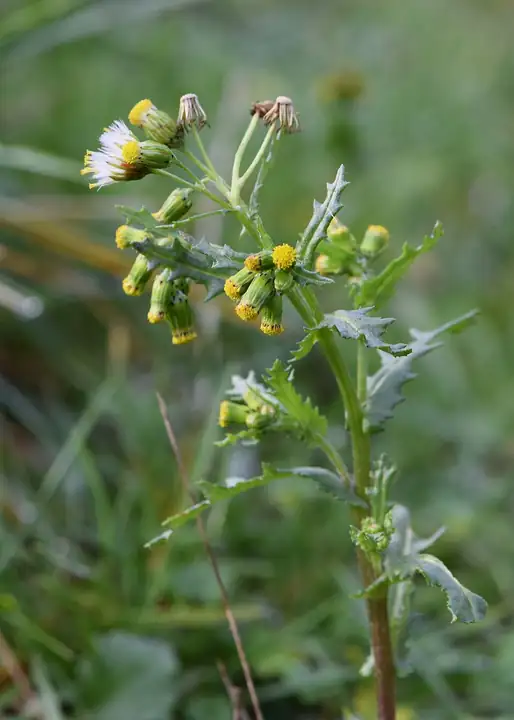
Common groundsel
Senecio vulgaris
| Type | Broadleaf |
|---|---|
| Life cycle | Annual |
| Family | Aster family (Asteraceae) |
| Origin | Introduced from elsewhere |
| Most common in | Northeast, Midwest, Pacific Northwest, California |
About
A small, speedy weed from Europe that can go from seedling to seed in about six weeks and squeeze several generations into one year. It carries pyrrolizidine alkaloids that slowly damage the liver, so keep it out of pastures, hay and anywhere animals graze.
Also called groundsel, old-man-in-the-spring, chickenweed, grundsel, birdseed
How to identify it
Look for
An upright plant, usually under 18 inches, with fleshy, hollow stems that are often purple near the base. Leaves are deeply lobed with irregular teeth. The small yellow flower heads have no petals and are wrapped in green bracts with black tips; they open into white, fluffy seed heads like a tiny dandelion.
Look-alikes
Its petal-less yellow flower heads set it apart from most yellow daisy-type weeds. Its relatives the ragworts (other Senecio species) carry the same liver toxins, so treat any of them as unsafe for animals.
Where it grows
Gardens, nursery pots, vegetable beds, orchards, lawns, pavement cracks and roadsides, especially where the soil stays cool and moist.
When
Sprouts mostly from early spring to early summer and again into fall, and grows year-round along mild coasts; plants can bloom 4-5 weeks after sprouting and drop seed about a week later.
How it spreads
By seed only; a plant typically makes about 1,100-1,800 wind-carried seeds (far more with no competition), and plants pulled while blooming can still ripen about a third of their seeds.
Most common in
| Northeast | Very common here |
|---|---|
| Southeast | Common here |
| South Central | Occasional here |
| Midwest | Very common here |
| Great Plains | Common here |
| Mountain West | Common here |
| Southwest | Occasional here |
| Pacific Northwest | Very common here |
| California | Very common here |
| Alaska | Common here |
| Hawaii | Occasional here |
Where it is regulated
Washington lists common groundsel as a Class C noxious weed.
What to do, gentlest first
Protect yourself first. Weed killers are a last step; always read and follow the label.
Clear edges and clean up after harvest Prevent
Pull groundsel from path edges, pots and waste spots near the garden before it seeds, and clear beds soon after harvest. It sets seed so fast that one missed round restocks the bed.
Pull or hoe before any flowers open By hand
The shallow, fibrous roots pull out easily and seedlings die when hoed. Get plants before the first flowers open, because cut or pulled plants that are already blooming can still ripen seed.
Bag blooming plants instead of leaving them on the soil or adding them to compost; wear gloves.
Keep beds mulched Barrier
Most seeds need light to sprout, and seedlings have little ability to push through a dense layer of organic mulch.
Spot-treat or use a pre-emergent Conventional spray
In landscape beds, glyphosate can be used as a spot treatment; in lawns, 2,4-D products work. A pre-emergent broadleaf herbicide can stop seedlings in beds that are always infested.
Read and follow the label. Many lawn weed killers also kill vegetables and flowers, and glyphosate harms any plant it touches.
Uses, wildlife and pets
For wildlife
Caterpillars of many butterflies and moths feed on the leaves.
Pets
Toxic to dogs, cats and horses (ASPCA, listed as groundsel, Senecio species): its pyrrolizidine alkaloids cause liver damage, and an animal may seem fine before getting suddenly sick. Cattle and horses are more sensitive than sheep and goats.
Sources
- ipm.ucanr.edu
- plants.ces.ncsu.edu
- cals.cornell.edu
- hortsense.cahnrs.wsu.edu
- aspca.org
- plantsservices.sc.egov.usda.gov
- poison.org
Photo: Photo: Krzysztof Ziarnek, Kenraiz / Wikimedia Commons, CC BY-SA 4.0 (CC BY-SA 4.0). Photo resized for the web.

Planting dates and advice are general guidance; check with your local Cooperative Extension office for your area.