
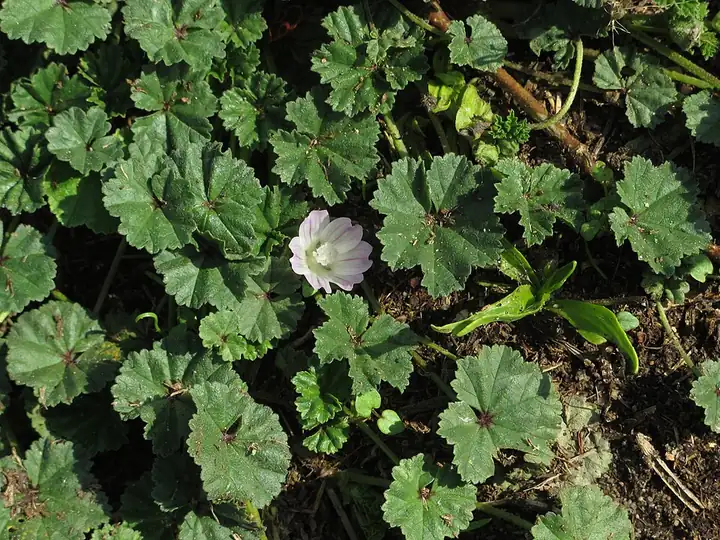
Common mallow
Malva neglecta
| Type | Broadleaf |
|---|---|
| Life cycle | Annual |
| Family | Mallow family (Malvaceae) |
| Origin | Introduced from elsewhere |
| Most common in | Northeast, Midwest, Great Plains, Mountain West, Pacific Northwest |
About
Common mallow is a sprawling weed from Europe and Asia with round, scalloped leaves that shows up in thin lawns and garden beds. It acts as an annual, biennial or short-lived perennial, and its deep taproot makes older plants hard to pull.
Also called cheeseweed, cheese plant, buttonweed, dwarf mallow, mallow
How to identify it
Look for
Leaves are round to kidney shaped, on long stalks, with shallow lobes and rounded teeth, and they feel slightly rough from short hairs. Stems sprawl up to about 2 feet from a deep, woody taproot. Small white to pale pink five-petaled flowers, often with violet veins, become flat, round fruits shaped like a wheel of cheese.
Look-alikes
Ground ivy also has round, scalloped leaves, but its leaves are opposite on square stems and smell minty; mallow leaves are alternate and rough.
Where it grows
Thin lawns, planting beds, gardens, crop fields, orchards and waste areas.
When
Seeds sprout from mid-spring to early fall whenever the soil is moist; it flowers from early summer to mid-fall and can stay green all year in mild areas.
How it spreads
Seed only, from cheese-wheel fruits with 10 to 20 seeds; the tough seed coat lets seeds wait in the soil for years.
Most common in
| Northeast | Very common here |
|---|---|
| Southeast | Common here |
| South Central | Common here |
| Midwest | Very common here |
| Great Plains | Very common here |
| Mountain West | Very common here |
| Southwest | Common here |
| Pacific Northwest | Very common here |
| California | Common here |
| Alaska | Occasional here |
| Hawaii | Occasional here |
What to do, gentlest first
Start at the top. Weed killers are a last step; always read and follow the label.
Thick turf and full beds Prevent
Keep the lawn dense and beds planted so bare spots don't invite it; remove plants before they flower and seed.
Pull while it has four or fewer leaves By hand
Pull seedlings with four or fewer true leaves, before the taproot turns woody. For older plants, cut the taproot below the soil with a hoe or weeding knife.
Control has to get the root, not just the top growth.
Mulch at least 3 inches Barrier
At least 3 inches of bark or wood chips keeps most seedlings from coming up. Solarization and flaming don't work well on mallow.
Burn down seedlings with a contact spray Organic spray
Horticultural vinegar (acetic acid), fatty-acid soap, pelargonic acid or clove-oil sprays burn what they touch within hours. They work best on very young seedlings in warm, sunny weather, and you will need to repeat, because they don't move into roots and bigger plants regrow.
They kill any plant they touch, so shield crops. Strong vinegar can burn skin and eyes; wear goggles and gloves and follow the label.
Limited options; pull instead Conventional spray
Glyphosate does not control mallow well. In lawns, 2,4-D gives only partial control on young plants, and pre-emergents such as oryzalin or pendimethalin give partial control.
Read and follow the label. Many lawn weed killers also kill or damage vegetables and flowers, so keep spray and drift off garden plants.
Uses, wildlife and pets
Edible?
NC State Extension notes the leaves and seeds are edible, with mature seeds cooked like a grain. Only eat plants you are sure of, from ground that hasn't been sprayed, which is rare for lawn weeds.
Not 100% sure? Don't eat it. Never pick from ground that may have been sprayed, or along roads and railways.
For wildlife
The flowers draw bees and butterflies (NC State).
Pets
Not listed by the ASPCA.
Sources
- crops.extension.iastate.edu
- ipm.ucanr.edu
- extension.usu.edu
- plants.ces.ncsu.edu
- plantsservices.sc.egov.usda.gov
- ucanr.edu
Photo: Photo: Robert Flogaus-Faust / Wikimedia Commons, CC BY 4.0 (CC BY 4.0). Photo resized for the web.

Planting dates and advice are general guidance; check with your local Cooperative Extension office for your area.