
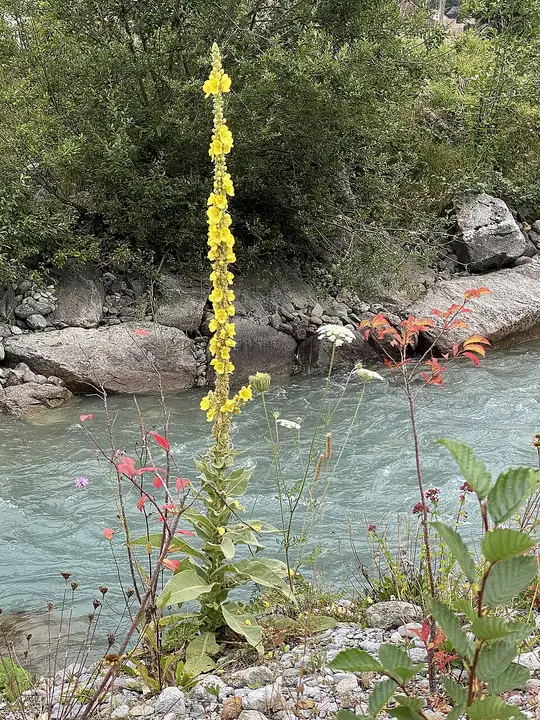
Common mullein
Verbascum thapsus
| Type | Broadleaf |
|---|---|
| Life cycle | Biennial |
| Family | Figwort family (Scrophulariaceae) |
| Origin | Introduced from elsewhere |
| Most common in | Mountain West |
About
Common mullein is a fuzzy Eurasian biennial with big velvety rosettes and a tall yellow flower spike. It seeds heavily into bare, disturbed soil, and its seeds can wait in the ground for decades.
Also called woolly mullein, mullein
How to identify it
Look for
The first year it forms a rosette of thick, felt-like, gray-green leaves 4 to 12 inches long. The second year it sends up a stout stalk 5 to 10 feet tall packed with small, five-petaled yellow flowers that open from the bottom up. It has a deep taproot.
Where it grows
Roadsides, pastures, fields, burned or cleared land, vacant lots and bare garden soil, especially dry, sandy or gravelly ground in full sun.
When
Seeds sprout mostly in spring; rosettes overwinter, and plants flower from about June to September in their second year, then die.
How it spreads
By seed only: about 100,000 to 240,000 seeds per plant, mostly dropping near the parent, and seeds have sprouted after 100 years in soil.
Most common in
| Northeast | Common here |
|---|---|
| Southeast | Common here |
| South Central | Common here |
| Midwest | Common here |
| Great Plains | Common here |
| Mountain West | Very common here |
| Southwest | Common here |
| Pacific Northwest | Common here |
| California | Common here |
| Alaska | Occasional here |
| Hawaii | Common here |
Where it is regulated
Listed as a noxious weed in Colorado (List C) and Hawaii.
What to do, gentlest first
Start at the top. Weed killers are a last step; always read and follow the label.
Keep soil covered Prevent
Seedlings come up almost only on bare, sunny soil, so keep ground planted or mulched and avoid disturbing it.
Pull, hoe or dig before seed By hand
Pull, hoe or dig plants as soon as they're big enough to grab, easiest when the soil is moist, and always before they set seed. Hoeing through the crown works on rosettes.
Mowing doesn't control it. Bag plants with seed pods.
Herbicide with a surfactant Conventional spray
Glyphosate, 2,4-D or triclopyr can work on rosettes, but the woolly leaves shed spray, so a surfactant is needed.
Read and follow the label; many lawn and brush herbicides also kill garden plants.
Uses, wildlife and pets
For wildlife
Bees, butterflies, flies and other pollinators visit the flowers.
Pets
Not listed by the ASPCA.
Sources
- hort.extension.wisc.edu
- montana.edu
- plants.ces.ncsu.edu
- ag.colorado.gov
- plantsservices.sc.egov.usda.gov
- aspca.org
- aspca.org
- aspca.org
Photo: Photo: W. Bulach / Wikimedia Commons, CC BY-SA 4.0 (CC BY-SA 4.0). Photo resized for the web.

Planting dates and advice are general guidance; check with your local Cooperative Extension office for your area.