
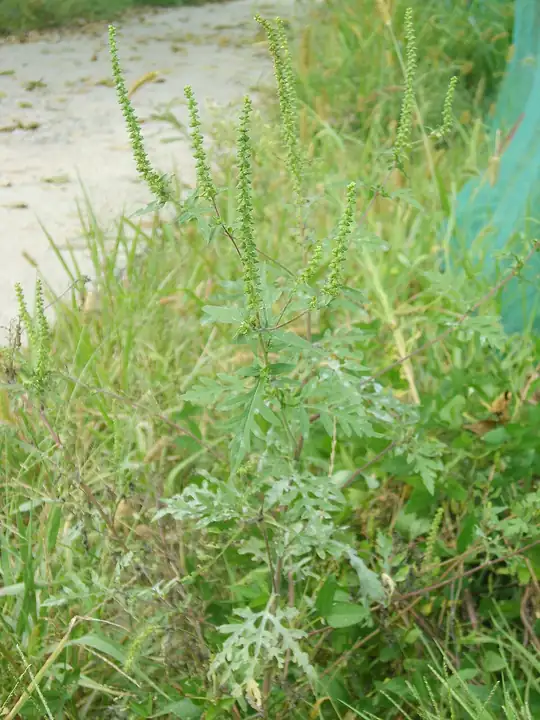
Common ragweed
Ambrosia artemisiifolia
| Type | Broadleaf |
|---|---|
| Life cycle | Summer annual |
| Family | Aster family (Asteraceae) |
| Origin | Native to the US |
| Most common in | Northeast, Southeast, South Central, Midwest, Great Plains |
About
Common ragweed is a native annual of sunny, disturbed ground and the main cause of late-summer hay fever; one plant can release over a billion grains of wind-blown pollen. It also crowds crops, and its seeds can wait in the soil for up to 40 years.
Also called ragweed, annual ragweed
How to identify it
Look for
Leaves are fern-like and deeply cut, 2 to 4 inches long, and the stems are covered in rough, short hairs. The first leaves are opposite and later ones alternate. In late summer, small male flower heads line slender spikes at the tips, with the seed-making flowers tucked in clusters below.
Look-alikes
Wild carrot and deadly poison hemlock also have finely cut leaves, but both are biennials that start as a flat rosette of leaves; never handle or taste a lacy-leaved plant you can't name. Western ragweed is a perennial with less deeply cut leaves.
Where it grows
Gardens, new beds, field edges, roadsides, vacant lots and other open, disturbed soil in full sun.
When
Sprouts in early to late spring, then flowers and sheds pollen from about August to October as the days shorten; seeds ripen in fall.
How it spreads
Seed only: typical plants make 3,000 to 60,000 seeds, and they can stay alive in the soil for decades.
Most common in
| Northeast | Very common here |
|---|---|
| Southeast | Very common here |
| South Central | Very common here |
| Midwest | Very common here |
| Great Plains | Very common here |
| Mountain West | Common here |
| Southwest | Common here |
| Pacific Northwest | Common here |
| California | Occasional here |
| Alaska | Not found here |
| Hawaii | Occasional here |
Where it is regulated
Illinois lists common ragweed as a noxious weed.
What to do, gentlest first
Start at the top. Weed killers are a last step; always read and follow the label.
Remove it before it flowers Prevent
Pull or cut plants in early summer, before the flower spikes open in August. That spares your hay-fever neighbors and stops seed.
The pollen triggers hay fever; if you are allergic, weed early or let someone else do it.
Pull or hoe seedlings By hand
Seedlings come from the top inch of soil, so shallow hoeing in spring works well. Pull bigger plants by the base while the soil is moist.
Wear gloves; handling the plant can cause a rash in some people.
Mulch 3 inches deep Barrier
Clemson calls a 3-inch layer of mulch the best defense in landscape beds.
Burn down seedlings with a contact spray Organic spray
Horticultural vinegar (acetic acid), fatty-acid soap, pelargonic acid or clove-oil sprays burn what they touch within hours. They work best on young seedlings in warm, sunny weather, and you will need to repeat, because they don't move into roots and bigger plants regrow.
They kill any plant they touch, so shield crops. Strong vinegar can burn skin and eyes; wear goggles and gloves and follow the label.
Treat seedlings under 6 inches Conventional spray
Herbicides work best on plants under 6 inches tall. In lawns, a broadleaf weed killer such as 2,4-D works; in beds, spot spray glyphosate on the weed only.
Read and follow the label. Many lawn weed killers also kill or damage vegetables and flowers, so keep spray and drift off garden plants.
Uses, wildlife and pets
For wildlife
The oily, protein-rich seeds feed songbirds, game birds and small mammals (Clemson).
Pets
Not listed by the ASPCA.
Sources
- sare.org
- hgic.clemson.edu
- crops.extension.iastate.edu
- dnr.illinois.gov
- plantsservices.sc.egov.usda.gov
- ipm.ucanr.edu
- ucanr.edu
Photo: Photo: Dalgial / Wikimedia Commons, CC BY-SA 3.0 (CC BY-SA 3.0). Photo resized for the web.

Planting dates and advice are general guidance; check with your local Cooperative Extension office for your area.