
Cow parsnip
Heracleum maximum
| Type | Broadleaf |
|---|---|
| Life cycle | Perennial |
| Family | Carrot family (Apiaceae) |
| Origin | Native to the US |
| Most common in | Mountain West, Pacific Northwest, Alaska |
About
A big native wildflower of moist meadows and stream banks, valued by pollinators and wildlife. Its sap can burn skin in sunlight, and it is the plant most often mistaken for invasive giant hogweed.
Also called American cow parsnip, common cowparsnip, American hogweed, Indian celery, pushki
How to identify it
Look for
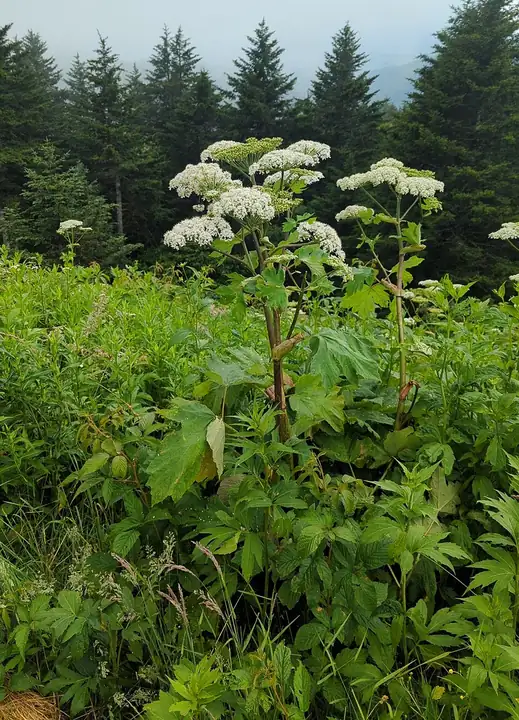
Plants stand 4 to 10 feet tall with large leaves split into three broad, lobed, toothed leaflets. Stems are grooved, hollow and hairy, sometimes with purple splotches, and smell strong when crushed. Flat white flower clusters are about 6 to 12 inches across.
Look-alikes
Giant hogweed is much larger (7 to 14 feet), with stems 2 to 4 inches thick, coarse hairs, deeply cut leaves and flower heads up to 2½ feet wide. Poison hemlock has smooth, spotted stems and fern-like leaves.
Where it grows
Moist meadows, stream banks, floodplains, woodland openings and shady yard edges.
When
Leaves come up in spring, and it blooms from late spring into summer (about April to August depending on the region), then sets flat seeds.
How it spreads
Spreads by seed and comes back each year from a stout taproot.
Most common in
| Northeast | Common here |
|---|---|
| Southeast | Occasional here |
| South Central | Not found here |
| Midwest | Common here |
| Great Plains | Occasional here |
| Mountain West | Very common here |
| Southwest | Occasional here |
| Pacific Northwest | Very common here |
| California | Common here |
| Alaska | Very common here |
| Hawaii | Not found here |
What to do, gentlest first
Protect yourself first. Weed killers are a last step; always read and follow the label.
Let it be where it's welcome Prevent
It's a native wildflower, so leave it in wild corners and along streams. Wear protective clothing when working near it.
Make sure it isn't giant hogweed; if unsure, report it.
Pull or dig unwanted plants By hand
Remove unwanted plants by hand or dig the taproot, ideally before they set seed.
Wear gloves and eye protection, and wash exposed skin right away with soap and water.
Uses, wildlife and pets
For wildlife
Bees, wasps and butterflies use the easy-to-reach nectar and pollen, it hosts swallowtail caterpillars, and deer, elk, moose and bears eat it.
Pets
Toxic to dogs, cats and horses (ASPCA); the sap can cause sunburn-like skin damage.
Sources
- plants.sc.egov.usda.gov
- plants.ces.ncsu.edu
- fs.usda.gov
- dec.ny.gov
- nwcb.wa.gov
- plantsservices.sc.egov.usda.gov
- aspca.org
Photo: Photo: miketilley / Wikimedia Commons, CC BY 4.0 (CC BY 4.0). Photo resized for the web.

Planting dates and advice are general guidance; check with your local Cooperative Extension office for your area.