
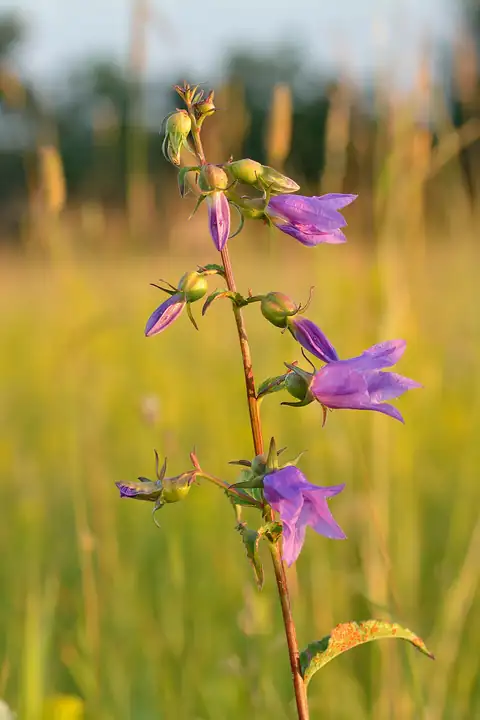
Creeping bellflower
Campanula rapunculoides
| Type | Broadleaf |
|---|---|
| Life cycle | Perennial |
| Family | Bellflower family (Campanulaceae) |
| Origin | Introduced from elsewhere |
| Most common in | Midwest |
About
Creeping bellflower is a pretty purple bellflower that turns into a stubborn weed in gardens and lawns. Its tuber-like roots and rhizomes regrow from small pieces, so it is very hard to dig out completely.
How to identify it
Look for
Stems grow 2 to 3 feet tall and bear bell-shaped blue-purple flowers with five pointed lobes. Lower leaves are heart-shaped and upper leaves lance-shaped, all with coarse teeth, and broken stems ooze milky sap. Underneath are tuber-like storage roots and spreading rhizomes.
Look-alikes
Violets and heal-all can look similar, and native harebell (Campanula rotundifolia) is a related bellflower; creeping bellflower's milky sap, toothed heart-shaped lower leaves and tuber-like roots help tell it apart.
Where it grows
Gardens, lawns and disturbed soil, especially moist garden beds, though it adapts to most sites.
When
Shoots come up in spring and it flowers from summer into early fall.
How it spreads
By rhizomes and tuber-like roots that regrow from small pieces, and by seed (up to 15,000 per plant).
Most common in
| Northeast | Common here |
|---|---|
| Southeast | Occasional here |
| South Central | Occasional here |
| Midwest | Very common here |
| Great Plains | Common here |
| Mountain West | Common here |
| Southwest | Occasional here |
| Pacific Northwest | Occasional here |
| California | Occasional here |
| Alaska | Occasional here |
| Hawaii | Not found here |
What to do, gentlest first
Start at the top. Weed killers are a last step; always read and follow the label.
Don't plant or share it Prevent
Don't plant it or accept divisions of it, and keep turf dense and healthy so it can't get in.
Dig out every root By hand
Dig out the whole plant, including all tuber-like roots and rhizome pieces, and keep removing shoots that come back.
Pieces left in soil regrow; bag the roots rather than composting them.
Smother with a tarp Barrier
Cover the patch with a tarp or thick newspaper to block light for a long time.
Spot spray Conventional spray
Dicamba, triclopyr and glyphosate work on creeping bellflower; 2,4-D and quinclorac do not.
Read and follow the label; many lawn and brush herbicides also kill garden plants.
Uses, wildlife and pets
Pets
Not listed by the ASPCA.
Sources
Photo: Photo: Ivar Leidus / Wikimedia Commons, CC BY-SA 3.0 (CC BY-SA 3.0). Photo resized for the web.

Planting dates and advice are general guidance; check with your local Cooperative Extension office for your area.