
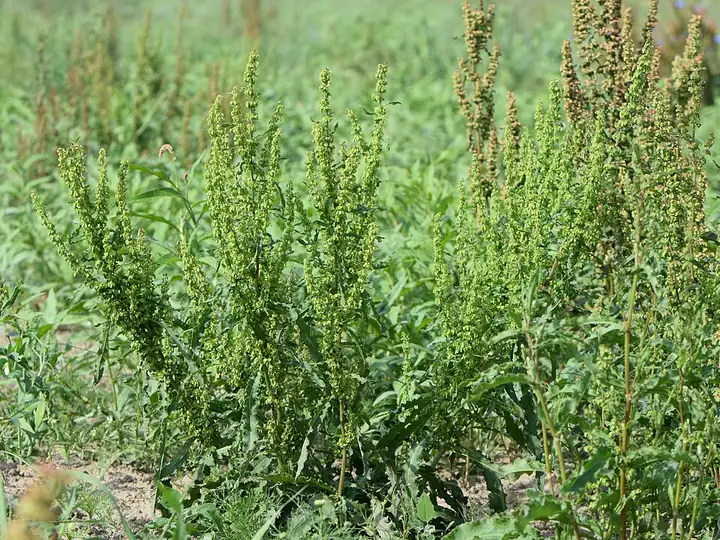
Curly dock
Rumex crispus
| Type | Broadleaf |
|---|---|
| Life cycle | Perennial |
| Family | Buckwheat family (Polygonaceae) |
| Origin | Introduced from elsewhere |
| Most common in | Northeast, Southeast, South Central, Midwest, Pacific Northwest, California |
About
Curly dock is a tough, taprooted perennial with long wavy leaves and tall rusty-brown seed stalks. It is common in thin lawns, compacted or wet ground, and neglected garden corners across the country.
Also called curled dock, yellow dock
How to identify it
Look for
Leaves are long and narrow (about 6 to 12 inches) with strongly wavy, crinkled edges, starting as a ground-level rosette. A papery sheath wraps the stem at each leaf base, and stems grow 2 to 5 feet tall. Seed clusters turn rusty brown by midsummer, and a thick yellow taproot sits below.
Look-alikes
Broadleaf dock has much wider, flatter leaves with a heart-shaped base and toothed wings on its seeds. Red sorrel is much smaller, with arrowhead-shaped leaves.
Where it grows
Thin lawns, pastures, ditches, roadsides, orchards and damp or compacted spots; it tolerates wet and flooded soils.
When
Rosettes grow from fall through spring; it flowers mainly in spring and early summer and the seed stalks turn brown by mid to late summer.
How it spreads
By seed (a plant can make anywhere from about 100 to over 60,000 seeds, which may survive decades in soil) and by regrowth from the crown and upper root.
Most common in
| Northeast | Very common here |
|---|---|
| Southeast | Very common here |
| South Central | Very common here |
| Midwest | Very common here |
| Great Plains | Common here |
| Mountain West | Common here |
| Southwest | Common here |
| Pacific Northwest | Very common here |
| California | Very common here |
| Alaska | Occasional here |
| Hawaii | Occasional here |
What to do, gentlest first
Start at the top. Weed killers are a last step; always read and follow the label.
Grow thick turf Prevent
Pick lawn grasses suited to your area and fertilize, mow and water well; dock seldom sets seed in well-kept turf. Loosen compacted, soggy areas.
Dig out the taproot By hand
Dig when the soil is moist and remove the crown plus the top few inches of root; pieces of the crown can regrow. Cut seed stalks before they turn brown.
Digging can bring buried seeds up; mulch or reseed the bare spot.
Broadleaf lawn herbicide or spot spray Conventional spray
In lawns, products with 2,4-D, dicamba or clopyralid control dock; in beds, spot-treat with glyphosate only.
Read and follow the label; many lawn and brush herbicides also kill garden plants.
Uses, wildlife and pets
Pets
Toxic to dogs, cats and horses (ASPCA lists dock and sorrel, Rumex, as toxic); livestock can be poisoned if they eat a lot of it.
Sources
- ipm.ucanr.edu
- turffiles.ncsu.edu
- cals.cornell.edu
- hortsense.cahnrs.wsu.edu
- plantsservices.sc.egov.usda.gov
- aspca.org
- aspca.org
- aspca.org
Photo: Photo: Krzysztof Ziarnek, Kenraiz / Wikimedia Commons, CC BY-SA 4.0 (CC BY-SA 4.0). Photo resized for the web.

Planting dates and advice are general guidance; check with your local Cooperative Extension office for your area.