
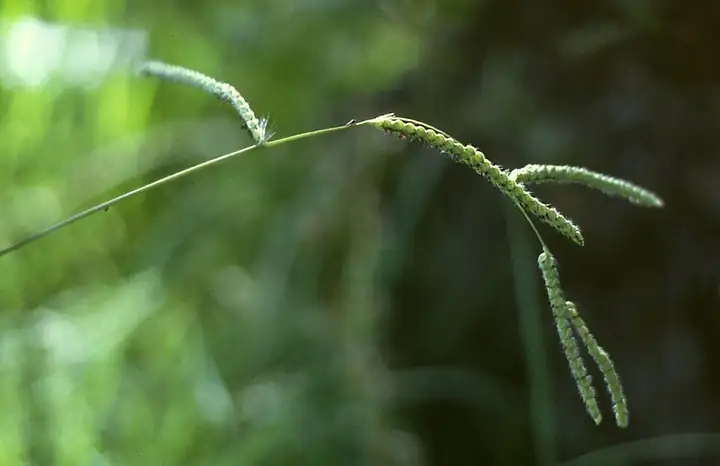
Dallisgrass
Paspalum dilatatum
| Type | Grass |
|---|---|
| Life cycle | Perennial |
| Family | Grass family (Poaceae) |
| Origin | Introduced from elsewhere |
| Most common in | Southeast, South Central |
About
A coarse, clumping warm-season perennial grass that is common in southern lawns. Its clumps grow faster than the lawn, look ragged and can trip people.
Also called dallis grass
How to identify it
Look for
Gray-green leaves 1/4 to 1/2 inch wide with a clear midrib grow in clumps with purplish bases. Short rhizomes show ring-like joints. Tall seed stalks carry 2 to 10 drooping branches lined with flat, egg-shaped seeds and tiny black flower parts.
Look-alikes
Crabgrass seedlings look alike, but crabgrass dies at frost. Goosegrass seedheads are shorter and stiffer, and bahiagrass and knotgrass are close look-alikes too.
Where it grows
Lawns, wet ditches, garden edges and orchards, often in thin turf or dry, compacted soil.
When
Seeds sprout in spring and summer once soil reaches 60 to 65 degrees F, and clumps flower from late spring into fall and live through winter.
How it spreads
Spreads mostly by heavy seed crops carried by water, mowers, people and pets, plus short rhizomes; it also arrives in sod or soil.
Most common in
| Northeast | Occasional here |
|---|---|
| Southeast | Very common here |
| South Central | Very common here |
| Midwest | Occasional here |
| Great Plains | Occasional here |
| Mountain West | Occasional here |
| Southwest | Common here |
| Pacific Northwest | Occasional here |
| California | Common here |
| Alaska | Not found here |
| Hawaii | Common here |
What to do, gentlest first
Start at the top. Weed killers are a last step; always read and follow the label.
Keep turf thick and water evenly Prevent
Mow at the right height and fertilize to keep the lawn dense. Avoid long dry gaps between heavy waterings, which favor dallisgrass.
Dig young clumps By hand
Dig out young plants before they form rhizomes or seed. Older clumps can regrow from rhizome pieces left behind.
Mulch, smother or solarize Barrier
In beds, a thick organic mulch stops seedlings, black plastic kills existing clumps, and summer solarization with clear plastic kills much of the seed.
Pre-emergent for seedlings, repeated spot sprays for clumps Conventional spray
A spring pre-emergent such as prodiamine or dithiopyr stops new seedlings. Few lawn-safe products kill established clumps; in warm-season lawns, sulfosulfuron, foramsulfuron or thiencarbazone mixes need at least 3 applications over 2 to 3 years. Spot-spray glyphosate on single clumps, knowing it kills lawn grass too.
Read and follow the label. Many lawn herbicides kill garden plants, so keep spray and drift off beds and vegetables.
Uses, wildlife and pets
Pets
Not listed as toxic to dogs, cats or horses by the ASPCA. Its seedheads can host an ergot fungus that is toxic to livestock.
Sources
- ipm.ucanr.edu
- ipm.ucanr.edu
- content.ces.ncsu.edu
- lsuagcenter.com
- plantsservices.sc.egov.usda.gov
- aspca.org
- aspca.org
- aspca.org
Photo: Photo: Franz Xaver / Wikimedia Commons, CC BY-SA 3.0 (CC BY-SA 3.0). Photo resized for the web.

Planting dates and advice are general guidance; check with your local Cooperative Extension office for your area.