
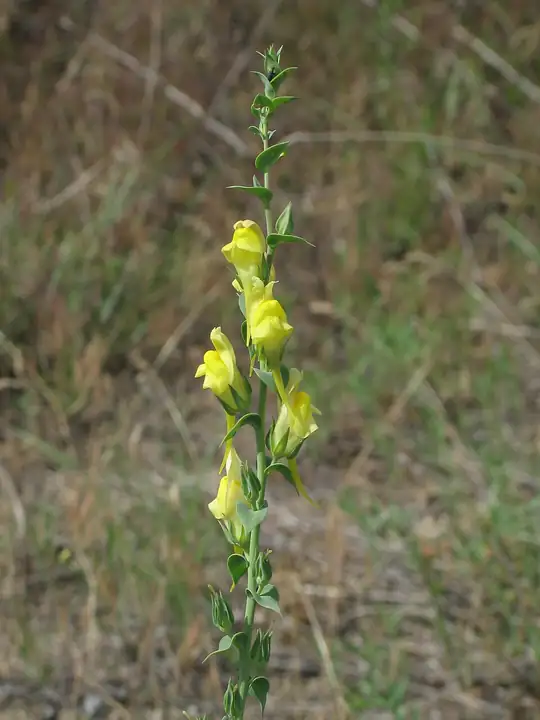
Dalmatian toadflax
Linaria dalmatica
| Type | Broadleaf |
|---|---|
| Life cycle | Perennial |
| Family | Plantain family (Plantaginaceae) |
| Origin | Introduced from elsewhere |
| Most common in | Mountain West, Pacific Northwest |
About
Dalmatian toadflax is a pretty yellow 'snapdragon' from southeastern Europe, brought over as an ornamental, that now spreads over dry western ground. Deep roots and huge seed crops mean removal takes 5 to 6 years of steady effort.
Also called broadleaf toadflax, Balkan toadflax
How to identify it
Look for
Stout, upright stems grow 2 1/2 to 5 feet tall. Waxy, light green, heart-shaped leaves 1 to 3 inches long clasp the stem. From May to September it has bright yellow snapdragon-like flowers, often orange in the throat, with a spur at the base.
Look-alikes
Yellow toadflax (butter-and-eggs) has narrow, grass-like leaves instead of broad, clasping ones. Garden snapdragons have no spur on the flower.
Where it grows
Dry, sandy or gravelly soils along roadsides, pastures, rangeland and waste ground.
When
It flowers from about May to September.
How it spreads
By seed (a mature plant can make up to 500,000) and by creeping roots from a taproot that can go 6 feet deep.
Most common in
| Northeast | Occasional here |
|---|---|
| Southeast | Not found here |
| South Central | Occasional here |
| Midwest | Occasional here |
| Great Plains | Common here |
| Mountain West | Very common here |
| Southwest | Common here |
| Pacific Northwest | Very common here |
| California | Occasional here |
| Alaska | Not found here |
| Hawaii | Not found here |
Where it is regulated
Washington lists it as a Class B noxious weed and quarantines it, and Minnesota lists it as a prohibited noxious weed to eradicate.
What to do, gentlest first
Start at the top. Weed killers are a last step; always read and follow the label.
Don't plant it and report it Prevent
Don't plant toadflax or spread its seed. In states where it's rare, like Minnesota, report sightings to the state or EDDMapS.
Pull or dig roots for years By hand
On small patches, pull or dig out the whole taproot and creeping roots, and repeat for 5 to 6 years.
Mowing and burning spur regrowth, so skip them.
Toadflax stem weevil Natural enemies
The toadflax stem weevil (Mecinus janthinus) mines the stems and suppresses the plants.
Systemic herbicide in spring or fall Conventional spray
Chlorsulfuron, dicamba, imazapic and picloram work best in April-May or September-October; fall sprays after a hard frost work well. Expect to repeat for 2 to 3 years.
Read and follow the label. Many lawn weed killers also kill garden plants, so keep spray and drift off beds and vegetables. Picloram is restricted-use, for certified applicators only.
Uses, wildlife and pets
Pets
Not listed by the ASPCA.
Sources
Photo: Photo: Robert Flogaus-Faust / Wikimedia Commons, CC BY 4.0 (CC BY 4.0). Photo resized for the web.

Planting dates and advice are general guidance; check with your local Cooperative Extension office for your area.