
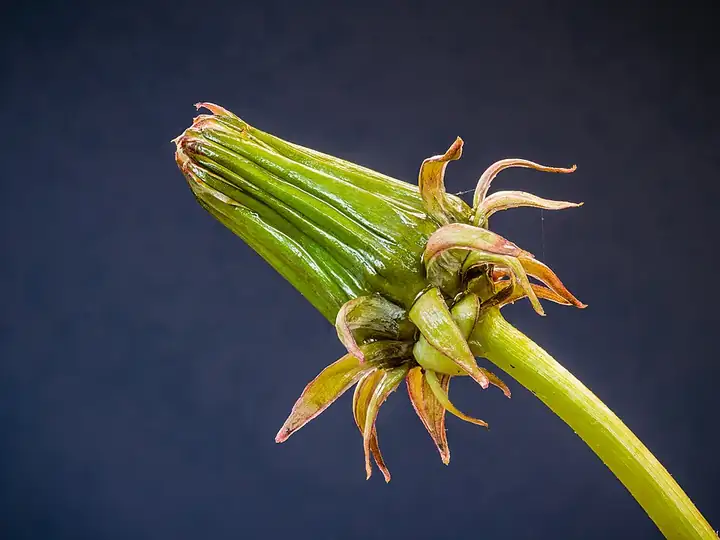
Dandelion
Taraxacum officinale
| Type | Broadleaf |
|---|---|
| Life cycle | Perennial |
| Family | Aster family (Asteraceae) |
| Origin | Native and introduced forms |
| Most common in | Northeast, Southeast, Midwest, Great Plains, Mountain West, Pacific Northwest, California |
About
Dandelion is the familiar yellow-flowered lawn weed with puffball seed heads. Its deep taproot and wind-blown seeds make it hard to get rid of, though bees welcome its early flowers.
Also called common dandelion, lion's tooth
How to identify it
Look for
Look for a flat rosette of long, deeply toothed leaves whose lobes point back toward the center, with no leafy stem. Each bright yellow flower head sits alone on a hollow, leafless stalk, and leaves, stalks and roots ooze milky sap when broken. Underneath is a thick, fleshy taproot.
Look-alikes
Catsear (false dandelion) looks similar but has densely hairy leaves and branched flower stalks; annual sowthistle is also similar, but a true dandelion has a single flower head on each hollow stalk.
Where it grows
Thin or weak lawns, garden beds, pastures, roadsides and other disturbed ground in sun.
When
It can bloom from early spring into fall, with the biggest flush in spring and a second one in fall; seeds sprout in spring and fall.
How it spreads
Up to 15,000 wind-carried seeds per plant, and broken pieces of taproot can grow into new plants.
Most common in
| Northeast | Very common here |
|---|---|
| Southeast | Very common here |
| South Central | Common here |
| Midwest | Very common here |
| Great Plains | Very common here |
| Mountain West | Very common here |
| Southwest | Common here |
| Pacific Northwest | Very common here |
| California | Very common here |
| Alaska | Common here |
| Hawaii | Occasional here |
What to do, gentlest first
Start at the top. Weed killers are a last step; always read and follow the label.
Grow a thick lawn and mow before seed heads open Prevent
Choose a grass suited to your area, then fertilize, water and mow it properly so it stays dense. Mowing off the yellow flowers before they turn to puffballs cuts down on new seed.
Dig out the whole taproot By hand
Use a long, narrow weeding tool when the soil is moist and pry out as much root as you can. Young plants come out most easily.
Root pieces left behind can resprout. The milky sap can irritate sensitive skin, so gloves help.
Mulch garden beds Barrier
A layer of mulch in beds keeps wind-blown seeds from reaching bare soil and sprouting.
Corn gluten meal or vinegar Organic spray
Corn gluten meal spread in early spring can keep dandelion seeds from rooting, but it does nothing to plants already growing. Horticultural vinegar (acetic acid) kills tiny seedlings but only burns the tops of established plants, which regrow from the root.
Strong vinegar (over about 11% acetic acid) can burn skin and eyes, so wear gloves and eye protection. It browns any leaves it touches, grass included.
Spot-treat with a broadleaf lawn herbicide in fall Conventional spray
Products with 2,4-D, MCPP (mecoprop), MCPA, dicamba or triclopyr work best sprayed on actively growing plants in late summer or early fall, when the weed pulls food down to its roots.
Read and follow the label. Many lawn weed killers also harm vegetables, flowers and shrubs, so don't let spray drift into beds, and keep dicamba products off the root zones of trees and shrubs.
Uses, wildlife and pets
Edible?
Extension foragers eat young leaves (raw or cooked), fresh flowers, and dried, roasted roots as a coffee substitute. Only pick from ground that hasn't been sprayed and isn't next to a road, and be sure of the ID.
Not 100% sure? Don't eat it. Never pick from ground that may have been sprayed, or along roads and railways.
For wildlife
Its flowers give honeybees and other insects nectar and pollen in early spring, when little else is blooming.
Pets
Not listed by the ASPCA. Its look-alike catsear is listed by the ASPCA as toxic to horses.
Sources
- ipm.ucanr.edu
- turffiles.ncsu.edu
- plants.ces.ncsu.edu
- extension.umn.edu
- extension.psu.edu
- extension.umd.edu
- hgic.clemson.edu
- extension.umn.edu
- yardandgarden.extension.iastate.edu
- extension.umd.edu
- ipm.ucanr.edu
- npgsweb.ars-grin.gov
- plantsservices.sc.egov.usda.gov
- aspca.org
Photo: Photo: Dominicus Johannes Bergsma / Wikimedia Commons, CC BY-SA 4.0 (CC BY-SA 4.0). Photo resized for the web.

Planting dates and advice are general guidance; check with your local Cooperative Extension office for your area.