
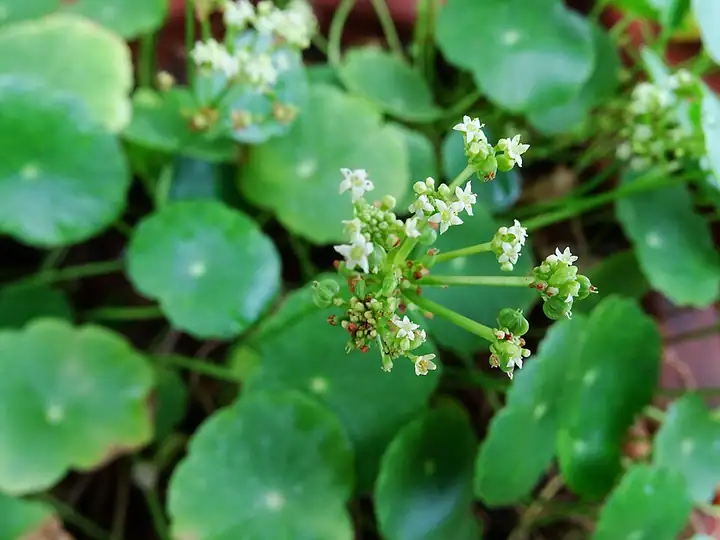
Dollarweed
Hydrocotyle umbellata
| Type | Broadleaf |
|---|---|
| Life cycle | Perennial |
| Family | Carrot family (Apiaceae) |
| Origin | Native to the US |
| Most common in | Southeast |
About
Dollarweed is a native, water-loving plant with round, shiny leaves like tiny lily pads that takes over soggy lawns in the South. It is mostly a sign of too much water, and cutting back irrigation is the first fix.
Also called pennywort, manyflower pennywort, manyflower marshpennywort
How to identify it
Look for
Leaves are round, glossy and scalloped, up to about the size of a silver dollar, with the stalk attached right in the center like an umbrella. Clusters of tiny white flowers rise on stalks, and white underground stems (rhizomes) connect the plants.
Look-alikes
Dichondra also has roundish leaves, but they are kidney-shaped with the stalk attached at the notch on the edge, not in the center.
Where it grows
Overwatered or poorly drained lawns, ditches, pond edges and low wet spots; it can even float in water.
When
It grows through the warm season and flowers from spring into fall.
How it spreads
White rhizomes, plus seeds and broken stem pieces.
Most common in
| Northeast | Occasional here |
|---|---|
| Southeast | Very common here |
| South Central | Common here |
| Midwest | Occasional here |
| Great Plains | Not found here |
| Mountain West | Not found here |
| Southwest | Occasional here |
| Pacific Northwest | Occasional here |
| California | Occasional here |
| Alaska | Not found here |
| Hawaii | Not found here |
What to do, gentlest first
Start at the top. Weed killers are a last step; always read and follow the label.
Water less and improve drainage Prevent
Water lawns deeply about once a week (1 to 1.5 inches) instead of a little every day, and fix soggy spots. Grass often takes back over once the soil dries out.
Pull it with its white runners By hand
Hand-pull plants and follow the white rhizomes so you get them too; periodic pulling is often the most effective control.
Complete eradication is rarely practical.
Mulch beds Barrier
Keep about 3 inches of mulch in planting beds.
Vinegar only burns the tops Organic spray
Horticultural vinegar may brown the leaves, but the rhizomes regrow.
Strong vinegar (over about 11% acetic acid) can burn skin and eyes, so wear gloves and eye protection. It browns any leaves it touches, grass included.
Lawn herbicide matched to your grass Conventional spray
In lawns, options include a 2,4-D/MCPP/dicamba mix, metsulfuron or imazaquin; the right choice depends on your grass type, so check the label.
Metsulfuron, dicamba and atrazine can be taken up by the roots of nearby shrubs and flowers, and atrazine can reach groundwater. Read and follow the label. Many lawn weed killers also harm vegetables, flowers and shrubs, so don't let spray drift into beds, and keep dicamba products off the root zones of trees and shrubs.
Uses, wildlife and pets
For wildlife
UF/IFAS notes native pollinators visit its flowers and birds and waterfowl eat its leaves and seeds.
Pets
Not listed by the ASPCA.
Sources
- turffiles.ncsu.edu
- gardeningsolutions.ifas.ufl.edu
- blogs.ifas.ufl.edu
- extension.msstate.edu
- ask.ifas.ufl.edu
- ipm.ucanr.edu
- extension.umd.edu
- plantsservices.sc.egov.usda.gov
Photo: Photo: Forestowlet / Wikimedia Commons, CC0 (CC0). Photo resized for the web.

Planting dates and advice are general guidance; check with your local Cooperative Extension office for your area.